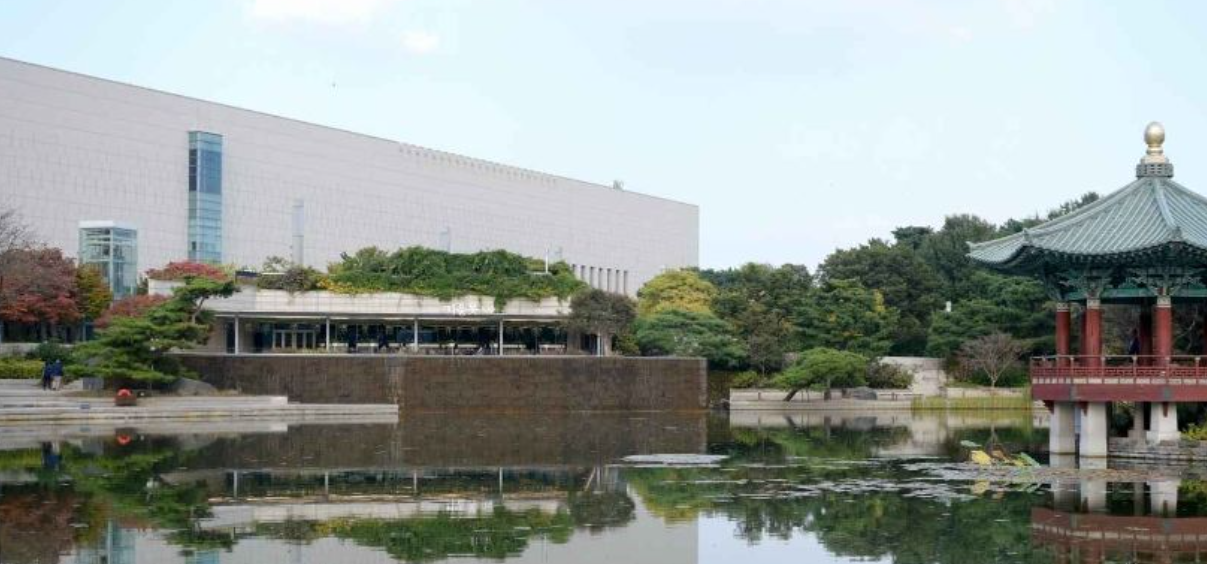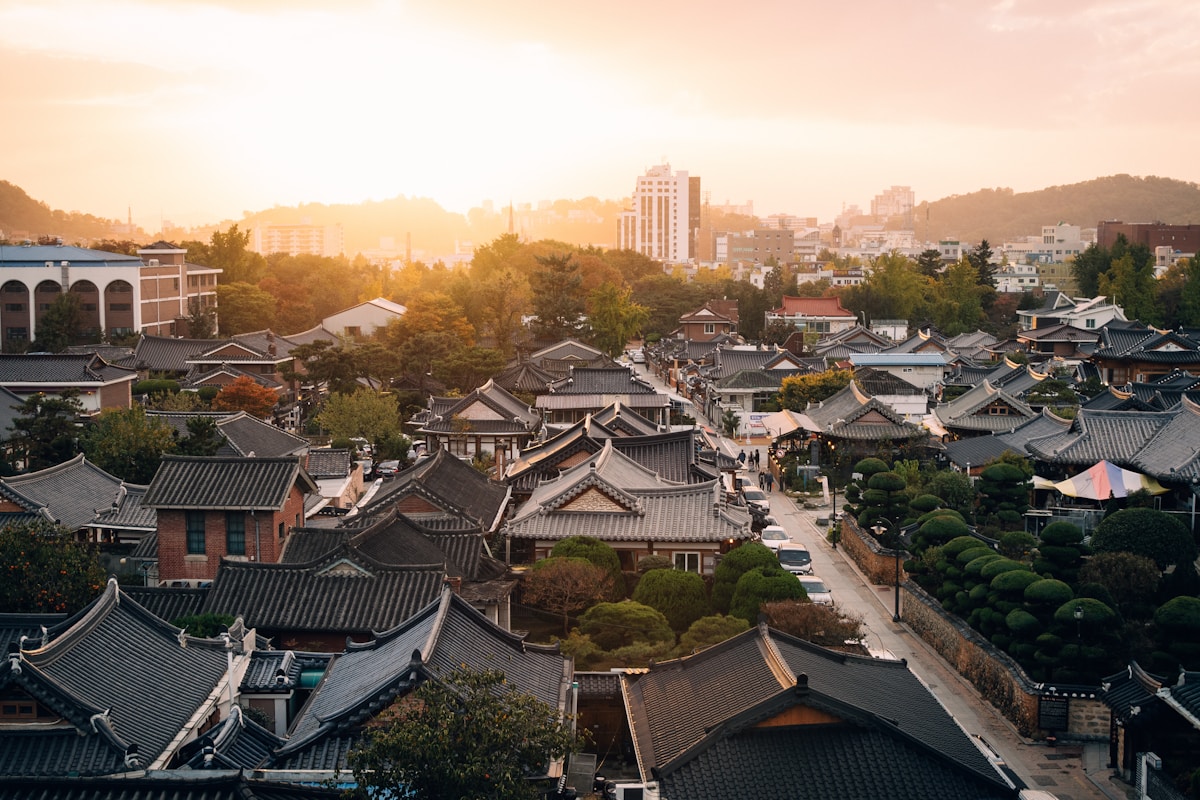
There is a moment, walking through Gwanghwamun Gate into the palace grounds at Gyeongbokgung on a clear morning, when the mountain behind the palace appears framed perfectly above the throne hall roof. The palace is in front of you, Bugaksan is behind it, and the whole composition looks exactly as it was designed to look in 1395 — when King Taejo’s royal architects positioned the palace according to geomantic principles that treat mountains, rivers, and cardinal directions as architecture in themselves.
That view is free. You paid ₩3,000 — roughly two dollars — to walk through the gate.
Korea’s palaces are one of the great underrated experiences in East Asian travel, in part because they’re so accessible. No palace on this list costs more than ₩10,000 to enter. Most are minutes from a subway exit. And unlike the palace complexes of China or Japan, which can feel polished into abstraction, Seoul’s palaces carry the visible weight of their history — the invasions, the fires, the demolitions, the patient reconstructions — in a way that makes them feel genuinely alive rather than preserved.
This guide covers every major royal palace in Korea, gives you the context you need to actually understand what you’re looking at, and makes a clear recommendation for where to start.
Quick Reference: Seoul’s Five Grand Palaces
| Palace | Era Built | UNESCO | Admission | Closed | Highlight |
|---|---|---|---|---|---|
| Gyeongbokgung | 1395 | No | ₩3,000 | Tuesday | Largest palace; throne hall; guard ceremony |
| Changdeokgung | 1405 | Yes (1997) | ₩3,000 + ₩5,000 Secret Garden | Monday | Secret Garden; UNESCO status |
| Changgyeonggung | 1483 | No | ₩1,000 | Monday | Night viewing; cherry blossoms |
| Deoksugung | 1450s | No | ₩1,000 | Monday | Western-style halls; stone wall walk |
| Gyeonghuigung | 1616 | No | Free | Monday | Quiet; partially restored |
The Joseon Dynasty and Why Seoul Has So Many Palaces
Before you visit any palace in Korea, it helps to understand what you’re actually looking at.
In 1392, General Yi Seonggye overthrew the Goryeo dynasty and founded the Joseon Dynasty — a kingdom that would last for 519 years, until 1897. He chose the site of modern Seoul as his new capital, calling it Hanyang, and set about building a city from the ground up. At its centre would be a palace complex that expressed everything his new dynasty stood for: Confucian order, filial piety, the primacy of scholarship over military force, and an explicit connection between political authority and the natural landscape.
Joseon kings built five major palaces in and around Hanyang. Each was built for a reason — some as primary residences, some as secondary palaces for the crown prince, some as emergency replacements after the primary palace burned down (which happened more than once). The result is a city that still contains, within a few kilometres of each other, five distinct royal complexes that together cover an area larger than some European city centres.
What they have in common: all five palaces follow the same broad principles of Joseon palace architecture. The main gate faces south. A second gate follows. The throne hall sits on a raised stone terrace at the complex’s heart. The king’s private quarters, the queen’s quarters, and the administrative buildings are arranged around it in a hierarchy of public and private space. Gardens and ponds occupy the rear. Everything is built in timber, which is why everything has also burned.
What makes each different: the siting, the scale, the degree of surviving structure, and in one case, a UNESCO designation that makes it the most internationally recognised. We’ll get to all of them.
Gyeongbokgung (경복궁): The Palace to Start With
If you visit only one palace in Seoul, make it Gyeongbokgung.
Not because it’s the most beautiful — Changdeokgung’s Secret Garden is arguably more spectacular — but because Gyeongbokgung is where the full story begins. It’s the primary palace, the largest, the most intact above ground, and the one that has been most central to Korean history at every point since 1395. Understanding Gyeongbokgung gives you the architecture, the vocabulary, and the historical context that makes every other palace in Korea make sense.
The name (경복궁) translates roughly as “Palace Greatly Blessed by Heaven” — taken from a line in the Chinese classic Shi Jing. The choice of name was deliberate: King Taejo was founding not just a palace but a claim to dynastic legitimacy rooted in classical learning, and every element of the complex’s design expressed that claim.
A History of Destruction and Restoration
1392–1592: The Palace at the Height of Joseon
Gyeongbokgung was built in 1395, three years after King Taejo founded the Joseon dynasty. Working from a plan that oriented the palace toward Bugaksan mountain to the north and positioned it on the main north–south axis of the new capital, royal architects constructed a complex of approximately 330 buildings over an area of more than 400,000 square metres.
For nearly two centuries it functioned as the centre of the Joseon world — where kings held court in the throne hall, where examinations were administered that would determine which scholars entered government, where queens gave birth and dowager queens managed political intrigue, and where the most powerful figures in Korean society navigated a complex system of Confucian hierarchy.
1592: The Imjin War and the First Destruction
In 1592, Japanese forces under the warlord Toyotomi Hideyoshi invaded Korea in a campaign that would become known as the Imjin War. Korean forces were overwhelmed, King Seonjo fled north toward the Chinese border, and the people of Hanyang — furious at the abandonment — burned the palace themselves before Japanese forces even arrived, reportedly destroying the slave registry records held inside along with the palace complex.
Gyeongbokgung was left in ruins. It would remain that way for nearly 275 years.
During those years, the seat of Joseon government moved to Changdeokgung, and Gyeongbokgung became a kind of ghost — physically present as a ruin in the centre of the capital, but abandoned. Successive kings discussed rebuilding it and never did, in part because of the enormous cost, in part because the memory of the abandonment made it politically sensitive.
1867: The Great Reconstruction
The palace was finally rebuilt by Heungseon Daewongun — the regent who governed Korea on behalf of his young son, King Gojong — between 1865 and 1868. The reconstruction was on a massive scale: approximately 500 buildings were built or rebuilt over three years, making the restored Gyeongbokgung even larger than the original. Daewongun funded the project partly through controversial new taxes and the forced melting of temple bells, which damaged his political standing but produced a palace.
The timing was deliberate. Rebuilding Joseon’s primary palace was a statement of dynastic confidence at a moment when Korea was under increasing pressure from Western powers seeking trade access, and when Japan was beginning the modernisation process that would eventually threaten Korean sovereignty.
1895–1945: Japanese Colonial Destruction
The second destruction was slower and more calculated than the first.
In 1895, Queen Min (Empress Myeongseong) was assassinated in her quarters in the palace complex by Japanese agents — one of the most brazen political murders in modern Korean history. King Gojong fled to the Russian Legation the following year and never returned to the palace. Gyeongbokgung was effectively abandoned by the royal family.
Under Japanese colonial rule, which began formally in 1910, the palace was systematically dismantled. Buildings were demolished. The grounds were reduced to accommodate a Government-General Building constructed directly in front of Geunjeongjeon, the throne hall — a structure positioned specifically to interrupt the palace’s original axis and dominate the skyline where Bugaksan had once been the backdrop. By the mid-20th century, roughly 98% of the palace’s structures had been destroyed or removed, and the grounds held an exhibition hall.
1995–Present: The Ongoing Restoration
The Government-General Building was demolished in 1995 — on the 50th anniversary of Korea’s liberation from Japan — after years of debate about whether it should be preserved as a historical artefact of the colonial period or removed as an act of national restoration. The demolition decision won. The building came down, and a systematic, decades-long restoration of Gyeongbokgung began.
The restoration is still ongoing. Each year, new buildings are reconstructed using traditional woodworking techniques by artisans who trained specifically for the project. The goal is to return the palace to something approaching its post-1867 condition — a process that will take decades more to complete. When you walk through Gyeongbokgung today, you’re walking through a living restoration project, not a finished museum.
What to See Inside Gyeongbokgung
The palace is large — budget at least two hours, and closer to three if you want to see it properly. Here is what to prioritise.
Gwanghwamun Gate (광화문)
The main south gate, rebuilt on its original alignment in 2010 after a restoration project that used historical photographs, survey records, and pigment analysis to recreate the original dancheong painted decoration. The gate has three arched passageways: the central passage was reserved for the king, the side passages for officials. It’s the starting point of any Gyeongbokgung visit — and if you want to time the Changing of the Royal Guard (수문장 교대의식), it happens at the gate at 10:00 and 14:00, daily except Tuesdays. The ceremony lasts 20 minutes; guards perform in full Joseon military dress. See the full Gwanghwamun guide here.
Heungnyemun Gate (흥례문)
The second gate, just inside Gwanghwamun, with a courtyard between them. This is where you’ll buy your ticket if you haven’t already. A stream called Geumcheon runs east to west across this courtyard — in Joseon times, officials crossed the bridge over it as a symbolic purification before entering the inner palace.
Geunjeongjeon Hall (근정전) — National Treasure No. 223
The throne hall. This is the heart of the palace and the building that every architectural element of the complex is arranged to frame. The two-storey timber hall sits on a double-tiered stone platform in a vast courtyard paved with stone slabs. Stone rank markers line both sides of the courtyard — where officials would have stood, arrayed by grade, during royal audiences. Flanking buildings, gates, and the mountain behind all compose into a single hierarchical picture.
Inside, the throne (the eojwa) sits under an elaborate canopy. Behind it, a painted screen showing the sun, moon, and five mountain peaks — a symbolic image that appeared behind every Joseon king in every formal setting. The hall is National Treasure No. 223, which in Korean heritage designation means it is among the most historically and architecturally significant surviving structures in the country.
Gyeonghoeru Pavilion (경회루) — National Treasure No. 224
A large two-storey pavilion built over an artificial rectangular pond, Gyeonghoeru was the venue for state banquets, royal celebrations, and diplomatic receptions. In the context of the otherwise austere palace, it is strikingly beautiful — stone columns rising from the water, reflections of the pavilion and the mountains beyond, lotus blooms covering the pond in summer.
Access to the pavilion itself is restricted, but the view from the pathway around the pond is one of the best photographs in Seoul. Come early, before the tour groups arrive.
Hyangwonjeong Pavilion (향원정)
A smaller hexagonal pavilion built on an island in the middle of a circular pond, connected to the shore by a wooden bridge. If Gyeonghoeru is formal and impressive, Hyangwonjeong is intimate and contemplative — the kind of spot that makes it easy to understand why kings came here to think. The pond reflects the surrounding trees, and in autumn the foliage turns the whole composition gold and red.
Gangnyeongjeon & Gyotaejeon (강녕전 & 교태전)
The king’s sleeping quarters (Gangnyeongjeon) and the queen’s sleeping quarters (Gyotaejeon), connected by a garden called Amisan that contains some of the palace’s most refined decorative stonework: decorative chimney stacks of fired brick, carved with flowers and animals, that were used to carry heat up from the ondol floor heating below.
These buildings are quieter than the main courtyard and worth seeking out. The human scale of the private quarters — compared to the monumental scale of the throne hall — says something about the balance the palace was trying to strike between symbolic authority and actual habitation.
Jagyeongjeon Hall (자경전) — National Treasure No. 809
The queen dowager’s quarters, notable for its decorative tile wall on the west side — one of the most intact examples of Joseon-period decorative architecture in the palace. The tiles depict symbols of longevity: deer, cranes, pine trees, rocks. It was built by Heungseon Daewongun specifically for his own mother.
National Folk Museum of Korea (국립민속박물관)
Located inside the palace grounds in the northeastern section, the National Folk Museum covers the daily life of ordinary Koreans through the Joseon period and into the 20th century. It’s free, substantial, and often overlooked by visitors who run out of time in the palace itself. If you’re visiting with children, this is probably the best use of an hour.
National Palace Museum of Korea (국립고궁박물관)
Also free, and adjacent to the Gyeongbokgung grounds (enter from the western side). This museum houses artefacts from all five grand palaces — royal seals, ceremonial robes, court paintings, musical instruments — and does a better job than any guidebook of explaining what palace life actually looked like. Strong English signage throughout.
Wearing Hanbok to Gyeongbokgung
Visitors who arrive wearing hanbok (한복) — the traditional Korean dress — receive free entry to Gyeongbokgung. This has made hanbok rental near the palace an industry in itself.
Rental shops are clustered around the Gyeongbokgung Station exit and in the Insadong and Bukchon areas nearby. Prices typically run ₩15,000–₩25,000 for two to three hours, including help dressing and storage for your regular clothes. The rental includes a range of styles: from simple cotton versions suitable for warm weather to heavier silk brocade options for colder months.
If you rent hanbok, the palace’s main courtyard and Gyeonghoeru pond are the obvious backdrop. Early morning is significantly better than midday for this — the light is softer, the crowds are smaller, and the experience is more genuine. Coming on a weekday morning in spring or autumn gives you the best conditions.
One practical note: traditional hanbok includes separate shoes or socks, often thin-soled. The palace grounds involve a lot of stone paving and outdoor walking. Check with the rental shop about comfortable footwear options before you commit.
Gyeongbokgung Practical Information
| Detail | Info |
|---|---|
| Address | 161 Sajik-ro, Jongno-gu, Seoul (Naver Map) |
| Nearest subway | Line 3, Gyeongbokgung Station, Exit 5 |
| Also accessible from | Line 5, Gwanghwamun Station, Exit 2 |
| Admission | ₩3,000 adults (19–64) / ₩1,500 ages 7–18 / Free for under-7s and over-65s / Free in hanbok |
| Hours (Mar–Oct) | 09:00–18:00 (last entry 17:00) |
| Hours (Nov–Feb) | 09:00–17:00 (last entry 16:00) |
| Extended summer hours | Until 18:30 in June–August |
| Closed | Tuesdays |
| Guard ceremony | 10:00 & 14:00, daily except Tue (weather permitting) |
| Hanbok free entry | Yes — rental shops outside Gyeongbokgung Station |
The Other Four Grand Palaces of Seoul
Changdeokgung (창덕궁): The UNESCO Palace
If Gyeongbokgung is the palace where Joseon began, Changdeokgung (창덕궁 — “Palace of Illustrious Virtue”) is the one where much of Joseon actually happened. Built in 1405 as a secondary palace, it became the primary royal residence for much of the dynasty’s later history — preferred by many kings over Gyeongbokgung for reasons that are immediately clear when you see both. Changdeokgung is smaller and less formally imposing, and the topography of the site — uneven, wooded, with a natural ridge at its back — produces a palace that feels less like a declaration and more like a place where someone might actually want to live.
It received UNESCO World Heritage designation in 1997, recognised for the way the palace complex was designed to harmonise with its natural landscape — a guiding principle of traditional Korean architecture that Changdeokgung exemplifies better than any other surviving structure.
The crown jewel is Huwon (후원) — the Secret Garden. A 78-acre (316,000 m²) wooded garden behind the palace, with ponds, pavilions, lotus fields, and paths through stands of pine and zelkova. Joseon kings used it as a place of rest and study, and access to it was restricted to the royal family and high officials. Entry today is still controlled — guided tours in Korean and English run at fixed times — but the experience is extraordinary. Autumn foliage season turns it into something genuinely hard to describe.
- Admission: Palace ₩3,000; Secret Garden ₩5,000 (combined ₩8,000)
- Hours: 09:00–17:30 (summer to 18:30); closed Mondays
- Secret Garden tours: Regular departures throughout the day; English tour times vary by season — check the palace website before visiting
- Subway: Line 3, Anguk Station, Exit 3
- Naver Map: 창덕궁
- Recommended time: Half-day minimum; full day if you’re visiting the Secret Garden in peak foliage season
Changgyeonggung (창경궁): The Quiet One
Built in 1483 by King Seongjong, Changgyeonggung (창경궁) is the most intimate of Seoul’s five grand palaces — and among the least visited by tourists, which is a reasonable reason to put it near the top of your list if you’re trying to avoid crowds.
Unusually for a Joseon palace, its main gate faces east rather than south — a practical concession to the topography of the site, which doesn’t allow for the standard north–south orientation. The effect is a palace that feels slightly off-axis, looser in its layout, more like a garden complex than a formal court.
During the Japanese colonial period, it was converted into a public zoo and botanical garden — one of the most deliberate acts of debasement of a royal site during the occupation. The zoo was relocated in 1983 and the site restored to its historical condition, but the greenhouse building from the 1909 period survives as a period artefact in the grounds.
Changgyeonggung is most famous in Seoul for late-night cherry blossom viewing in spring. During peak blossom weeks (usually late March to early April), the palace extends its hours and allows evening visits — the combination of lit paths, blossom trees, and a traditional palace setting is one of Seoul’s most atmospheric spring events and books out quickly.
- Admission: ₩1,000
- Hours: 09:00–21:00; closed Mondays
- Subway: Line 4, Hyehwa Station, Exit 4; or Line 3, Anguk Station
- Connected to: Changdeokgung (a shared wall connects the two palaces)
- Naver Map: 창경궁
Deoksugung (덕수궁): The Unusual One
Deoksugung (덕수궁) breaks almost every rule that the other four palaces follow. It contains Western neoclassical buildings alongside traditional Korean halls. Its main ceremonial hall faces south toward a roundabout rather than a mountain. And it survived the Japanese colonial period relatively intact, in part because the Japanese used it as a museum.
The palace’s origins were not as a royal residence but as the home of a royal relative, elevated to palace status when King Seonjo used it as a temporary refuge after the Imjin War left Gyeongbokgung in ruins. It became the site of one of modern Korean history’s most significant moments: in 1897, King Gojong proclaimed the establishment of the Korean Empire here, briefly elevating Korea’s status from a vassal kingdom to an independent empire — a title that lasted thirteen years before Japanese annexation.
The Western-style buildings — Seokjojeon and Junmyeongjeon — were built in the early 20th century and now house art collections. Walking between a traditional wooden Korean throne hall and a neoclassical stone building within the same palace complex is a strange and interesting experience, and one that says something honest about the period in which they were built.
Deoksugung Doldam-gil — the stone wall road that runs along the palace’s eastern perimeter — is one of Seoul’s most famous walking streets. The path through mature trees beside the stone wall is beautiful in all seasons, and there is a local saying, probably apocryphal, that couples who walk it together will break up. This has not reduced its popularity.
The Changing of the Guard at Daehanmun Gate runs at 11:00, 14:00, and 15:30, Tuesday to Sunday — three times daily compared to Gyeongbokgung’s two.
- Admission: ₩1,000
- Hours: 09:00–21:00; closed Mondays
- Guard ceremony: 11:00, 14:00 & 15:30, Tue–Sun
- Subway: Lines 1 & 2, City Hall Station, Exit 1 or 2
- Naver Map: 덕수궁
Gyeonghuigung (경희궁): The Forgotten Palace
The fifth of Seoul’s grand palaces is also the most ruined and least visited. Gyeonghuigung (경희궁 — “Palace of Rejoicing and Harmony”) was built in 1616 by King Gwanghaegun, and served as a western detached palace — a secondary court used when the primary palace was unavailable or during military threats.
At its height it was a substantial complex of around 100 buildings. The Japanese colonial administration demolished most of it to build a school on the site — Gyeongseong Middle School, later Seoul High School, which occupied the grounds until 2002. What survives is fragmentary: the main gate (Heunghwamun), the throne hall (Sungjeongjeon), and a handful of other structures, rebuilt based on old documents on a site that is now shared with the Seoul History Museum.
It is quiet, rarely crowded, and strange — a palace that functions as much as a scar as a building. Worth an hour if you’re visiting the Gwanghwamun area and want a contrast to the full-scale reconstruction across the road.
- Admission: Free
- Hours: 09:00–18:00; closed Mondays
- Subway: Line 5, Seodaemun Station, Exit 4; or Gwanghwamun Station, Exit 7
- Naver Map: 경희궁
Palaces Beyond Seoul
Hwaseong Fortress, Suwon (수원 화성) — UNESCO World Heritage
About an hour from Seoul by train, Hwaseong Fortress is a UNESCO World Heritage Site built between 1794 and 1796 by King Jeongjo — one of the most reform-minded kings of the late Joseon period, who constructed the fortress partly as a tribute to his father (Prince Sado, who had been executed by his grandfather King Yeongjo) and partly as a potential new capital.
The fortress is remarkable for its integration of the landscape: the walls follow the natural contour of the hills around Suwon, incorporating water gates, towers, command posts, and rest platforms across a total length of 5.7 kilometres. Unlike Seoul’s palaces, you can walk the entire circuit of the walls — a two-to-three hour route with good views over the city.
The associated Hwaseong Haenggung (행궁), the palace used by King Jeongjo during visits to the fortress, is the largest surviving haenggung (temporary royal residence) in Korea, with 576 rooms. The adjacent street, Haenggung-gil, has become one of the better-preserved traditional commercial streets in the country.
- How to get there: KTX or commuter rail from Seoul Station to Suwon Station; the fortress is walkable from Suwon Station
- Time needed: Full day
Donggung Palace and Wolji Pond, Gyeongju (동궁과 월지)
Gyeongju was the capital of the Silla Kingdom (57 BCE–935 CE), which preceded both Goryeo and Joseon and unified the Korean peninsula for the first time. The city is sometimes called the “museum without walls” — royal tombs, temple foundations, and palace ruins are distributed across the city and surrounding countryside.
The most accessible site for visitors is Donggung Palace and Wolji Pond (formerly known as Anapji), the garden and palace complex used by Silla royalty for banquets and recreation from the 7th century onward. The pond was dredged in the 1970s, recovering thousands of Silla artefacts now displayed in the National Museum of Gyeongju. Today the restored pond, with three pavilions at its edge reflected in still water, is one of Korea’s most photographed sites — especially at night, when it’s illuminated and the reflections double the architecture.
- How to get there: KTX from Seoul to Singyeongju Station (2 hours), then local bus or taxi
- Best time: Evening, for illuminated reflections
How to Plan a Palace Day in Seoul
If you have one day: Gyeongbokgung in the morning (arrive by 09:00 for the guard ceremony at 10:00), the National Folk Museum inside the grounds after lunch, and Changgyeonggung in the late afternoon (it stays open until 21:00 and the evening light in the gardens is excellent). Link them with a walk through Bukchon Hanok Village between Anguk and Changdeokgung.
If you have two days: Day one as above. Day two: Changdeokgung including the Secret Garden (book your tour slot in advance for English; they fill up, especially in autumn), then walk south to Deoksugung in the afternoon via the Anguk and Jongno street grid, and finish with a walk along Doldam-gil to City Hall Station.
Combining with other activities: Gyeongbokgung pairs naturally with Insadong for traditional crafts and teahouses (10–15 minutes on foot), with Bukchon Hanok Village for traditional architecture, and with Gwanghwamun Square for the statues of King Sejong and Admiral Yi.
When to Visit Korea’s Palaces
Spring (late March–early May): Cherry blossoms bloom on the palace grounds, particularly at Changgyeonggung and along the paths near Gyeonghoeru. Crowds are significant in peak blossom weeks (usually the last week of March to the second week of April). Mid-week mornings are your best bet.
Autumn (mid-October–mid-November): Foliage season is arguably the best time to visit any palace in Korea. Changdeokgung’s Secret Garden is especially dramatic — the deciduous trees turn full red, gold, and orange over the ponds and pavilions. Book Secret Garden tours well in advance for October.
Summer (June–August): Hot and humid. Extended palace hours (until 18:30 at Gyeongbokgung). Gyeonghoeru pond is at its best with lotus blooms. Visit early morning or late afternoon to avoid the worst of the heat.
Winter (December–February): Light snow on palace rooftops is one of Seoul’s most striking images. Gyeongbokgung does special winter programmes and occasionally night openings. Dress in layers — the stone courtyards hold cold.
Frequently Asked Questions
Which palace in Seoul should I visit first? Gyeongbokgung. It’s the largest, the most historically central, the most fully restored, and the one that gives you the architectural and historical vocabulary to appreciate every other palace in Korea. The National Folk Museum inside the grounds is also free and excellent. If you only have one day for palaces, start here.
Can I visit multiple palaces in one day? Yes — Gyeongbokgung, Changdeokgung, and Changgyeonggung are all within walking distance of each other in the Jongno district. A full day will cover Gyeongbokgung in the morning and Changdeokgung (without the Secret Garden) in the afternoon. Add Changgyeonggung in the evening — it’s open until 21:00.
Is Changdeokgung worth the extra cost for the Secret Garden? If you’re visiting in autumn or spring, yes — unambiguously. The Secret Garden is one of the best examples of traditional Korean garden design in existence and the setting in peak foliage is extraordinary. In winter or midsummer it’s still beautiful but less dramatic. The combined ticket (₩8,000) is still very cheap for what it covers.
Do I need to book Gyeongbokgung in advance? No booking required for Gyeongbokgung itself. Buy tickets at the gate. For Changdeokgung’s Secret Garden English tours, advance booking is strongly recommended in autumn (October–November) — they fill up weeks ahead.
What is the Changing of the Royal Guard at Gyeongbokgung? The Changing of the Royal Guard (수문장 교대의식) is a re-enactment of the ceremonial changing of the palace’s security guard, performed twice daily at Gwanghwamun Gate at 10:00 and 14:00, daily except Tuesdays. Guards wear full Joseon military dress. The ceremony lasts about 20 minutes. It’s free to watch from the plaza and is genuinely worth timing your arrival around.
Can I wear hanbok to the palace? Yes, and you should — visitors wearing hanbok receive free entry to Gyeongbokgung. Rental shops are directly outside Gyeongbokgung Station and in the Anguk and Insadong areas nearby, with rentals running ₩15,000–₩25,000 for a few hours. Come early morning for the best light and fewer people.
Are Korea’s palaces free? Not entirely, but they’re extraordinarily affordable. Gyeongbokgung is ₩3,000 (about US$2), Changdeokgung is ₩3,000 for the palace plus ₩5,000 for the Secret Garden (₩8,000 combined), and Deoksugung and Changgyeonggung are ₩1,000 each. Gyeonghuigung is free. The National Folk Museum and National Palace Museum, both on palace grounds, are free.
How does Gyeongbokgung compare to palaces in China and Japan? It’s a different kind of experience. China’s Forbidden City is larger and more palatial in a way that emphasises sheer scale and imperial power. Japan’s imperial palaces are generally more restricted in access. What Korea’s palaces offer — particularly Gyeongbokgung — is access at close range to throne halls, private royal quarters, and garden pavilions that in other countries you’d be viewing from behind barriers. The restoration is ongoing and visible, which gives it an honesty that polished museum-palaces sometimes lack.
Planning the rest of your time in Seoul? The things to do in Seoul 2026 guide covers the full range of attractions across the city. If the Jongno and Bukchon area is your base, the Seoul first-timer guide has practical neighbourhood-by-neighbourhood advice. For context on the gate that starts every palace visit, the Gwanghwamun Gate guide has the full history.