
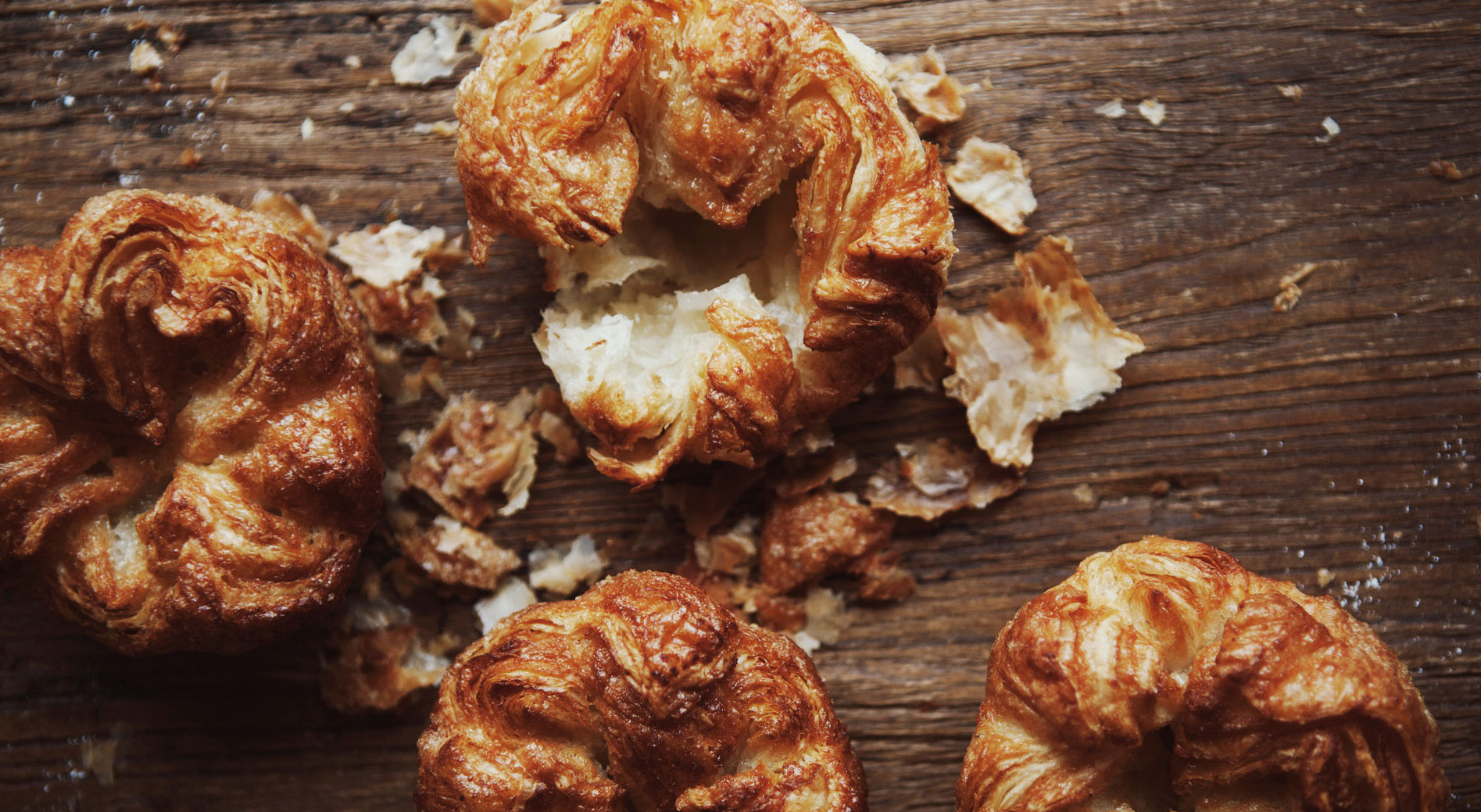
Arrive fifteen minutes before a posted bake time and the line is often already curling along the front window. Few people are there for coffee. Most are watching the pass-through counter the way you watch a departures board — waiting for one specific tray to appear. That tray holds kouign-amann, and at b. patisserie, the wait for it has become as much a part of the shop’s identity as the pastry itself.
A San Francisco Bakery, Transplanted to Mapo-gu
b. patisserie isn’t a Korean startup riding a dessert trend — it’s an import with real pedigree. The original opened in San Francisco, founded by pastry chef Belinda Leong and Michel Suas (founder of the San Francisco Baking Institute), and it went on to earn recognition at the James Beard Awards for its baking. After branches in San Francisco and Honolulu, the brand crossed the Pacific to Seoul, first landing in Garosu-gil in 2018 before the lineup settled into its current two locations: Gongdeok and Central City.
The menu has sandwiches, coffee, and a full pastry case, but ask anyone why they’re standing in line and you’ll get the same one-word answer: kouign-amann. It’s a Breton specialty — a laminated dough folded with sugar so the outside caramelizes into a shattering, almost toffee-like shell while the inside stays soft and buttery — and it’s the dish this bakery has built its Korean reputation on.
Why This Specific Pastry Blew Up
The kouign-amann had a loyal following for years, but it jumped several tiers of hype after chef Son Jong-won — the pâtissier who became a household name off Netflix’s Culinary Class Wars — said in an interview that if he could eat only one dessert for the rest of his life, this would be it. That quote got recirculated across food Instagram and Threads accounts for months afterward, alongside pieces noting the bakery had also turned up on lists of bakeries favored by Korean celebrities. Once a chef with that kind of credibility puts his name on a specific pastry at a specific counter, the daily line practically writes itself.
What makes the Gongdeok branch particularly interesting is that it doesn’t bake continuously — it drops the kouign-amann in scheduled batches throughout the day, and each batch has a fixed, publicly known size. On weekdays, trays reportedly come out around 9 a.m. (about 120 pieces) and 2 p.m. (about 170 pieces); on weekends, the schedule expands to roughly 10 a.m. (160), noon (210), and 3 p.m. (180). Knowing the exact number in a batch seems to be part of why people plan around it — it turns a bakery run into something closer to a countdown.
Getting There Before the Tray
A weekday drop is generally the safer bet, on the theory that weekends run busier. Even fifteen minutes ahead of a posted time, it’s common to find a couple dozen people already in line — phones out, several of them regulars comparing notes on which batch tends to sell out slowest. By the time a tray comes out, the queue can grow to fifty or sixty. Other visitors have described lines of roughly a hundred people at a single drop and the shop selling out entirely well before closing — accounts that track with how quickly a 170-piece batch can disappear, sometimes within minutes of hitting the counter.
Purchase limits are part of how the shop manages this: according to staff and echoed across reviews, the cap currently sits at two kouign-amann per customer, which is tighter than it apparently used to be — a sign of how much demand has grown rather than shrunk.
What the Pastry Is Like
By most accounts, this is a genuinely well-made kouign-amann, not just a well-marketed one. The bottom and edges have that deep amber, almost burnt-sugar crackle that’s the entire point of the pastry — bite into it and it shatters rather than bends. Inside, the lamination is tight and even, with a buttery, faintly salty interior that keeps the whole thing from tipping into being too sweet. It’s dense in a good way — the kind of pastry that’s genuinely filling, not the airy croissant-adjacent version some bakeries pass off under the same name. Eaten warm, within a few minutes of coming off the tray, it stands among the better versions of this pastry in Seoul, and it’s not hard to see why a chef with Son Jong-won’s résumé would single it out.
The rest of the case is worth a look too: beyond the classic, the kouign-amann comes in flavored versions — chocolate, black sesame, and pecan pie among them — and the shop also turns out croissants, scones, and sandwiches. Solid, well-executed picks, though completely overshadowed by the reason everyone else is in line.
Practical Information
| Detail | Info |
|---|---|
| Name | b. patisserie (비파티세리), Gongdeok branch |
| Known for | Kouign-amann classique, sold in scheduled daily batches |
| Address | 4 Mapo-daero 14-gil, 1F, Mapo-gu, Seoul (서울 마포구 마포대로14길 4 1층) |
| Nearest subway | Gongdeok Station (Lines 5, 6, Airport Railroad, Gyeongui-Jungang Line), roughly a 10-minute walk from Exit 4 |
| Hours | Weekdays 8 a.m.–9 p.m. (last order 8:30 p.m.); weekends 9 a.m.–10 p.m. (last order 9:30 p.m.) |
| Kouign-amann drop times | Weekdays: ~9 a.m. (~120 pcs), ~2 p.m. (~170 pcs). Weekends: ~10 a.m. (~160 pcs), ~12 p.m. (~210 pcs), ~3 p.m. (~180 pcs) |
| Purchase limit | Reportedly 2 kouign-amann per customer at time of writing |
| Phone | 02-702-1220 |
| Reservations | None — first-come, first-served, in-person only |
| Map | View on Naver Map · Kakao Map · Official site |
Batch times, quantities, and purchase limits are the kind of detail an independent bakery can and does adjust without notice — treat the numbers above as a guide to the rhythm of the place rather than a guarantee, and build in a buffer before the posted drop time.
Tips Before You Go
- Arrive at least 10–15 minutes before a posted drop time, not after. The line forms before the pastry does.
- The early-morning weekday batch is your best shot at a shorter line. Weekend batches, especially the midday one, draw the biggest crowds.
- Know the purchase limit going in so you’re not negotiating at the register while the line behind you grows.
- Have a backup pastry in mind. If the kouign-amann sells out before you reach the counter, the rest of the case — flavored kouign-amann variants, croissants, scones, sandwiches — is genuinely worth ordering instead of leaving empty-handed.
- Eat it fresh if you can. The caramelized shell is the whole appeal, and it softens the longer the pastry sits.
Frequently Asked Questions
What is b. patisserie? b. patisserie is a San Francisco-founded bakery, recognized at the James Beard Awards, with locations in Seoul at Gongdeok and Central City. Its signature item is a caramelized, laminated kouign-amann.
Why is there a line specifically for the kouign-amann? The pastry gained a strong following in Korea after chef Son Jong-won of Culinary Class Wars praised it as one of the best he’s had, and the Gongdeok branch bakes and releases it in scheduled, limited-quantity batches rather than continuously, which concentrates demand around specific times of day.
How many can I buy? A purchase limit — reportedly two per customer at the time of writing — is in place, though this is the kind of policy that can change as demand shifts.
Is it worth the wait? For a genuinely well-executed version of a pastry that’s hard to find done this well in Seoul, many think so — though it’s worth budgeting for the possibility of missing a batch and settling for the rest of the case, which is still solid.
Do I need a reservation? No — it’s walk-in only, with no booking system for the pastry drops.
If you’re chasing more of Seoul’s short-window sellouts, Xurreria San Roman is another pastry queue worth knowing about, and our Seoul cafe culture guide rounds out the neighborhoods worth pairing with a bakery run. For a very different kind of Seoul queue, Gangsanok in Euljiro trades pastry for a summer-only bowl of kongguksu.


