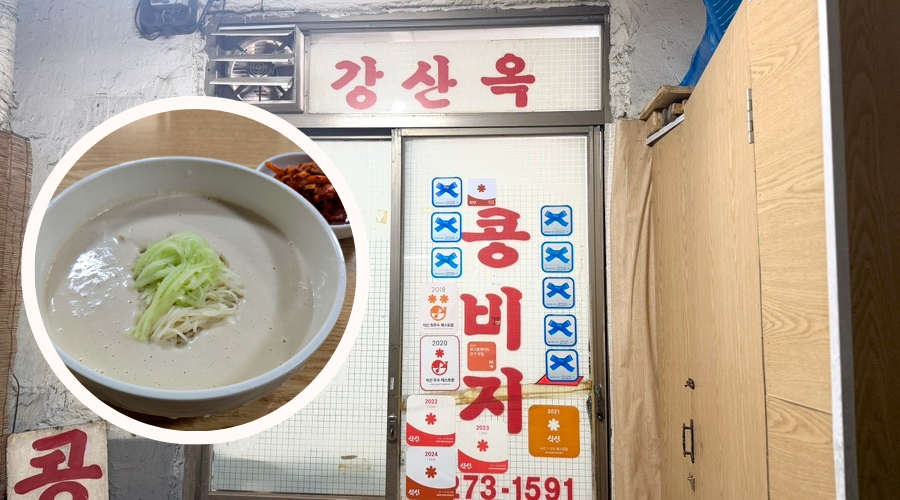
By the time I found the door, I’d already found the line — it started on the sidewalk, folded back through a stairwell, and kept going up to a second-floor landing I didn’t know was part of the restaurant until I was standing in it. Nobody in that line was checking a phone for directions. Everybody already knew where they were. That’s Gangsanok (강산옥), a kongbiji shop that’s been open since 1958 and turns, for exactly three months a year, into one of the most-queued-for lunches in Seoul.
A Soybean Shop That’s Been Doing This Since 1958
Gangsanok sits in the tangle of machine-parts and hardware alleys just behind Gwangjang Market and Bangsan Market, the kind of block where the neighbors are wholesale ribbon shops and printing suppliers, not other restaurants chasing the same lunch crowd. It’s now on its third generation of the same family, and for most of the year the menu is exactly one dish: kongbiji-baekban, a soybean-pulp stew set with rice, seasoned soy sauce, radish salad, and mul-kimchi.
I’d read that it’s been quietly collecting Blue Ribbon recommendations for years and has turned up on Korean food TV more than once, but none of that fully explained the stairwell full of people. The thing that does is the second item on the menu — the one that only exists from June to August.
What I Actually Went For: The Summer-Only Kongguksu
For those three months, Gangsanok adds kongguksu — cold noodles in a thick, unsweetened soy milk broth — and sells a strictly limited number of bowls a day, somewhere in the low hundreds depending on who you ask. Once that batch is gone, it’s gone, no matter what time the shop’s supposed to close.
I’ll say upfront that I’m not going to pretend I timed my visit with military precision or remember every detail of the walk over — this is a shop I’d wanted to try for a while, and I went on an ordinary weekday close to midday, which turned out to be exactly the wrong instinct. The line was already wrapped around the stairwell when I arrived, and it moves in that deceptive way lines at fast-turnover places do: slowly enough to make you check the time, quickly enough that you’re seated before you’ve fully committed to being annoyed about it.
What came out was not the thin, faintly sweet soy milk soup I’d had at other places around the city. Gangsanok’s version is genuinely thick — closer to a purée than a milk — nutty rather than sweet, with a savory, almost roasted depth that made the usual sugar-or-salt debate feel beside the point. The noodles held their bite under all that broth, and the portion was generous enough that I didn’t regret skipping breakfast. It’s a simple bowl, and it’s simple on purpose — the kind of dish where thirty extra minutes of standing in a stairwell reads less like an inconvenience and more like the shop being honest about the fact that they’re not cutting corners to move people through faster.
I also tried the kongbiji-baekban, since it’s the dish the shop has actually built its reputation on for the other nine months of the year, and I understood immediately why regulars don’t treat it as the consolation option. The soybean pulp stew is warm, coarse-textured, faintly funky in the good way fermented soy dishes are, and comes with just enough rice and banchan that it reads as a full, unfussy lunch rather than a side dish pretending to be a meal.
The Line, Honestly
If there’s a single thing worth knowing before you go, it’s this: the queue is real, it’s not a social-media exaggeration, and it gets worse the closer you get to the shop’s roughly 11:30 a.m. opening and the standard lunch rush that follows. I’ve seen other visitors describe getting there before 11 and still catching the tail end of a line already forming — by 11:30, it can run from the counter down the stairs and out onto the street.
The shop only runs a lunch window, generally winding down by early-to-mid afternoon or whenever the day’s kongguksu batch sells out, whichever comes first. There’s no dinner service to fall back on if you miss it.
Practical Information
| Detail | Info |
|---|---|
| Name | Gangsanok (강산옥) |
| Known for | Kongbiji-baekban (soybean pulp stew set) year-round; kongguksu (cold soy milk noodle soup), June–August only, limited daily quantity |
| Address | Cheonggyecheon-ro 196-1, Jung-gu, Seoul (서울 중구 청계천로 196-1), near Gwangjang and Bangsan Markets — Naver Map |
| Nearest subway | Euljiro 4-ga Station (Lines 2 and 5), Exit 4, roughly a 3-minute walk |
| Hours | Roughly 11:30 a.m.–2 p.m., closing earlier once the day’s kongguksu sells out; closed Sundays |
| Price | Kongbiji-baekban around ₩12,000; kongguksu around ₩16,000 (confirm on arrival — these old-school shops tend to raise prices quietly) |
| Reservations | None — first-come, first-served, in-person queue only |
| Seating | Small, old-school dining room across two levels; expect to share the space with a fast-moving crowd |
Hours, prices, and daily kongguksu quantities are drawn from third-party listings and past visitor reports and can shift year to year — this is not a shop with a reservation app or a live wait tracker, so building in extra time is the safest bet.
Tips Before You Go
- Get there before 11 a.m. if you want the short version of the line. By 11:30, the queue already routinely reaches the stairwell; by noon, expect it on the street.
- Go in June or July if you can. It’s a three-month menu item, and by late August the season — and the daily kongguksu allocation — can end without much warning.
- Don’t expect a fallback if you’re late. Once the day’s batch is sold out, it’s kongbiji-baekban or nothing until tomorrow.
- Bring cash-adjacent patience, not cash specifically — but do confirm current prices when you arrive, since a shop like this doesn’t update its listings often.
- Pair it with a Gwangjang Market walk. You’re a few minutes from one of Seoul’s most famous traditional markets either side of your meal.
Frequently Asked Questions
What is Gangsanok? Gangsanok (강산옥) is a Euljiro restaurant open since 1958, now run by its third generation, known primarily for kongbiji-baekban (a soybean pulp stew set) and, every summer, a limited-batch kongguksu (cold soy milk noodle soup).
When can I get the kongguksu? Only from roughly June through August each year, in a strictly limited daily quantity. Outside that window, the kongbiji-baekban is the only dish on the menu.
How long is the wait? It varies, but arriving before 11 a.m. gives you the best shot at a short line. By opening time and through the lunch rush, expect the queue to reach a stairwell landing or the street outside.
Do I need a reservation? No — there’s no booking system. It’s an in-person, first-come queue only.
Is it worth the wait? For a genuinely thick, nutty, unsweetened soy milk broth that tastes distinct from most other versions around the city, and a kongbiji-baekban with decades of practice behind it, I thought so — but go in with the expectation that you’re there for two very simple, very well-made dishes, not a big menu.
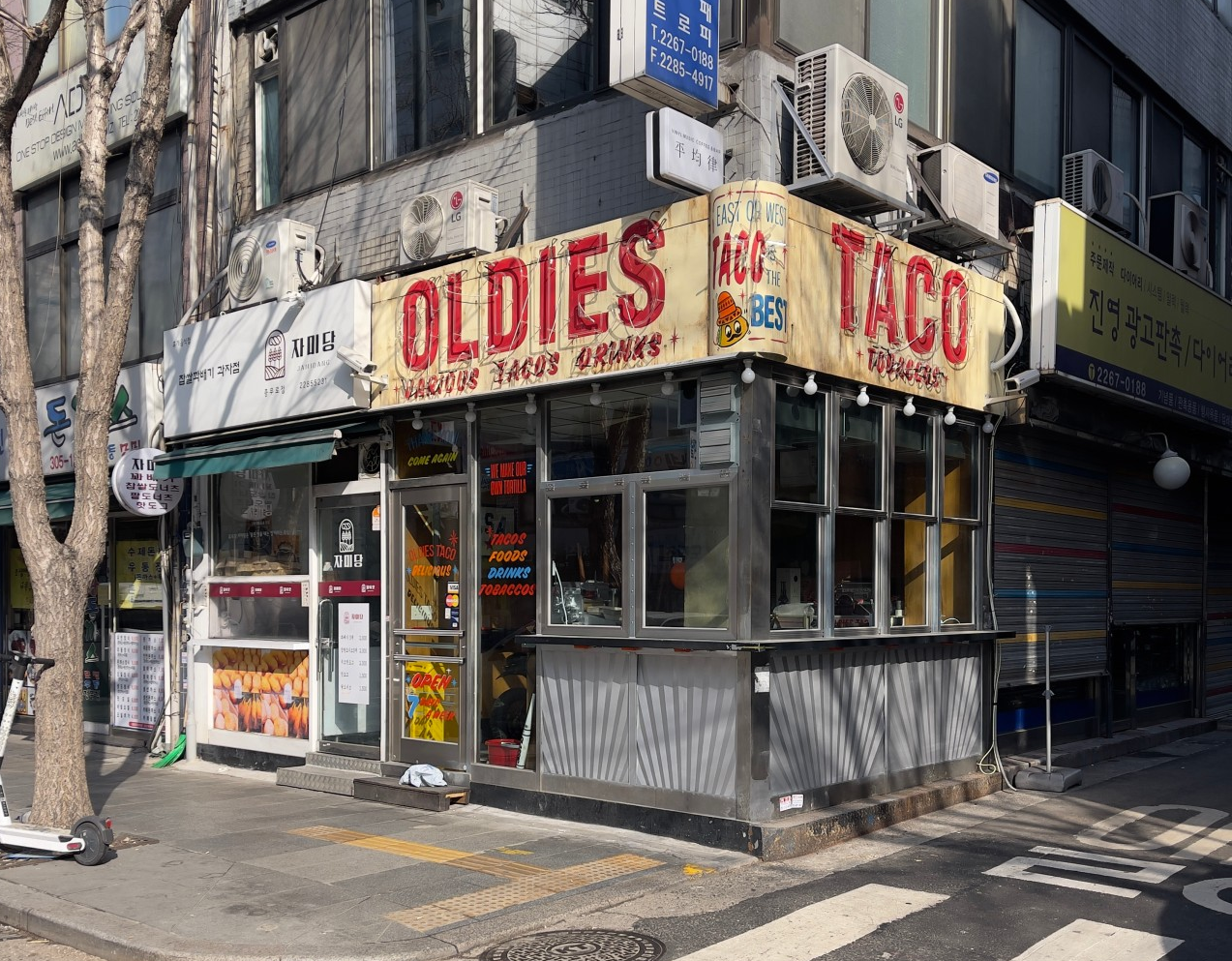
If cold noodles are your thing beyond soy milk broth, our guide to Seoul’s best naengmyeon covers the buckwheat side of Korea’s summer noodle obsession, and Korea’s traditional markets guide is worth a read before you wander into Gwangjang Market next door. For more of Seoul’s hardest lines to get into right now, Oldies Taco in Euljiro is a very different kind of queue just a short walk away.