There is a category of Korean food that visitors encounter by accident — usually late at night, after a few rounds of soju [Korean distilled spirit], when someone at the table says “가자, 곱창 먹으러” [“Let’s go, let’s eat gopchang”] and you follow without quite knowing what you’ve agreed to. You sit down. A grill comes out. The smell arrives before the food does — rich, smoky, deeply animal, with an edge of char. And then you eat something that has no real equivalent in Western food culture, and you understand, suddenly, why Koreans talk about it with the particular fondness they reserve for the things they grew up eating.
곱창 [Gopchang] is grilled beef small intestines. It is fatty, chewy, intensely flavoured, and it has been a staple of Korean working-class food culture since the Joseon Dynasty. Today, it is one of Seoul’s most beloved anju [food eaten alongside alcohol], the kind of dish that anchors a late-night gathering and tends to outlast the initial bottles of soju by several hours. It is also, for the uninitiated, one of the most rewarding first experiences you can have in this city — if you know where to go.
For that, the answer I keep returning to is Wonjomanlgobchang (원조만류곱창) in Mullae, Yeongdeungpo. It is not the most famous gopchang restaurant in Seoul. But it may be the best.
| Key Facts | Details |
|---|---|
| Address | 17-1, Gyeongin-ro 79-gil, Yeongdeungpo-gu, Seoul |
| Hours | Weekdays 4:00 PM – 11:00 PM · Weekends 3:00 PM – 12:00 AM |
| Price range | ₩23,000–₩25,000 per 200–300g portion |
| Getting there | Line 2 → Mullae Station, Exit 7 |
| Tripadvisor rating | 4.9 / 5 · #7 of ~21,000 Seoul restaurants |
| Best dish | Hanwoo Maneul Gopchang (한우 마늘 곱창) |
What Is Gopchang? A Guide to Seoul’s Grilled Intestines
곱창 [Gopchang] refers specifically to the small intestines of cattle. It should not be confused with 대창 [daechang], the large intestines — those are thicker, fattier, and slightly more gelatinous — or 막창 [makchang], the abomasum (fourth stomach), which is popular in Daegu and has a different, more yielding texture. These three cuts are sometimes grouped together on menus as a 모듬 [modeum, mixed] plate; knowing the difference helps you order what you actually want.
The appeal of gopchang is textural as much as it is flavourful. The small intestine, when cleaned properly and grilled well, develops a bite that is at once springy and yielding — firmer than slow-cooked offal, less tough than you might expect. Inside the tube there is a thin layer of 기름 [gireom, fat] that renders as it cooks, creating a rich, savoury concentration of flavour that has no precise equivalent in leaner cuts of meat. The outside chars slightly against the grill. The contrast — crisp skin, fatty interior, the faint mineral depth of the offal — is what keeps people ordering another round.
The history of gopchang as food dates to the Joseon era, when it was eaten by people who could not afford the premium cuts. Like most great cheap-cut traditions — French cassoulet, Italian nose-to-tail cooking, Taiwanese night market offal — it has outlasted the economic conditions that produced it and is now eaten across the social spectrum, in everything from market stalls to dedicated restaurants with chef’s menus. What remains constant is the pairing: gopchang and 소주 [soju] belong together the way grilled cheese and tomato soup do. The fat needs the alcohol; the alcohol needs the fat.
Preparation matters enormously. Raw intestines have a strong odour that, if not properly managed, will define the eating experience in the wrong way. The best gopchang restaurants clean the intestines meticulously — rubbed with 밀가루 [milgaru, wheat flour] and coarse salt, rinsed repeatedly, soaked to draw out residual blood — and then marinate in a combination of garlic, ginger, onion, 청주 [cheongju, rice wine], and ground pepper. This process removes the off-notes and leaves the characteristic flavour clean and forward. When you eat gopchang at a restaurant that has done this well, the smell at the grill is appetising, not challenging. When they haven’t, you’ll know within thirty seconds.
Mullae and the Gopchang Belt
문래동 [Mullae-dong] is the kind of Seoul neighbourhood that does not need to explain itself to tourists. It doesn’t try particularly hard to be interesting to outsiders — it simply is interesting, in the way that working-class industrial districts converted gradually by artists and small businesses tend to become interesting. The streets around Mullae Station (문래역) still carry the remnants of a metalworking district: small workshops where you can hear lathes running behind shutter doors, hardware vendors, industrial suppliers. The new layer — studios, small restaurants, independent coffee shops — sits alongside the old without quite replacing it.
The area also has a strong, unglamorous gopchang tradition. The streets around here, particularly toward the Yeongdeungpo side, are dense with grills and restaurant signboards advertising beef intestines, and they fill up early. Workers from the nearby industrial zones, students making the commute from Sinchon, and locals who have been eating on these streets for decades occupy the same plastic tables under fluorescent lighting. It is not atmospheric in any designed sense — it is atmospheric because it is genuinely itself.
Wonjomanlgobchang is part of this landscape, but it has distinguished itself within it. A rating of 4.9 out of 5 on Tripadvisor, and a ranking of #7 out of nearly 21,000 restaurants in Seoul — in a city of this size and food culture, those numbers are not coincidental.
What to Order at Wonjomanlgobchang (원조만류곱창)
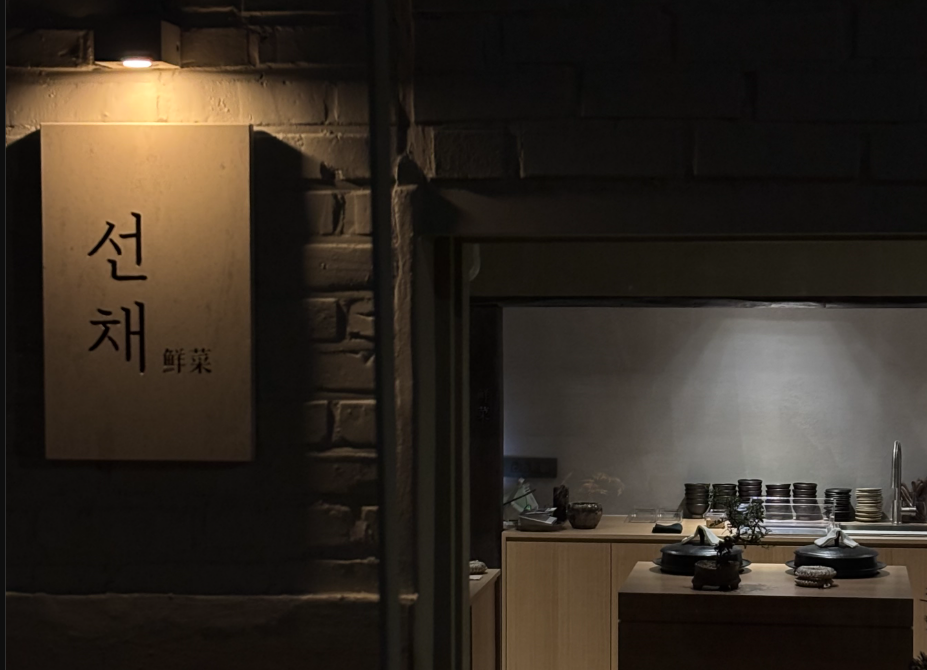
The interior matches the neighbourhood: retro in the unselfconscious way, with exposed concrete walls, raw ceiling beams, and practical furniture. Each table has a built-in grill and a tablet ordering system, which removes the language barrier for non-Korean visitors considerably. The place is not large, which contributes to a waiting time on busy evenings — arrive before 5:30 PM on weekdays if you want to seat without a queue.
The menu is built around Hanwoo (한우, premium Korean beef), which is notable. Most gopchang restaurants work with domestic beef of varying quality or with pork intestines; sourcing Hanwoo intestines and committing to them as a menu foundation is a statement of intent. The cut is cleaner and richer than standard beef intestines, and the fat inside the tube is perceptibly different — it melts at a slightly lower temperature, rendering faster on the grill and basting the outer surface from the inside as it cooks.
What to order:
한우 마늘 곱창 — Hanwoo Maneul Gopchang [Hanwoo Garlic Gopchang] · ₩25,000 / 200g
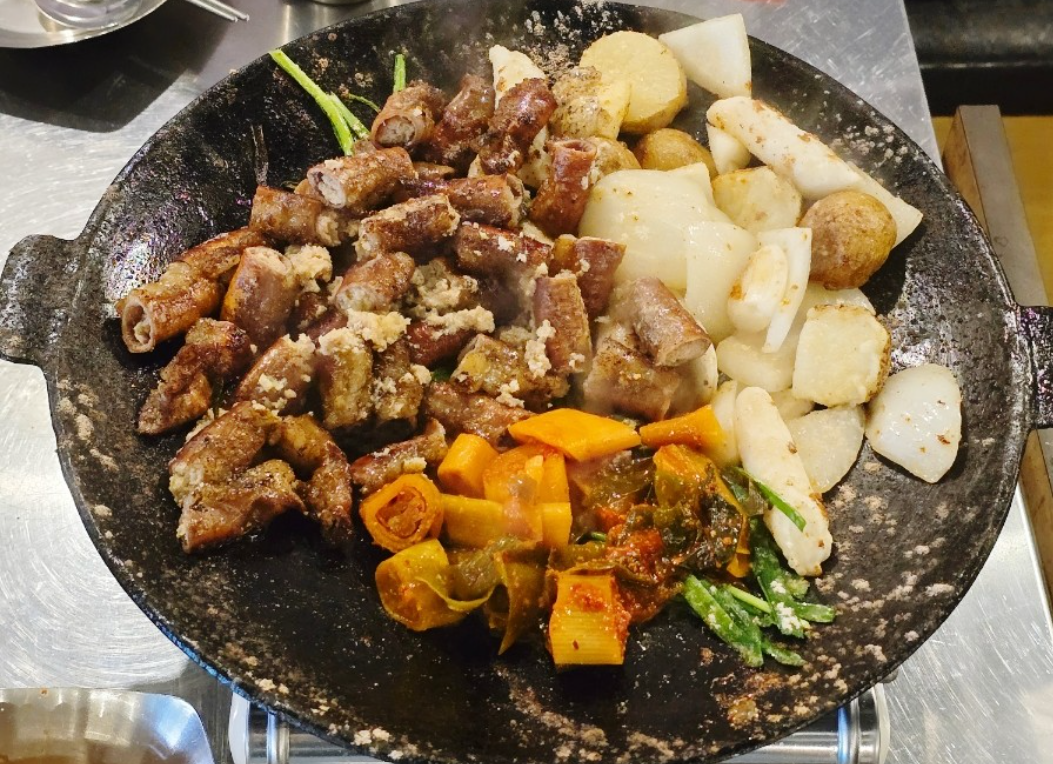
The signature dish. The small intestines come pre-stuffed with whole cloves of garlic, which cook inside the tube as the gopchang grills. The garlic softens and sweetens, the fat from the intestine bastes it continuously, and the result is a piece of offal that is simultaneously intensely savoury and subtly sweet. Order this first. It is the reason people come back.
한우 곱창 — Hanwoo Gopchang [Hanwoo Small Intestines] · ₩23,000 / 200g
The baseline — clean, unadulterated, the pure version of the thing. Useful if you want to compare it against the garlic stuffed version, and very good on its own merits. The portion size is on the smaller side at 200g, which is standard for gopchang; offset this with side dishes.
한우 대창 — Hanwoo Daechang [Hanwoo Large Intestines] · ₩24,000 / 300g
Thicker and fattier than gopchang, with a more overtly gelatinous texture. The portion is more generous at 300g. If you enjoy the richness of marrow bones or slow-cooked short ribs, daechang is the direction to go.
한우 파 대창 — Hanwoo Pa Daechang [Hanwoo Green Onion Large Intestines] · ₩25,000 / 300g
The daechang version of the stuffed preparation — large intestines packed with 파 [pa, green onion] rather than garlic. Lighter and more herbaceous than the garlic gopchang, which makes it a good counterpoint if you’re ordering both.
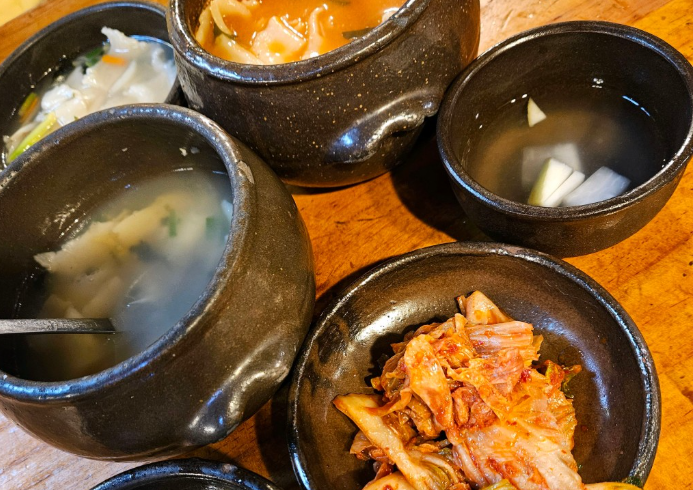
Complimentary sides arrive automatically: a small plate of 떡볶이 [tteokbokki, spicy rice cakes] and a 찌개 [jjigae, stew], both of which serve the meal better than they might sound as an afterthought. The tteokbokki cuts through the fat effectively; the stew arrives toward the end when you want something liquid and warming.
The fried rice finish — once the grill starts to wind down, ask the staff to fry rice (볶음밥) in the residual fat on the grill surface. This is standard practice at gopchang restaurants and produces fried rice with a depth of flavour that no amount of butter or oil can replicate. Do not skip it.
Drinking Alongside Gopchang in Seoul: The Anju Logic
안주 [Anju] is the Korean concept of food designed to accompany alcohol. This is not a side note to gopchang — it is the whole point. The relationship between grilled intestines and soju is not incidental; the fat in gopchang coats the stomach, slows alcohol absorption, and provides the richness against which soju’s clean burn tastes correct. Remove the alcohol and gopchang becomes just a rich, flavourful meat dish. Add soju and it becomes a social institution.
At Wonjomanlgobchang, 소주 [soju] is the obvious pairing — the classic clear variety or, if you prefer less alcohol, 막걸리 [makgeolli, fermented rice wine], which has enough acidity to contrast the fat without the sharpness of soju. Korean beer (맥주, maekju) in a half-and-half mix with soju — 소맥 [somaek] — is also standard and provides something lighter to drink between bites.
Getting to Wonjomanlgobchang in Mullae, Seoul
Wonjomanlgobchang is a short walk from Mullae Station (문래역) on Seoul Metro Line 2, Exit 7. The address is 17-1, Gyeongin-ro 79-gil, Yeongdeungpo-gu, Seoul.
→ Find Wonjomanlgobchang on Naver Map
The neighbourhood is easiest to navigate on foot from the station. Parking is limited and the streets are narrow; public transport is strongly recommended.
Practical Notes
Wonjomanlgobchang (원조만류곱창)
| Address | 17-1, Gyeongin-ro 79-gil, Yeongdeungpo-gu, Seoul |
| Phone | +82 2-2678-0170 |
| Hours | Weekdays 4:00 PM – 11:00 PM · Weekends 3:00 PM – 12:00 AM |
| Getting there | Seoul Metro Line 2 → Mullae Station, Exit 7 → short walk |
| Ordering | Tablet ordering system at each table (language-accessible) |
| What to order first | Hanwoo Maneul Gopchang (한우 마늘 곱창) — the garlic stuffed version |
Arrive early. Weekday evenings from around 6 PM fill up. Weekend afternoons from 3 PM are possible if you want to eat without pressure.
Go with at least two people. Gopchang is priced by 200–300g portions, and ordering a variety across the table is how the meal is meant to work. A solo visit is perfectly possible, but the full experience is communal.
First time with offal? Start with the Hanwoo Daechang (한우 대창) rather than the gopchang. The larger intestine has a more familiar texture — closer to slow-braised fatty beef than to anything that would challenge a cautious palate. Let the garlic gopchang come second, once you’ve settled in.
For more on Seoul’s grilled meat culture, see the Korean BBQ guide. For a broader overview of where to eat in the city, the Seoul restaurant guide 2026 covers everything from neighbourhood institutions to fine dining.
Gopchang has survived five centuries because it delivers something that no cleaner, more obviously appealing cut of meat quite manages: a flavour that is genuinely intense, a texture that holds up to a long grill and a long conversation, and a richness that makes the bottle of soju on the table feel necessary rather than optional. It is not food that tries to be elegant. It is food that tries to be correct — and at Wonjomanlgobchang, by almost any measure available, it succeeds.
Frequently Asked Questions: Gopchang in Seoul
What is gopchang and how is it different from other Korean offal?
Gopchang (곱창) refers specifically to grilled beef small intestines. It differs from daechang (대창, large intestines), which is thicker and fattier, and from makchang (막창), the beef abomasum stomach popular in Daegu. On combined menus, these three appear as a modeum (모듬, mixed) plate. Gopchang has a firmer, springier texture than daechang, and is the most commonly ordered of the three at Seoul restaurants.
Is gopchang safe to eat for first-timers?
Yes — gopchang at reputable restaurants is meticulously cleaned before cooking. Good preparation removes any strong odour; at a well-run restaurant like Wonjomanlgobchang, the smell at the grill should be appetising rather than challenging. First-timers who are cautious about offal are usually advised to start with daechang, which has a more familiar, slow-braised quality, before trying gopchang.
How much does gopchang cost in Seoul?
At Wonjomanlgobchang, Hanwoo gopchang costs ₩23,000–₩25,000 per 200g portion. Budget around ₩50,000–₩80,000 per person for a full meal with side dishes and drinks. This is on the higher end for gopchang in Seoul, reflecting the premium Hanwoo sourcing; standard gopchang restaurants are often cheaper, but the quality difference is noticeable.
What drink should I order with gopchang?
Soju (소주) is the classic pairing — its clean burn contrasts the richness of the fat. Somaek (소맥, soju and beer mix) is popular for a lighter option. Makgeolli (막걸리, fermented rice wine) is a good alternative if you prefer something with more body and less alcohol intensity.
What is the best dish to order at Wonjomanlgobchang?
The Hanwoo Maneul Gopchang (한우 마늘 곱창, ₩25,000) — garlic-stuffed small intestines — is the signature dish and the reason most regulars return. The garlic cooks inside the intestine tube as it grills, softening and sweetening from the rendered fat. Order this first, and add plain gopchang or daechang as secondary dishes.
When should I arrive to avoid a queue at Wonjomanlgobchang?
Arrive before 5:30 PM on weekdays for the best chance of immediate seating. Weekend evenings fill quickly from 5–6 PM; weekend afternoons from 3 PM (when the restaurant opens) are quieter. The restaurant does not take phone reservations, so timing your arrival is the only strategy.