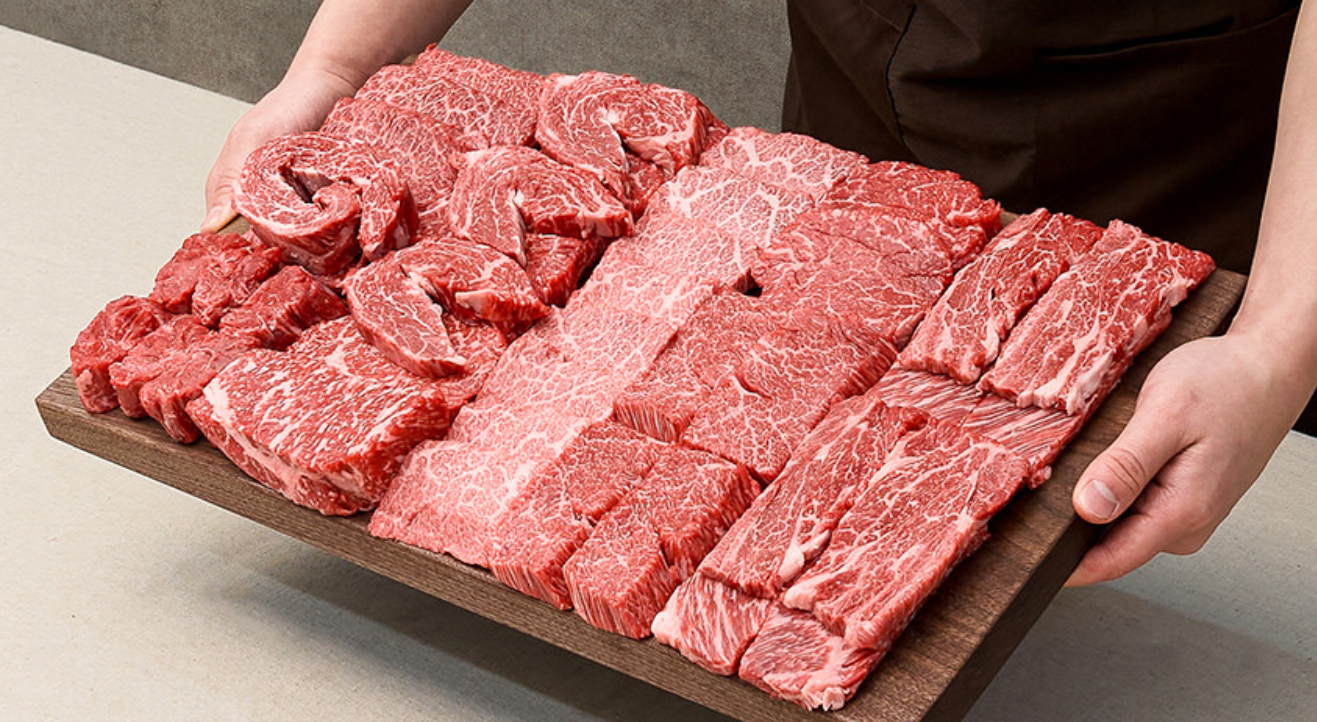
Walk into a butcher stall at Majang Market in eastern Seoul and you’ll understand immediately why Koreans take their Hanwoo (한우) so seriously. Behind a glass counter, under cool fluorescent light, sits a rack of short ribs so marbled with fat that the red and white have nearly merged into a single pale-pink mass. A sign above it says 한우 1++ No.9 — the top of the top grade. Less than one percent of all Korean beef ever reaches it.
The butcher wraps a piece and hands it over for inspection. The fat is snow-white and glossy. It will melt at slightly below body temperature. The flavour — once you grill it — will be deeply savory, rich with what Koreans call 육향 (yukhyang): a concentrated, almost mineral beefy fragrance that no other beef quite replicates.
That beef is Hanwoo (한우): Korea’s native cattle breed, one of the world’s great premium beef traditions, and still largely unknown outside Asia. If you’re visiting Korea, this guide will tell you what it is, why it matters, and exactly where to eat it.
Quick Reference: Hanwoo in Seoul
| What | Details |
|---|---|
| What is Hanwoo | Korea’s native cattle breed; 5,000-year history on the peninsula |
| Top grade | 1++ (BMS No. 8–9); only ~10% of cattle reach Grade 1++ |
| Ultra-premium | 1++ No. 9; approximately 1% of total production |
| Retail price (1++ sirloin) | ₩25,000–35,000 per 100g (~$18–26 USD) |
| Restaurant price (1++ sirloin) | |
| Best value in Seoul | Majang Meat Market — ₩17,000–20,000/100g at source |
| High-end experience | Born & Bred omakase — ₩350,000–380,000/person |
| How much is exported | Less than 0.5% of total production leaves Korea |
What Is Hanwoo?
Hanwoo (한우, literally “Korean cattle”) is the indigenous cattle breed of the Korean Peninsula, with a documented presence dating back roughly 5,000 years. Bones excavated from the Gimhae shell mound — dated to around 100 BCE — confirm early domesticated cattle populations in Korea. The breed is believed to have migrated to the peninsula from northern China or Manchuria, possibly before that from the Middle East, and evolved in geographic isolation into a genetically distinct breed.
For most of Korean history, Hanwoo were not primarily a food source. They were the backbone of Korean agriculture: essential draft animals used for plowing rice paddies and hauling goods. During the Joseon Dynasty (1392–1910), slaughtering a cow required government permission, and doing so without it was a punishable offense. A farming household’s Hanwoo was its single most valuable asset. This is why, to this day, gifting premium Hanwoo is a gesture of genuine significance in Korea — the respect runs deep.
The modern transformation of Hanwoo into a premium meat breed happened rapidly after Korea’s economic development in the 1960s. A formal national herd book was established in 1968, and systematic selective breeding programs followed, focused specifically on enhancing intramuscular fat and marbling. The results have been remarkable. Today’s Hanwoo produces beef with oleic acid and marbling profiles that rival the most expensive Wagyu — a feat of breeding compressed into roughly 50 years. Korea currently maintains a national herd of approximately 3.8 million head (2024).
Hanwoo has been officially designated as one of Korea’s 100 Cultural Symbols.
What Does Hanwoo Look Like?
The most recognisable feature of Hanwoo is its yellow-brown coat — more than 90% of the breed carries this warm tan colouring, which is distinct enough to be immediately recognisable to any Korean. Three other coat variants exist (black, white, and spotted), but the golden-brown Hanwoo is the defining image. Adult cattle reach a live weight of 700–800 kg.
Genetically, SNP analysis has confirmed that Hanwoo forms a distinct group alongside the Yanbian breed of northeastern China, clearly separate from European taurine breeds and distant from the indicine (Zebu) cattle group. It is, in the most meaningful sense, its own thing.
The Hanwoo Grading System: Korea’s 1++ to 3 Scale Explained
Korea operates one of the most rigorous beef grading systems in the world, administered by the Livestock Products Quality Assessment Division (축산물품질평가원, LSES), established under a formal carcass grading framework introduced in 1992.
Every Hanwoo carcass is graded on two independent axes: quality grade (품질등급) and yield grade (육량등급). What you see on a restaurant menu or butcher label refers to the quality grade.
Quality Grades: The 1++ to 3 Scale
| Grade | Korean | BMS Score | What It Means |
|---|---|---|---|
| 1++ | 최고등급 | No. 8 or 9 | Extraordinary marbling; top ~10% of Hanwoo |
| 1+ | No. 6 or 7 | Excellent marbling; next ~26% | |
| 1 | No. 4 or 5 | Very good; next ~31% | |
| 2 | No. 2 or 3 | Good; standard commercial grade | |
| 3 | No. 1 | Minimal marbling |
The grade is determined by physical assessment of the exposed longissimus dorsi muscle (the eye of the loin, revealed at the 13th rib cut), evaluated on four factors: marbling score, meat colour, fat colour, and texture and firmness.
The 9-Point BMS (Beef Marbling Standard, 근내지방도)
The Korean Beef Marbling Standard runs from No. 1 (devoid of intramuscular fat) to No. 9 (very abundant marbling). This scale was developed iteratively by the LSES:
- 1990s: Initial 3-grade system with a 1–5 BMS scale
- 1997: Grade 1+ introduced; BMS extended to No. 6 and 7
- 2004: Grade 1++ introduced; BMS extended to No. 8 and 9 to accommodate the improving quality of Korean beef
The extension of the scale tells its own story: Korean breeders kept producing beef so marbled that the existing top scores couldn’t adequately describe it, so the scale had to grow.
How Rare Is the Top Grade?
Based on LSES slaughter data:
- Grade 1++: approximately 10.1% of slaughtered Hanwoo
- Grade 1+: approximately 26.4%
- Grade 1: approximately 31.4%
- Grades 2 and 3: the remaining ~32%
- Grade 1++ No. 9 (the absolute ceiling): approximately 1% of total national production
The proportion reaching Grade 1 or higher has been steadily rising as breeding programs advance — a trend that continues through 2024.
Yield Grades: A, B, C
The yield grade (육량등급) assesses how much usable meat the carcass produces relative to its total weight. Grade A yields the highest percentage of saleable cuts; Grade C the lowest. This grade matters more to butchers and wholesalers than to restaurant diners, but it appears on official grading certificates alongside the quality grade.
Hanwoo vs. Wagyu vs. American vs. Australian Beef
The comparison question that most people arrive with: how does Hanwoo actually stack up against Wagyu — and why can it cost more?
The Science: Fat Composition
A peer-reviewed study published in the journal Asian-Australasian Journal of Animal Sciences (PMC5434201) measured the fatty acid profiles of grain-fed Hanwoo, American crossbred, and Australian crossbred cattle directly. The results:
| Beef | Oleic Acid (C18:1n-9) | Total MUFA |
|---|---|---|
| Grain-fed Hanwoo | 50.62% of total fatty acids | Highest |
| Grain-fed American crossbred | 44.15% | Mid |
| Grain-fed Australian crossbred | 40.09% | Lowest |
Oleic acid — the same dominant fatty acid in extra-virgin olive oil — is the single most important marker for both beef flavour complexity and health profile. Higher oleic acid content is directly associated with the buttery, lingering umami that distinguishes premium beef from ordinary cuts. Both Hanwoo and Wagyu are outliers among cattle breeds in oleic acid content; Hanwoo’s 50.62% is comparable to the profiles found in high-grade Wagyu.
Side-by-Side Comparison
| Category | Hanwoo (한우) | Wagyu (A5, Japan) | American Beef | Australian Beef |
|---|---|---|---|---|
| Breed | Korean native taurine | Japanese native (Kuroge Washu dominant) | Angus/Hereford | Angus crossbred |
| Primary finish | Grain (rice straw, concentrates) | Grain (200–700+ day feeding) | Grain or grass | Grass or grain |
| Top BMS equivalent | No. 8–9 (Korean scale) | BMS 10–12 (Japanese scale) | USDA Prime (~BMS 4–5 equivalent) | MSA/AUS-MEAT up to Marble Score 9 |
| Intramuscular fat (top grade) | ~22–24% (1++) | Up to 40–50%+ (A5) | ~6–8% (Prime) | ~8–12% (top grade) |
| Oleic acid content | ~50.6% | ~50–55% | ~44% | ~40% |
| Flavour profile | Deep beefy 육향; rich but balanced; pronounced iron and savory notes | Intensely buttery; fat-forward; subtle iron; best in small portions | Clean, firm; neutral fat; classic beef flavour | Grassy, lean; bright flavour; lighter fat |
| Texture | Tender with distinct bite | Extremely tender; near-dissolves | Firm to moderate | Firm; lean |
| Retail price (per 100g) | ₩25,000–35,000 ($18–26) | ₩30,000–50,000+ ($22–37) | ₩8,000–12,000 ($6–9) | ₩10,000–15,000 ($7–11) |
Why Hanwoo Can Cost More Than Wagyu
Wagyu from Japan is internationally exported at scale. Hanwoo is not. Less than 0.5% of total Hanwoo production leaves Korea. This is not a marketing decision — it is a physical constraint. South Korea is approximately 70% mountainous terrain, meaning grazing land is acutely limited. The domestic population of ~52 million people eats nearly all of the roughly 3.8 million head produced each year. Export-permitted markets are currently limited to Hong Kong, Macao, Cambodia, Malaysia, and the UAE, with Hong Kong absorbing approximately 80% of what does leave. Scarcity, combined with passionate domestic demand and a very high-maintenance breeding program, drives the price.
The flavour difference is also real. Wagyu at its peak (A5) achieves a near-complete dominance of fat over lean — extraordinary, but best consumed in small, focused portions. Hanwoo at Grade 1++ preserves more of the lean meat’s mineralic, savoury character while still delivering substantial marbling. Korean diners — and an increasing number of international chefs — find Hanwoo’s balance more versatile and, in a full BBQ meal, more satisfying across an extended sitting.
The Best Hanwoo Cuts
| Cut | Korean | Character | Best For |
|---|---|---|---|
| Sirloin | 등심 (deungsim) | Rich fat cap, juicy, full-flavoured | BBQ grilling; the quintessential Hanwoo cut |
| Striploin | 채끝 (chaekkeut) | Leaner than sirloin; clean, tender bite | Lighter preference; first-timers |
| Tenderloin | 안심 (ansim) | Leanest premium cut; subtle, delicate | Those who prefer lean over marbled |
| Short ribs | 갈비 (galbi) | Bone-in; sweet-savoury marinated classic | Traditional Korean BBQ; celebratory meals |
| Brisket | 차돌박이 (chadolbaegi) | Paper-thin slices; quick-cook | Light starter cut; broth or rapid grilling |
| Neck/Chuck | 목심 (moksim) | Affordable; good flavour; chewier | Everyday BBQ; best value cut |
For a full guide to how these cuts are ordered and grilled at a Korean BBQ restaurant, see our Korean BBQ guide.
Where to Eat Hanwoo in Seoul
Majang Meat Market (마장 축산물시장) — Best Value
Korea’s largest wholesale beef market, supplying an estimated 60% of the country’s beef. Located in eastern Seoul near Majang Station (Line 5, Exit 2), the market runs across multiple buildings packed with butcher stalls offering Hanwoo at prices significantly below what you’d pay at a restaurant. Buy your meat directly from the counter — Grade 1++ sirloin runs around ₩17,000–20,000 per 100g — then carry it upstairs or to an adjacent restaurant for grilling. A small table fee (roughly ₩5,000–6,000 per person) covers rice, banchan, and use of the grill.
This is the most authentic and most economical Hanwoo experience in Seoul — the same source that supplies top restaurants, at near-wholesale prices.
Pro tip: Go on a weekday morning when the selection is freshest. Point and use the Papago translation app to communicate your preferred grade and cut; staff are used to this.
Nonhyeon-dong (논현동), Gangnam — Butcher Restaurants
The back alleys of Nonhyeon-dong are lined with 정육식당 (jeongyuk sikdang) — hybrid butcher-restaurants that sell premium cuts from their display counters and grill them tableside. These charge roughly 20% less than glossy Gangnam BBQ restaurants while serving comparable quality. Look for shops that clearly display the grade certificate (등급판정서) on the counter.
Born & Bred (본앤브레드) — Fine Dining
Asia’s 50 Best Restaurants listed. Founded by Jeong Sang-won, whose family has deep roots in Majang Meat Market, Born & Bred is Seoul’s most celebrated Hanwoo omakase — a multi-course tasting menu built entirely around Korea’s finest beef, served in an intimate speakeasy-style basement dining room near Majang.
Price: ₩350,000–380,000 per person. Booking well in advance is essential.
Typical Pricing at Seoul Hanwoo Restaurants
| Setting | Price Range |
|---|---|
| Majang Market (butcher + grill fee) | ₩17,000–20,000/100g + ₩5,000–6,000 table fee |
| Nonhyeon-dong jeongyuk sikdang | ₩30,000–45,000/100g |
| Standard premium Hanwoo restaurant | ₩45,000–65,000/100g |
| Tourist-area restaurant (Myeongdong, Hongdae) | up to ₩40,000–50,000/100g |
| Hanwoo omakase (Born & Bred) | ₩350,000–380,000/person |
Hanwoo and Korean Culture: Why This Beef Matters
Hanwoo pride is not marketing — it is historical memory. For a farming society where cattle were legally protected and economically irreplaceable, the reversal into treating them as a luxury food is relatively recent. The residual reverence is genuine.
Today, Hanwoo is embedded in Korea’s ritual food calendar. It appears on the table during jesa (제사) ancestral ceremonies, at weddings, and above all at the two great national holidays — Chuseok (추석) and Seollal (설날) — when premium Hanwoo gift sets are among the most prized presents one Korean can give another. Department stores across the country dedicate entire floors to holiday Hanwoo packaging.
Chuseok in particular sends Hanwoo prices surging 20–40% above normal levels as families compete for the best cuts — a phenomenon Korean news media covers as an economic indicator every year.
Korea’s Push for Global Recognition
The South Korean government and beef industry associations are actively building Hanwoo’s international profile, positioning it alongside Wagyu as a world-class luxury protein. Promotional events like K-Beef Day 2024 at Hong Kong Cultural Centre have introduced it to luxury restaurant buyers in the city that receives 80% of all Hanwoo exports. Michelin-rated Seoul restaurants serving Hanwoo have received international press attention from the South China Morning Post, Epicure Asia, and others — several running stories explicitly framing the question of whether Hanwoo is overtaking Wagyu in prestige.
Given how little of it ever leaves Korea, most of the world has yet to encounter it.
Tips for Ordering Hanwoo in Seoul
Know the grade label. Every reputable Hanwoo restaurant or butcher displays the carcass grade certificate. Look for 한우 1++ on the signage — if it’s not clearly marked, ask. Grade 2 Hanwoo is still excellent beef, but if you’re paying premium restaurant prices, confirm what grade you’re getting.
Arrive hungry. A proper Hanwoo BBQ meal — banchan, multiple cuts grilled progressively, rice and doenjang jjigae to finish — is filling and meant to be shared. Expect to spend 1.5–2 hours at the table.
Pair with Korean soju or makgeolli. The fat richness of 1++ Hanwoo cuts through beautifully against the clean bite of cold soju. Sparkling makgeolli is equally good with the more marbled cuts.
At Majang Market, look for the grade certificate on the counter. Every legitimate Hanwoo stall has a LSES grading certificate posted. The BMS number is printed on it — that number is your guide to exactly what you’re buying.
Holiday pricing. If you’re visiting during Chuseok or Seollal, expect to pay 20–40% more for premium cuts everywhere. The weeks immediately before and after are better value.
Hanwoo FAQ
Is all beef in Korea Hanwoo? No. Korea imports significant quantities of beef — primarily from the US and Australia — labelled as imported beef (수입산). Hanwoo (한우) specifically refers to native Korean cattle. Korean domestic beef from other breeds is labelled as 국내산 (guknaesaan, domestic origin) but may not be Hanwoo. Always look for the specific 한우 designation.
What is the difference between Hanwoo and Wagyu? Both are premium, marbled beef with high oleic acid content and complex umami flavour. Wagyu at A5 grade is more intensely fatty and dissolves more completely; Hanwoo at 1++ retains more of the lean muscle’s beefy character while still delivering substantial marbling. At an equivalent grade level, both are exceptional — they are different expressions of the same pursuit of premium beef.
Can I bring Hanwoo beef home from Korea? Bringing uncooked beef across international borders is generally restricted by biosecurity regulations in most countries. Processed Hanwoo products (dried, vacuum-sealed, and certified) can sometimes be exported legally, but check your home country’s import rules. Majang Market and department store gift counters can advise on what packaging formats are approved for export.
Where can I buy Hanwoo beef outside Korea? In limited quantities only. Exports are currently permitted to Hong Kong, Macao, Cambodia, Malaysia, and the UAE. A small number of high-end Korean restaurants in these markets carry it. Outside those markets, finding genuine certified Hanwoo is currently very difficult.
Why is Hanwoo beef so expensive? Three reasons: Korea’s mountainous terrain limits grazing land severely; domestic demand from 52 million people absorbs nearly all production; and the selective breeding program required to achieve Grade 1++ marbling is costly and time-intensive. Less than 0.5% of Hanwoo is exported, meaning global scarcity is real — not manufactured.
When is the best time to eat Hanwoo in Seoul? Any time — but avoid the two weeks immediately before Chuseok and Seollal for pricing reasons, when premium cut prices surge 20–40%. Spring and autumn (March–May, September–November) are ideal travel windows for Seoul overall.
Plan Your Visit
Eating Hanwoo in Korea is one of those experiences that retrospectively changes how you think about beef. Not because it is the most extreme or the most marbled — though at 1++ No.9 it is genuinely extraordinary — but because it is the most complete: a breed with 5,000 years of history on this land, a grading system that documents its quality with scientific precision, and a culture that has never stopped treating it as something worth taking seriously.
Start at Majang Market for the full experience: choose your own cut from the counter, watch it graded and weighed, take it upstairs and grill it. After that, the price of 1++ Hanwoo at a Gangnam restaurant will make perfect sense.
For where to go after dinner, see our Seoul Restaurant Guide 2026 — and for everything else on the grill, our Korean BBQ Guide.