
There’s a particular kind of table in Korea — low, crowded, loud — where the food that arrives is nothing like what most visitors expected. Not the kimchi, which they knew about. Not the bulgogi [marinated grilled beef] or the bibimbap [mixed rice bowl], which they’d seen in travel guides. Something else comes out: a plate of small, writhing tentacles still in motion. Or a crock of amber-coloured liquid holding an entire raw crab. Or a ceramic bowl whose steam carries a faint, stinging suggestion of ammonia.
This is the other side of Korean food culture — older, less exported, and significantly more interesting to understand.
Korea has a long tradition of fermentation, preservation, and whole-animal eating that reaches back centuries before the country became famous for tteokbokki [spicy rice cakes] and Korean fried chicken. These challenging dishes are not novelties or dares. They are genuine culinary heritage — foods with regional histories, ritual significance, and devoted followings. In 2026, as food tourism across Korea reaches new highs and travellers increasingly prioritise authentic eating over safe menu choices, they are also increasingly accessible to the curious visitor who knows where to look.
What follows is not a list designed to shock. It is a guide to understanding.
1. Hongeo-hoe (홍어회) — Fermented Skate

If Korea has one dish that is genuinely comparable to the world’s most extreme fermented foods — Iceland’s hákarl, Sweden’s surströmming — it is hongeo-hoe: raw fermented skate, served in cold, thin slices that hit the back of your throat like a chemical event.
The fermentation is not manufactured. Skate (hongeo, a type of ray) is unique among fish in that it lacks a conventional urinary tract. Instead, it excretes uric acid — effectively urine — through its skin. When the fish is left unrefrigerated, the urea in its flesh converts to ammonia as it breaks down, producing a pungent, nose-clearing intensity that many first-time eaters describe as inhaling near an open bottle of bleach. That is not a metaphor. It is, for Koreans from the South Jeolla region (Jeollanam-do), the point.
The dish’s origins trace back to the fishermen of Heuksan Island (흑산도), located in the Yellow Sea off the southwestern coast. During the late Goryeo Dynasty, residents were displaced inland to Naju, Jeollanam-do — a journey of more than two weeks. The skate they carried with them fermented in transit, and they ate it anyway. They liked it. The practice persisted.
Today, the city of Mokpo and the surrounding Naju area are the undisputed heartland of hongeo culture. The dish is most commonly encountered as hongeo samhap (홍어삼합) — a three-part stack of fermented skate, bossam [boiled pork belly], and aged kimchi, eaten together in a single bite. The combination is deliberate: the fatty richness of the pork and the acidic funk of old kimchi soften the assault of the hongeo into something more navigable. In one mouthful, you get the full spectrum — animal fat, ferment, and fire.
Even Koreans who grew up outside the Jeolla region often approach hongeo with caution. The dish carries regional pride with it; to eat it sincerely is, in some small way, to acknowledge that part of Korea’s story.
Where to try it: Mokpo (목포) remains the definitive destination. The area around Dongmyeong-dong has a cluster of hongeo specialists, and the annual Yeongsanpo Hongeo Festival in Naju typically takes place each autumn.
2. Sannakji (산낙지) — Live Octopus

Sannakji is, by some distance, the challenging Korean food most frequently searched, filmed, and attempted by foreign visitors. The reason is simple: it moves on the plate.
The dish involves cutting a small live octopus (nakji) into pieces immediately before serving and plating them with sesame oil and seeds. Because the nervous system of an octopus continues to function after death, the pieces — tentacles and all — remain in active motion when they reach the table. The suckers retain their grip. The standard warning given to first-time eaters is entirely serious: chew thoroughly. The suction cups will adhere to the inside of your throat if you don’t. There are recorded deaths from choking.
None of which makes the dish any less popular. In a 2018 survey by The Korea Times, sannakji was ranked the most alluring Korean food for foreign visitors — beating even bibimbap — precisely because of its strangeness. It tastes clean and oceanic, similar to other raw seafood preparations, and the texture is simply the firm chew of fresh cephalopod. The challenge is almost entirely psychological.
For Koreans, the appeal is not the drama. Fresh sannakji is eaten for the same reason fresh oysters are eaten in France or raw sea urchin is eaten in Japan: when the ingredient is at its absolute freshest, the flavour is different and better. Live preparation is a quality signal, not a stunt.
Where to try it: Raw seafood markets throughout Korea serve sannakji, but the best setting is Noryangjin Fish Market (노량진수산물도매시장) in Seoul, where you can point to a live octopus in a tank, have it cut in front of you, and eat at a table on the upper floor. For context on the market, see our Noryangjin guide.
3. Ganjang Gejang (간장게장) — Soy-Marinated Raw Crab

The nickname, spoken affectionately by Koreans who love it, is bap doduk [밥도둑] — “rice thief.” The implication is that it’s so intensely flavoured you’ll eat far more rice than you intended trying to balance it.
Ganjang gejang is made by submerging live fresh crabs in a marinade of soy sauce, garlic, ginger, chilli, and sesame, then leaving them to cure for anywhere from several days to several weeks. There is no cooking. What you receive is a raw crab that has been fundamentally transformed by the marinade — its flesh firm and gelid, its roe (if female) custard-like and rich, its shell softened enough to be bitten through directly.
The technique is ancient, rooted in Korea’s pre-refrigeration traditions of preservation. The high-salt brine essentially cures the crab in the same way that gravlax cures salmon: enzymatic breakdown changes the texture, and the salt suppresses bacterial spoilage. Modern versions — particularly the high-end restaurant presentations in Seoul — use premium Haeryeo blue crabs (꽃게, kkotgae) sourced from the West Sea, which have a sweeter, less briny flesh than the alternatives.
Eating it is a full-contact experience. There is no way to be delicate. You pick up the shell, scrape the inner flesh with your tongue, crack sections directly with your teeth, suck marinated liquid from the cavities. Koreans eat it as a banchan [side dish] alongside plain white rice, loading each spoonful with a little claw meat and a smear of roe.
Where to try it: Ganjang gejang is available throughout Korea, but premium versions appear at specialist restaurants in Seoul. Look for menus specifying Haeryeo blue crab (해려 꽃게) and recent catch dates — freshness of the original crab matters as much as the quality of the marinade.
4. Beondegi (번데기) — Silkworm Pupae

The smell comes first. If you’ve walked through any traditional Korean market and encountered a dented metal pot steaming quietly near a market stall, you’ve already met beondegi — silkworm pupae, boiled and served in small cups with a toothpick.
The odour is distinctive and not neutral: earthy, vegetal, faintly acrid. It is the primary reason many visitors hesitate. The taste is softer than the smell suggests — nutty, slightly bitter, with a texture that is crisp-shelled and then mushily soft at the centre, like a soybean that has been left too long in broth.
Beondegi became a mainstream street food during and after the Korean War, when animal protein was scarce and silkworm pupae — a byproduct of the silk industry — were available, cheap, and nutritionally substantial. In postwar Korea, they fed a generation. For many older Koreans, eating beondegi is an act of memory as much as appetite.
In 2026, the food occupies an interesting cultural position. It has declined in mainstream popularity, with younger urban Koreans generally less interested in it. Simultaneously, it has attracted renewed attention globally, as the broader conversation around insect protein as a sustainable food source has grown. Beondegi predates the trend by decades.
You will still find it at traditional markets (재래시장) across the country — steamed at stalls or sold canned in supermarkets. It is distinctly an acquired taste, but for visitors interested in understanding where Korean food culture comes from, it belongs on the list.
Where to try it: Gwangjang Market (광장시장) in Seoul has stalls serving beondegi alongside other traditional market foods. Most vendors near the main entrance also sell it seasonally.
5. Gopchang & Makchang (곱창 / 막창) — Grilled Intestines
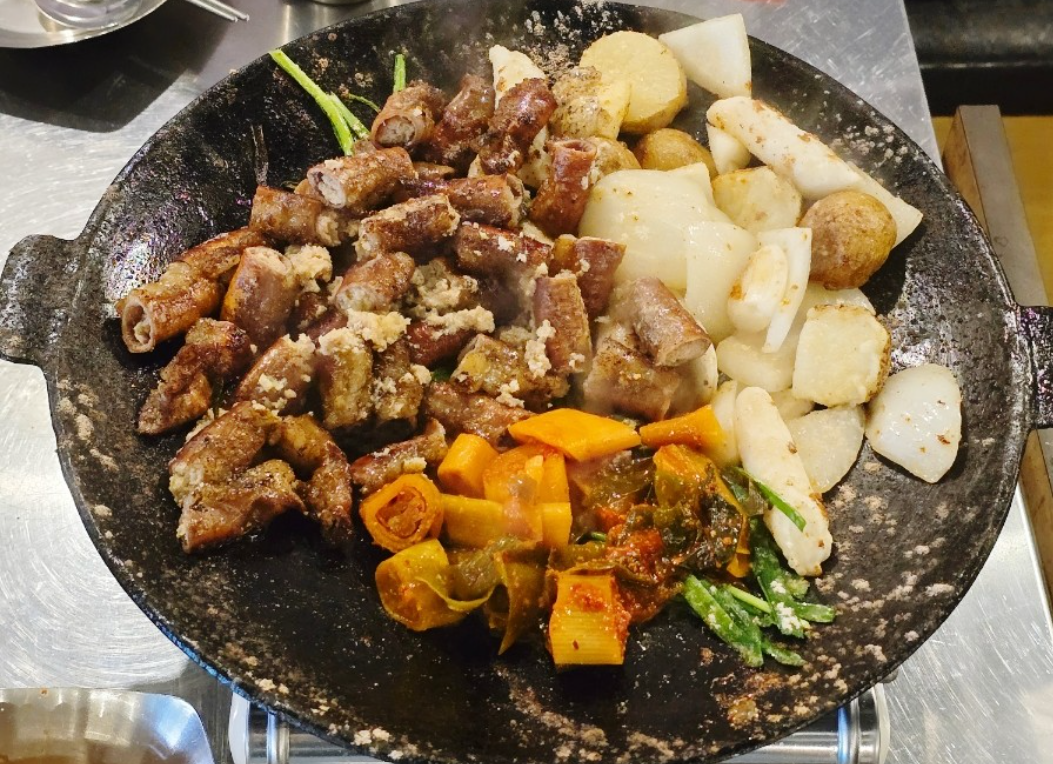
This one has a full guide of its own — see our Gopchang Seoul guide — but it warrants a place on any challenging food list because for most visitors, the idea of ordering grilled intestines at a barbecue restaurant still requires a deliberate decision.
Gopchang (small intestine of beef or pork) and makchang (beef abomasum, the fourth stomach) are, when properly prepared, among the most texturally rewarding things you can grill. The intestine develops a crisp exterior as it cooks, while the fat inside the tube renders and bastes the outer surface from within. The makchang — popular in Daegu more than Seoul — has a yielding, gelatinous quality that clings to the grill and chars at the edges. Both are traditionally eaten late, alongside soju [Korean distilled spirit], as anju [food eaten alongside alcohol].
The preparation stage is what separates a good gopchang restaurant from a bad one. Raw intestines require rigorous cleaning — flour rubbing, salt scrubbing, multiple soaks — and then marinating to suppress off-notes. At a skilled restaurant, the smell at the grill is appetising. At one that has cut corners, it isn’t.
The food’s working-class history is part of its appeal. These were cuts that premium butchers didn’t value, eaten by people who couldn’t afford not to. Like many such traditions — French abats, Italian quinto quarto [fifth quarter] — they outlasted the economics that produced them and are now eaten across all of society.
6. Sundae (순대) — Steamed Blood Sausage

Korea’s sundae (pronounced soon-deh — no relation to the dessert) is a steamed sausage made from pork or cow intestines stuffed with glass noodles, and in its traditional form, blood. In the modern street food version, the filling is primarily dangmyeon [sweet potato glass noodles] with a modest amount of blood and seasoning, which gives the sausage a milder, chewier character than most Western blood sausages.
The full guide is here — Korean Sundae Guide — but the short version for a challenging food list is this: sundae is one of Korea’s most beloved comfort foods, sold at street carts, market stalls, and standalone restaurants throughout the country. It comes sliced into rounds, often alongside steamed liver and lung, and is eaten with either doenjang [fermented soybean paste] or a salt-and-pepper dip. The challenge for most foreign visitors is primarily conceptual — the word “blood sausage” does a lot of heavy lifting before the actual eating begins.
In practice, sundae is approachable. The glass noodle filling gives it a bouncy, gentle texture, and the flavour is mild, savory, and faintly smoky. Sillim-dong Sundae Town (신림동 순대타운) in Seoul’s Gwanak District is the traditional pilgrimage destination for eating it properly — a neighbourhood of unpretentious, steamy restaurants that have been running the same menus for decades.
7. Seonji Haejangguk (선지해장국) — Ox Blood Hangover Soup

Haejangguk (해장국) means “soup to cure a hangover” — it is a category, not a single dish — and Korean culture has a sophisticated pharmacopoeia of broth-based morning-after remedies. Seonji haejangguk is among the most effective and the most confronting.
Seonji (선지) refers to coagulated ox blood, cut into cubes and added to a rich bone broth alongside cabbage, bean sprouts, and fermented vegetables. The blood cubes have a dense, silken texture — firmer than tofu, similar to a very dense blood pudding — and absorb the surrounding broth completely. The soup itself is deeply savoury, with a clean iron note underneath the marrow and vegetable funk of the base.
It is a dish that works. Koreans with serious night-out credentials swear by it at 7 AM outside market soup kitchens, sitting on plastic stools in the cold, wrapping both hands around the bowl. The high protein content, the restorative warmth, and the mineral iron from the blood all make physiological sense as a recovery food. It has been eaten this way for generations.
For foreign visitors, seonji haejangguk asks you to overcome the psychological weight of the word “blood” early on a morning when you are already compromised. Most people who do report that the soup itself does exactly what it promises.
Where to try it: Traditional haejangguk restaurants open early — often from 6:00 AM — near traditional markets and in older neighbourhoods. Cheonggyecheon (청계천) and Jongno (종로) areas in central Seoul have several long-running options.
A Note on Why These Foods Matter
Challenging food is always a cultural mirror. The things that feel difficult to eat in a foreign country are almost always the things that reveal the deepest assumptions of your own food culture — about what is clean, what is dangerous, what is acceptable to eat and what is not.
Korea’s challenging dishes are not challenging to Koreans. They are comfort, memory, practicality, heritage. Beondegi fed a country after a war. Hongeo is a regional identity. Gopchang is a late-night ritual. Ganjang gejang is what you make when blue crabs are at their peak and your grandmother’s recipe is better than any restaurant’s.
To try them seriously — not as a dare, not for content, but because you want to understand — is one of the more honest things you can do as a traveller in Korea. The food will challenge you. That’s also the point.
Planning your Korean food itinerary? See our Seoul Restaurant Guide 2026, Korean Street Food Guide, and Korea Traditional Markets Guide for where to eat across every style and budget.


