There is a version of Seoul’s café scene that appears on travel lists, in magazine round-ups, and on the feeds of every influencer who has spent a weekend in Seongsu. And then there is Mangwon-dong.
I grew up coming to 망원동 [Mangwon-dong] with my mother to shop at the market. We weren’t here for the coffee — the coffee, back then, was whatever came out of a vending machine near the bus stop. But somewhere in the last decade, young baristas and roasters started quietly setting up shop between the laundry dry cleaners and the banchan [side dish] stalls, and now Mangwon has one of the most genuinely interesting café scenes in the city. The difference is that nobody has quite noticed yet.
That, for me, is the point.
| Quick Reference | Details |
|---|---|
| Best for | Specialty coffee, local neighbourhood feel, morning market + café combo |
| Top café picks | Deep Blue Lake, Always August Roasters |
| Getting there | Mangwon Station (망원역), Line 6, Exit 1 or 2 |
| Nearest landmark | Mangwon Market (망원시장) |
| When to visit | Weekday mornings or early afternoon for the best seats |
Why Mangwon-dong Is Different from Seoul’s Other Café Neighbourhoods
Seongsu-dong has the exposed concrete and the concept café energy. Yeonnam-dong has the tree-lined streets and the weekend brunch crowd. Mangwon-dong has harabeoji [grandfather] playing baduk [Go] on a folding table outside the market while a barista twenty metres away is dialling in a single-origin Ethiopian pour-over.
That combination — genuine neighbourhood life running alongside serious coffee — is rarer in Seoul than it should be, and it is exactly what makes Mangwon worth the trip.
The neighbourhood sits in Mapo-gu, west of Hongdae, close enough to the Han River that a coffee run and a riverside walk make a natural pair. Mangwon Hangang Park is about ten minutes on foot — not the flashy park at Yeouido or the fountain show at Banpo, but a stretch of riverbank where locals bring picnic mats and stay for the afternoon. The cafés around here know this. Several of them do takeaway cups without being asked, because their customers are already walking toward the river.
The cafés themselves are mostly small, mostly independent, and mostly not on the tourist radar. That will not last forever — it never does in Seoul — but for now Mangwon-dong is still a neighbourhood that happens to have excellent coffee, rather than a coffee destination that has forgotten it is a neighbourhood.
Deep Blue Lake: Nordic Light Roast in a Blue Brick Building
딥블루레이크 커피 & 로스터스 [Deep Blue Lake Coffee & Roasters] is the café I bring people to when I want to show them what Mangwon does well: a space with real character, coffee taken seriously, and none of the self-conscious trendiness that can make even good Seoul cafés feel exhausting.
The building announces itself before you find the sign. The exterior is painted a deep, almost cobalt blue — unusual in a neighbourhood of grey concrete and beige render — and the first floor is where you’ll see the roasting setup and the counter. The two floors above are the café space proper: chic without being cold, with a mix of small tables, some greenery, and the kind of light that makes you want to sit longer than you planned.
Deep Blue Lake was established in 2016 by Lee Chul-won (이철원), which makes it one of Mangwon’s longer-standing roasters. That history shows in the consistency of the coffee. They source their own beans and roast on-site, and their approach leans toward the Nordic school: light roasts, bright acidity, fruity and sweet rather than bitter. If you’ve only drunk Americanos from mid-range Seoul chains and think you don’t like light roast, this is the place to reconsider.
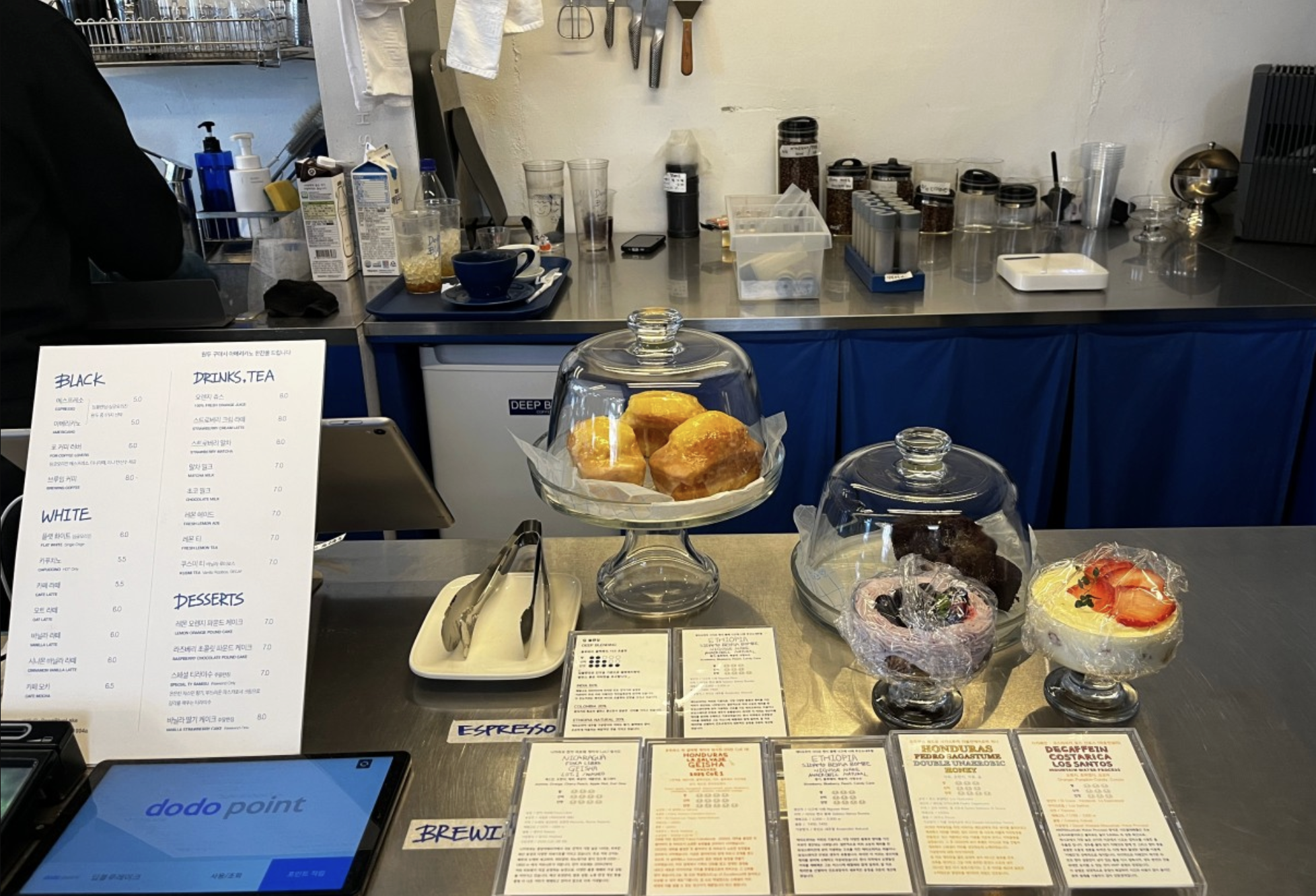
Their two signature blends are worth knowing: the Deep Blending (딥 블렌딩), which is the richer and more rounded of the two — good for latte drinkers — and the Blue Blending (블루 블렌딩), which is brighter and more expressive, best drunk black. I tend toward the Blue Blending as a first order, because it tells you clearly what they’re about. Order it without milk.
They also sell drip bags — fresh roasted every Saturday — which are worth picking up if you have a way to brew at home. The packaging has a small cat illustration and is the kind of thing that looks good on a kitchen shelf.
11 Poeun-ro 6-gil, Mapo-gu, Seoul (서울 마포구 포은로6길 11)
Daily 11:00am–9:30pm
Nearest station: Mangwon (망원역), Line 6 — 10 min walk from Exit 2
View on Naver Map →
Always August Roasters: Swedish Pour-Over near Mangwon Market
올웨이즈 어거스트 로스터스 [Always August Roasters] is the second café I always include in a Mangwon morning. It sits on a quiet street a short walk from Mangwon Market, sandwiched between residential buildings in a way that means you will probably walk past it at least once before you find it. When you do find it, the warm wooden interior and the smell of fresh ground coffee make the search feel worth it.
Always August roasts their own single-origin beans in-house and also partners with respected Korean green bean buyers for their blends. The specialty here is pour-over (핸드드립), prepared with care and served with a printed card that includes the bean’s tasting notes, origin, and the brewing guide — water temperature, ratio, method. It’s the kind of detail that makes you feel like you’re learning something while you drink, without it being preachy about it.
Their filter coffee draws inspiration from Swedish roasting traditions, which means you’re in bright, clean, lightly acidic territory — similar in philosophy to Deep Blue Lake but with a different expression. Order whatever single-origin they are featuring that week; the staff will tell you which is the most interesting at the moment.
For something different from black coffee, the milk drinks are genuinely good — the latte art is careful and the proportions are properly balanced, not the wall of steamed milk you sometimes get at cafés where the espresso is an afterthought. They also serve wine in the evenings, which turns a neighbourhood coffee stop into the kind of place where you might realise it has gone dark outside and you’re still sitting there.
Weekday mornings are the best time to visit: quiet enough to get a seat, busy enough to feel alive. On weekends, arrive by noon or expect to wait.
19 Mangwon-ro 6-gil, Mapo-gu, Seoul (서울 마포구 망원로6길 19)
Mon–Sat 12:00pm–10:00pm (last order 9:30pm) · Sun 12:00pm–9:00pm (last order 8:30pm)
Nearest station: Mangwon (망원역), Line 6 — 5 min walk from Exit 1
View on Naver Map →
How to Make a Morning of It: Market First, Then Coffee
The best version of a Mangwon visit goes like this: arrive before noon, walk through 망원시장 [Mangwon Market] first. The market is one of Seoul’s more functional traditional markets — still primarily used by residents rather than tourists — and the morning is when it is most alive. Pick up some kimbap, some twigim [fried snacks], whatever looks good at the banchan stalls. Eat standing up. That is the correct way to do it.
Then walk to Always August or Deep Blue Lake for coffee. Sit long enough to justify the seat. If the weather is good, get a takeaway cup from whichever café you’re at and walk the ten minutes to Mangwon Hangang Park. Find a patch of grass near the river, sit down, and drink your coffee watching the cyclists and the Han River go past.
This is how people who live in Mangwon spend a slow morning, and it is considerably better than most things on a Seoul itinerary.
Practical Notes for Visiting Mangwon-dong Cafés
Getting there: Mangwon Station (망원역) on Line 6 is the obvious entry point. Exit 1 puts you close to the market and Always August; Exit 2 is the better start for Deep Blue Lake. Both cafés are an easy walk from either exit.
When to go: Weekday mornings and early afternoons are significantly more relaxed than weekends. Saturday and Sunday afternoons bring more foot traffic — still manageable, but seating at both cafés can get competitive by 2pm.
Prices: Comparable to Seoul specialty café standards. Expect ₩6,000–8,000 for a pour-over or Americano, ₩7,000–9,000 for a latte. Drip bags at Deep Blue Lake start around ₩3,000–4,000 per bag.
Language: Both cafés have menus with English and can handle basic English orders. Pointing and numbers work fine everywhere.
No tipping — standard across Korean cafés. Order at the counter, take a number, wait for your name or number to be called.
For more on Seoul’s café scene — including Seongsu-dong specialty roasters and Hongdae’s indie coffee spots — see our Seoul café culture guide 2026. For everything else in the neighbourhood and nearby, the Seongsu-dong guide and Gangnam guide cover the wider Seoul context.
Frequently Asked Questions: Mangwon-dong Cafés
Is Mangwon-dong worth visiting for coffee?
Yes — and more so now than a year ago. The café scene in Mangwon-dong has developed significantly since 2020, with a cluster of independent specialty roasters settling in the neighbourhood. What makes Mangwon different from better-known café districts like Seongsu or Yeonnam is the local, residential feel: these cafés serve the people who actually live here, which tends to produce higher standards and lower prices than purely tourist-facing spots.
How do I get to Mangwon-dong?
Take Seoul Metro Line 6 to Mangwon Station (망원역). Exit 1 is most convenient for the market and the streets where Always August Roasters is located. Exit 2 is closer to the side streets where Deep Blue Lake sits — about a 10-minute walk. The neighbourhood is compact and easy to navigate on foot.
What is Deep Blue Lake (딥블루레이크) known for?
Deep Blue Lake is known for its Nordic-style light roast coffee — bright, fruity, and low bitterness — and its distinctive cobalt-blue building in Mangwon-dong. Established in 2016, it is one of the neighbourhood’s longest-running specialty roasters, and the two signature blends (Deep Blending and Blue Blending) are the best way to understand their style. Their Saturday fresh-roasted drip bags are also popular with regulars.
What is Always August Roasters known for?
Always August Roasters is known for Swedish-inspired specialty pour-over coffee, roasted in-house and served with detailed tasting cards covering bean origin, brewing temperature, and ratio. They partner with Korean green buyers for their blends alongside single-origin offerings. The café also serves wine in the evenings, making it one of the more versatile spots in the neighbourhood for a longer sit.
What is Mangwon Market and should I visit?
Mangwon Market (망원시장) is one of Seoul’s more genuine traditional markets — not a tourist market, but a working neighbourhood market used by local residents for daily grocery shopping. It’s excellent for Korean street food, fresh produce, banchan side dishes, and kimbap. Pairing a market walk with coffee from one of the nearby specialty cafés makes for one of the more authentic half-days you can spend in Seoul.