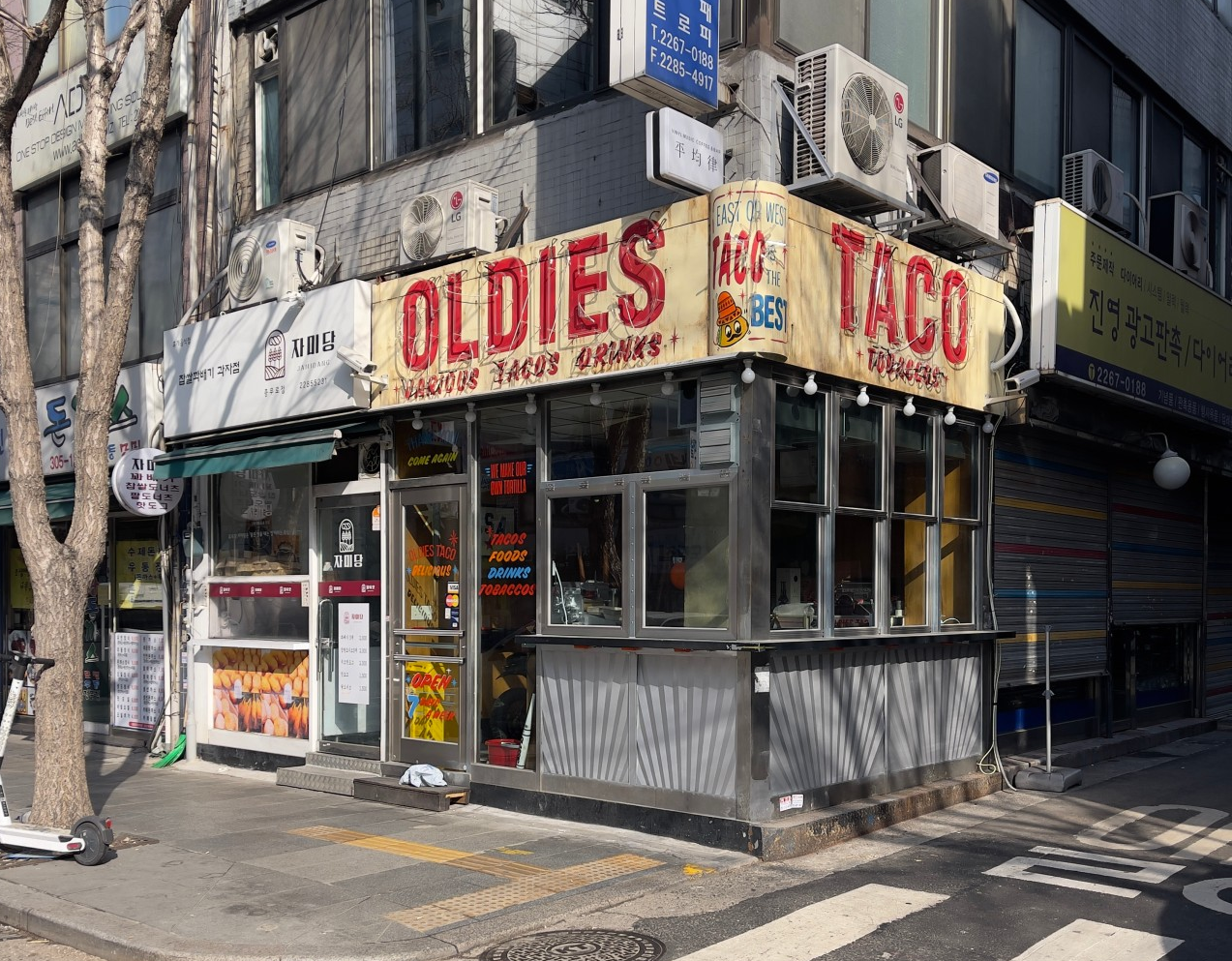
On this stretch of Euljiro, the line tends to appear before the restaurant does. Round a corner past a decades-old lighting-fixture shop and there’s a cluster of people standing along the wall of a building that still has its original hardware-store signage, holding phones, checking a waitlist app, not moving. That’s Oldies Taco (올디스타코).
The numbers read like the usual rounded-up food-media exaggeration — a shop the size of a small studio apartment reportedly selling somewhere between 600 and 800 tacos a day — but the pass-through window churns out orders one after another without a single dead second, and the figure becomes easy to believe.
A Taco Stand in the Middle of Euljiro’s Hardware District
Euljiro isn’t where you’d expect to find Seoul’s most talked-about taco line. For decades this was the city’s printing and machine-tool district — narrow lanes lined with signage shops, screw-and-bolt wholesalers, and industrial suppliers that still open before dawn. Over the past few years that same unglamorous texture has become the point: young Seoulites nicknamed it 힙지로 (Hipjiro), a portmanteau of “hip” and Euljiro, and started colonizing the ground floors of these old buildings with wine bars, listening rooms, and stand-up eateries that lean into the neighborhood’s rough edges rather than hiding them.
Oldies Taco is the restaurant most often cited as the one that made that shift permanent. It occupies about 4.5 pyeong — roughly 15 square meters — with an open kitchen taking up most of that footprint and a few standing-height tables out front where you eat off paper plates, no chairs, no ceremony. It didn’t open with a marketing plan. It opened as one guy’s attempt to figure out what to do with a small space and a taco recipe, and grew into a small chain almost by accident.
The founder, Kim Hang-geun (김항근), studied stage and set design, not food. By his own account in interviews, he wasn’t especially interested in business or money going in — a business partner lent him roughly 30 million won to get the shop open. What he did bring from his design background was the decision to build the kitchen in full view of the street: an open service window where you can watch every taco get assembled, meant to make an unfamiliar food format feel immediate and legible to people walking past who’d never really eaten a taco that wasn’t from a fast-casual chain. He’s described the sudden attention since as disorienting — comparing it, in one interview, to waking up as the guy in The Truman Show.
What the Wait Is Like
There’s no sit-down reservation system. Customers register on a tablet or a waitlist app posted outside, then join the line that forms along the sidewalk — which, on a Saturday around 1 p.m., can run roughly 45 minutes. Regulars say a weekday visit around 2 p.m. can shrink that to three or four parties ahead, and a late-evening drop-in sometimes means no wait at all. There’s no shade, no place to sit while waiting, and no table at the end — the food comes in foil, to be eaten standing at one of the shop’s few outdoor counters or taken to go.
What keeps the line moving despite the crowd is the same thing that makes the shop’s daily numbers plausible: turnover is fast because most orders are for takeaway, and the tacos themselves are built for speed — no plating, no cutlery, no ticket time beyond assembly. The same three or four movements repeat at the window all day: tortilla down, filling, onion and cilantro, sauce, fold, next.
What’s on the Menu
The two tacos most of the line orders are the signature Oldies Taco and the birria, with a burrito rounding out the menu for anyone after a heavier format.
The Signature Oldies Taco
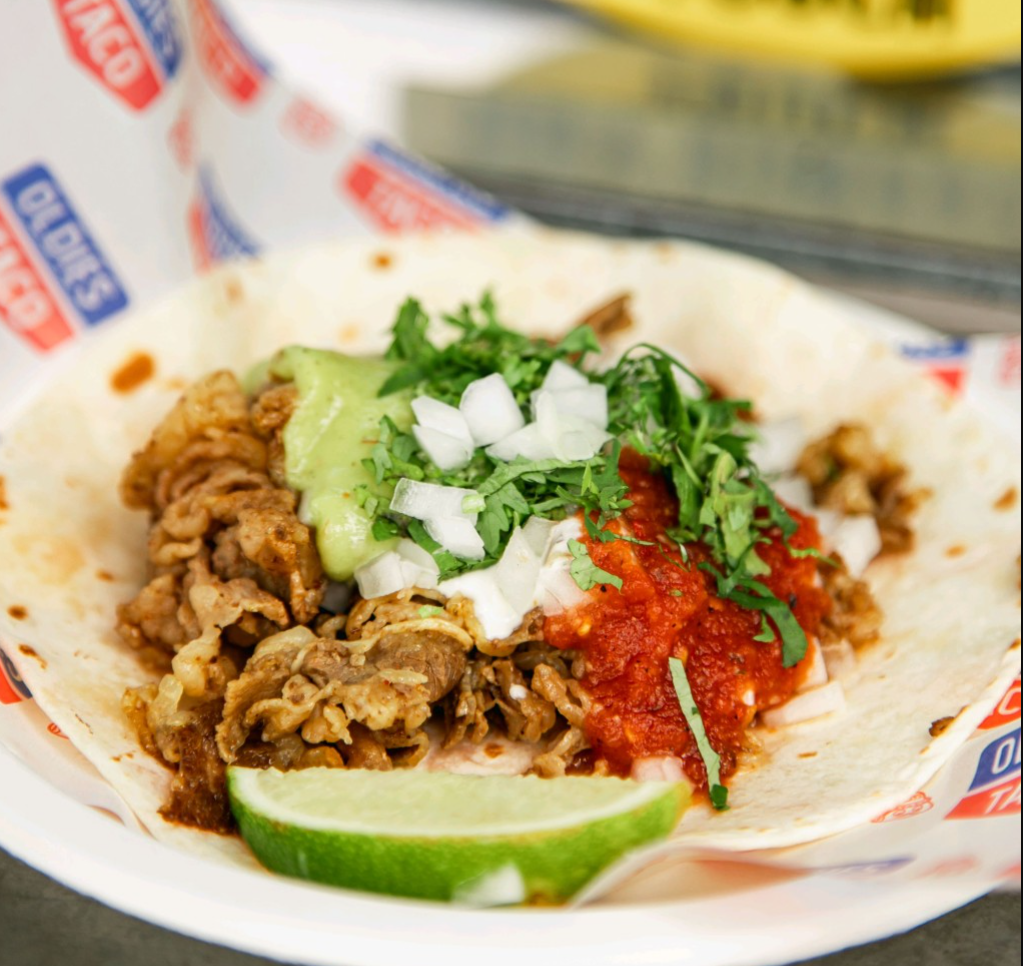
The namesake taco is built on thinly sliced beef brisket (양지) — served clean and light rather than heavily sauced — piled into a warm tortilla with diced onion, cilantro, and the house sauce. It’s a small taco, eaten in three or four bites, and it looks nothing like the ground-beef tacos most first-timers expect. The beef has real bite to it, seasoned in a way that reads more Korean-barbecue than taco-truck — a little sweet, a little smoky, built around the beef’s own flavor rather than disappearing under chili. The onion and cilantro cut through the richness and keep each bite tasting fresh rather than heavy.
The Birria Taco
This is the one most of the line is there for. The filling is hanwoo satae, chadol, and yangji — shank, short-plate, and brisket cuts — braised for over five hours until it shreds on contact, folded into a tortilla with melted cheddar and a consommé for dipping on the side. Cheddar isn’t the traditional birria cheese, but it works here: mild enough to let the long-braised beef stay the star, and sturdy enough to hold the taco together for the walk to the counter. Dipping the folded taco into the warm broth, the way it’s meant to be eaten, is what keeps people coming back.
Carnitas Burrito
The Carnitas Burrito is the heavier option — pulled pork, rice, beans, and cheese, rolled tight enough to survive being eaten standing up. It’s the pick for anyone who wants more food than two tacos without doing a second lap of the line, though the tacos are clearly where the kitchen’s attention goes.
Menu items land somewhere between ₩5,900 and roughly ₩13,000 apiece depending on the item, which — set against a 45-minute wait — is a bet the shop is clearly winning on volume rather than margin. At somewhere near 700 tacos a day moving through a counter that size, over a roughly 10-hour service window, the kitchen is putting out more than one item a minute for most of the day.
Why It Keeps Selling Out
Part of the appeal is simply that these Korean-style beef tacos are a genuinely novel combination in Seoul — the hanwoo birria in particular takes beef cuts most diners associate with barbecue or soup and reworks them into a format that reads as casual street food rather than a fusion stunt. Part of it is the setting: eating standing up in a former hardware district, phone out, taking the same photo everyone else in line is taking, is exactly the kind of low-stakes, high-turnover social moment that spreads fast on short-form video.
And part of it is straightforward success compounding on itself. What started as a single tiny counter has expanded to additional locations around the same pocket of Euljiro within roughly a year of opening — including a second location with proper stools and a slightly different menu that includes quesadillas. The brand has since stretched into an Oldies Hot Dog offshoot and even a June 2026 collaboration with national bakery-café chain Tous Les Jours (뚜레쥬르), putting Oldies Taco–flavored items on bakery shelves nationwide — the kind of mainstream crossover that only happens once a shop has become shorthand for a whole neighborhood’s food identity, not just a good meal.
Practical Information
| Detail | Info |
|---|---|
| Name | Oldies Taco (올디스타코) |
| Main branch address | Euljiro 3-ga, Jung-gu, Seoul — Hanshin Building, 충무로4길 3, 1F, a short walk from Euljiro 3-ga Station Exit 8 · View on Naver Map |
| 2nd branch address | 5 Chungmuro 4-gil, 1F, Jung-gu, Seoul (서울 중구 충무로4길 5 1층) · View on Naver Map |
| Hours (main branch) | Approx. 11:30–21:00; appears to close Mondays (see note) |
| Hours (2nd branch) | Daily 11:30–21:00 |
| Seating | Main branch: standing counters only, no indoor seating. 2nd branch has proper seating. |
| Cuisine | Korean-style tacos (incl. hanwoo birria), burritos, quesadillas |
| Price range | Roughly ₩5,900–₩13,000 per item |
| Reservations | No advance booking — join the in-person or app-based waitlist on arrival |
| Nearest subway | Euljiro 3-ga Station (Lines 2 and 3), Exit 8 |
Hours, closing days, and addresses vary by branch and are drawn from third-party listings (DiningCode); the original counter appears to close Mondays. Confirm the specific branch’s current hours on Naver Map before you go.
Tips Before You Go
- Go on a weekday afternoon if you can. Weekend lunch and early-evening slots are the busiest; a 2 p.m. weekday visit reportedly cuts the wait to a handful of parties.
- Know your order before you reach the window. With branches carrying slightly different menus, decide which one you’re headed to and what you want in advance — it keeps the line moving and gets you fed faster.
- Bring cash or a card you don’t mind tapping quickly. This isn’t a place to linger over a menu; orders move fast and so does the line behind you.
- Try the 2nd branch if standing isn’t for you. The original counter has no seating at all; the second location a few minutes away has proper tables if you’d rather not eat on your feet.
- Pair it with a Hipjiro wander. The surrounding blocks of old signage shops, wine bars, and printing studios are worth the walk either side of your wait.
Frequently Asked Questions
What is Oldies Taco? Oldies Taco (올디스타코) is a small taco stand in Seoul’s Euljiro district known for its Korean-style tacos — including a hanwoo birria — a tiny 4.5-pyeong original counter, and a line that regularly forms before and through opening hours.
Do I need a reservation? No. Oldies Taco runs on a same-day, in-person or app-based waitlist rather than advance bookings. Arrive, register, and wait your turn.
What should I order? The Birria Taco — hanwoo shank and brisket braised over five hours, served with a dipping broth — is the one most of the line is there for. The signature Oldies Taco (thinly sliced beef brisket, onion, cilantro) is the other big draw; the Carnitas Burrito is a heavier option if two tacos aren’t enough.
How long is the wait? It varies by time and day — expect something in the 30-to-45-minute range on a weekend afternoon, and shorter waits on weekday afternoons or later evenings.
Is there seating? The original counter is standing-room only with a few outdoor tables. The second branch, a short walk away, has proper seating.
Why is it called Oldies Taco? The name plays on the shop’s setting inside one of Euljiro’s older buildings, in a district whose worn, decades-old character is exactly what’s made it fashionable again among young Seoulites.
If Mexican flavors in Seoul are your thing beyond the taco line, Escondido in Hannam-dong is the fine-dining end of that same trend — Asia’s first Michelin-starred Mexican kitchen. For more of Korea’s current wait-worthy openings, Tonshou’s Busan tonkatsu counters and Lee Jae-mo Pizza cover two of the country’s other hardest lines to get into right now.