In July, Seoul steams. The humidity sits on you like a second skin, and the heat from the pavement bounces back into your face from every direction. Tourists find shade and cold drinks. Koreans, meanwhile, queue outside restaurants that serve soup.
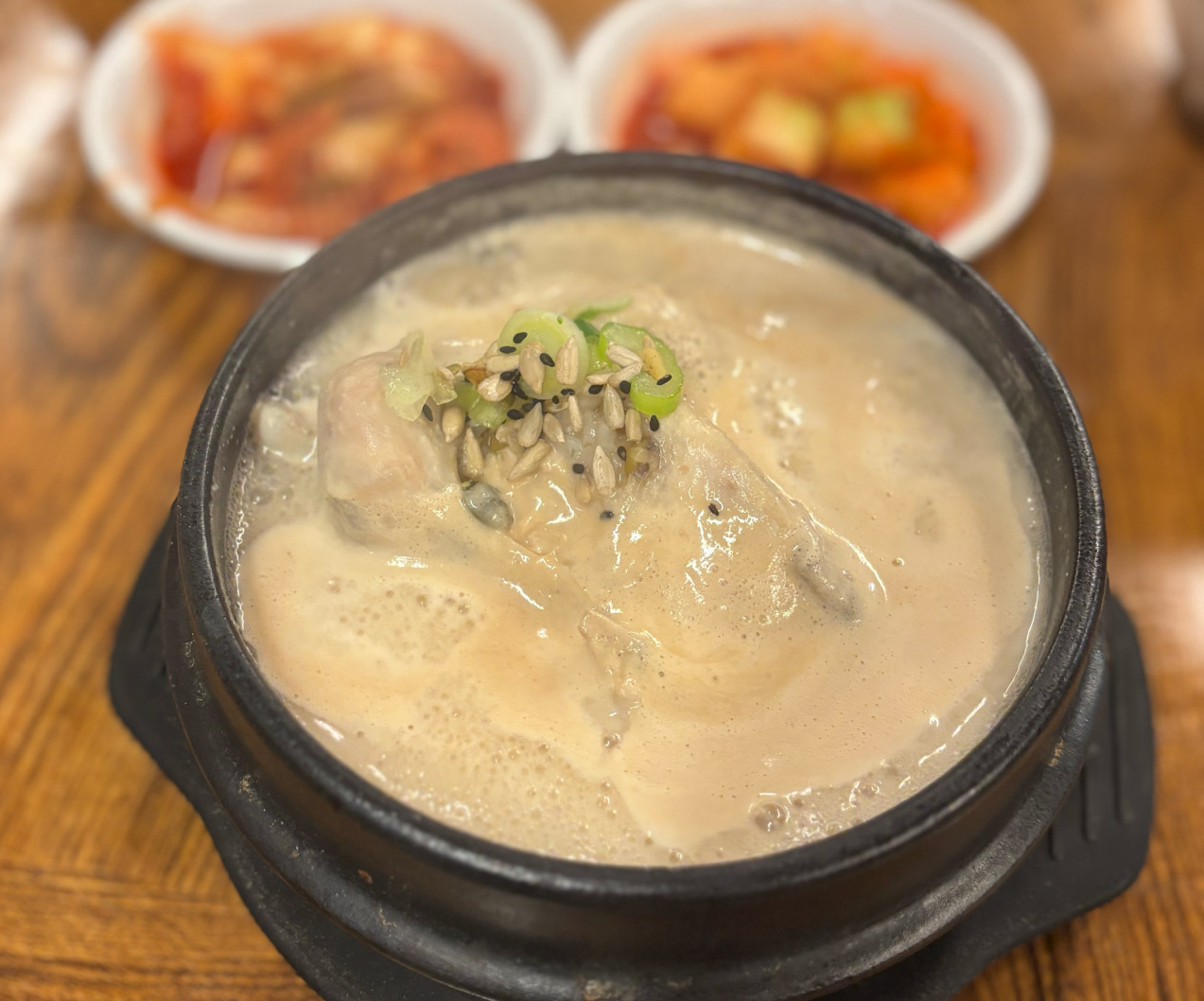
Not iced soup. Not chilled broth. Hot soup — 삼계탕 [samgyetang], a whole young chicken simmered for hours with ginseng, garlic, jujube, and glutinous rice until the broth turns milky and the meat is so tender it falls from the bone at the lightest pressure. It arrives at the table still bubbling in its clay pot, steam rising in the thick summer air, and you eat it with a thin layer of sweat already on your brow, and you feel, somehow, better.
This is not masochism. It is one of the oldest principles in Korean traditional medicine — and it makes more sense than it first appears.
| Quick Reference | Details |
|---|---|
| Dish | Samgyetang (삼계탕) — Korean ginseng chicken soup |
| Best restaurant in Seoul | Tosokchon Samgyetang (토속촌삼계탕), Jongno-gu |
| Price | from ₩20,000 per person |
| Hours | 10:00 AM – 10:00 PM daily (last order 9:00 PM) |
| Getting there | Line 3 Gyeongbokgung Station, Exit 2 |
| Naver Map | Tosokchon Samgyetang → |
| Best time to visit | Weekday mornings to avoid queues |
What Is Samgyetang?
삼계탕 [Samgyetang] breaks down simply: sam (삼) means ginseng, gye (계) means chicken, tang (탕) means soup or broth. The name is a description of the three core elements, and the dish rarely deviates far from them.
The preparation begins with a 영계 [yeonggye] — a young chicken, typically weighing 400–600g, small enough to be served whole in a single earthenware pot. The cavity is stuffed with 찹쌀 [chapssal, glutinous rice], a piece of fresh or dried 인삼 [insam, ginseng], several cloves of garlic, 대추 [daechuoo, dried jujube], and depending on the restaurant, additional ingredients such as 은행 [ginko nuts], 밤 [chestnuts], or pine seeds. The whole bird then goes into a pot with water and simmers, often for two hours or more, until the broth develops body and the chicken is completely yielding.
The result is a pale, slightly creamy soup — not rich in the way of French chicken stock, but deeply savoury and subtly herbal, with a faint bitterness from the ginseng root and a sweetness from the jujube. Salt is not added during cooking; a small dish of coarse salt and ground pepper arrives alongside, and you season as you go. This restraint is deliberate. The broth is meant to taste like the ingredients, nothing more.
Samgyetang has been served at Korean restaurants since at least the 1940s, though its roots go further back to Joseon-era preparations like 영계백숙 [yeonggye-baeksuk], a simpler boiled young chicken that predates the addition of ginseng as a defining element. The dish as it exists today — whole chicken, ginseng, glutinous rice, sold by name at dedicated restaurants — became widely popular after the 1960s, when refrigeration made fresh ginseng accessible to ordinary Koreans year-round.
Boknal: Why Koreans Eat Hot Soup on the Hottest Days of Summer
The tradition of eating samgyetang in summer is inseparable from 삼복 [sambok], the collective name for three specific days on the lunar calendar that fall within the hottest stretch of the Korean summer: 초복 [chobok, the first day of heat], 중복 [jungbok, the middle day], and 말복 [malbok, the final day]. Together, these are known as 복날 [boknal, “bok days”], and they typically fall between mid-July and mid-August.
The concept originates in Chinese geomancy and traditional medicine, but it has been thoroughly absorbed into Korean culture. For most Koreans, 복날 is not an academic or ritual occasion — it is simply the day you eat samgyetang. It is the kind of annual tradition that requires no explanation within the culture and almost always requires one outside of it.
The philosophical logic is 이열치열 [i-yeol-chi-yeol]: “fight heat with heat.” The premise is rooted in Korean traditional medicine, which holds that when the body is depleted by external heat — weakened by sweating, fatigued by the relentless summer — it needs to be replenished from within. Cold food, in this framework, shocks a system already in a state of imbalance. Hot, nutritious food, by contrast, restores 기운 [gi-un, life force or energy], warms the digestive organs, and allows the body to regulate itself properly.
Ginseng in particular is considered one of the most potent 보양식 [boyangshik, health-restorative foods] in Korean traditional medicine — believed to support immune function, improve circulation, and combat fatigue. Combined with the protein of a whole young chicken, the complex carbohydrates of glutinous rice, and the antioxidant properties of jujube, samgyetang is understood not simply as food but as medicine. A meal, yes — and also a remedy.
Even for Koreans who do not subscribe to traditional medicine in any structured way, 복날 and samgyetang remain a ritual. My grandmother made it on 초복 every year without fail, whether we were in the mood for it or not. Many still do. In Seoul in July, the queues outside samgyetang restaurants stretch down the street from early morning. You wait because everyone waits. You eat because it is 복날, and on 복날, you eat samgyetang.
Where to Eat Samgyetang in Seoul: Tosokchon (토속촌)
There is no shortage of samgyetang restaurants in Seoul, and most of them are decent — the dish is not complicated to prepare, and the core ingredients are widely sourced. But there is a meaningful gap between a competent bowl and an extraordinary one. The gap lives in ingredient quality, in the depth of the broth, and in the kind of accumulated attention that only comes from a restaurant that has been doing one thing for a very long time.
Tosokchon Samgyetang (토속촌삼계탕) has been that restaurant for Seoul since the 1990s. It sits a short walk from 경복궁 [Gyeongbokgung Palace] in Jongno-gu, housed in a cluster of traditional 한옥 [hanok] buildings — low tile roofs, dark lacquered wood, paper screen doors — that make the approach feel like a step out of the surrounding city. Inside, the space fans out across multiple rooms and floors, with over 400 seats, private rooms, table seating, and low floor seating in the traditional style. Despite its size, the restaurant consistently runs a waitlist on peak summer days. There is a reason for this.
The samgyetang at Tosokchon is notably richer than the standard — the chicken is stuffed not only with ginseng and glutinous rice but also with 호박씨 [pumpkin seeds], 검은깨 [black sesame], 잣 [pine nuts], 호두 [walnut], 밤 [chestnut], 은행 [ginkgo], 마늘 [garlic], 대추 [jujube], and 해바라기씨 [sunflower seeds]. This is not a recipe that was designed to be quick or cheap. The result — a broth of greater depth and body, a filling that brings textural complexity to each spoonful — reflects the ingredient list. When the pot arrives at your table, still at a rolling simmer, the aroma tells you before the first sip that something more thorough has happened in the kitchen.
Each serving comes with a small dish of 인삼주 [insamju, ginseng liquor] — a house tradition intended to complement the restorative function of the soup itself. Accept it.
What to Order
Tosokchon Samgyetang (토속촌삼계탕) — The signature dish. Standard ginseng chicken soup with the full ingredient lineup. Starts at ₩20,000.
Tosokchon Ogolgye Samgyetang (토속촌오골계삼계탕) — Made with 오골계 [ogolgye], the Korean silkie chicken — a black-meat, dark-skinned breed historically associated with royal court cuisine. The flavour is slightly more intense and mineral than the standard white chicken; the experience is richer overall. Order this if you want the full version.
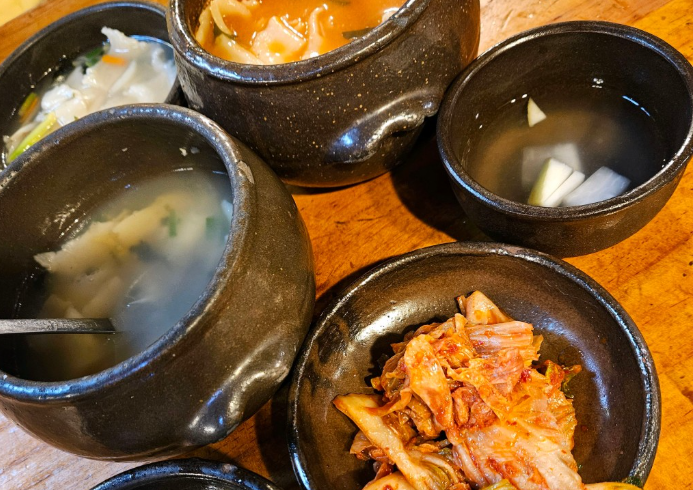
A selection of 반찬 [banchan, side dishes] arrives automatically with both options — typically kimchi, seasoned vegetables, and pickled radish — which serve as a contrast to the clean, delicate broth.
How to Eat Samgyetang
When the pot arrives, do not rush. The soup needs a minute to settle off its peak boil. Stir gently to distribute the filling. Season with a pinch of the coarse salt and a little ground pepper — taste first before adding, as the broth may already read as savoury enough to your palate.
Use the scissors provided to cut the chicken into pieces inside the pot. The meat should be yielding enough that this requires almost no effort. Eat the rice first — it will have absorbed a great deal of flavour from the broth — then alternate between pieces of chicken, sips of soup, and the banchan. Finish the broth. This is important. The broth is the point.
From ₩20,000 · Open daily 10:00 AM – 10:00 PM (last order 9:00 PM)
5 Jahamun-ro 5-gil, Jongno-gu, Seoul
서울특별시 종로구 자하문로5길 5
Line 3 → Gyeongbokgung Station, Exit 2 (approx. 15 min walk) · Tel: +82-2-737-7444
Naver Map →
Practical Tips for Visiting
Go on a weekday morning. The queue at Tosokchon on 복날 can stretch to an hour or more. On regular summer weekdays, arriving between 10:00 and 11:30 AM usually means a short wait. Weekends and the three boknal days are a different story.
Pair your visit with Gyeongbokgung. The palace is a 15-minute walk from the restaurant; the morning light on the throne hall is worth arriving for before the crowds. Combine the two for a natural half-day itinerary.
No reservations required for regular dining. Tosokchon operates on a walk-in basis. For large groups or private rooms, call ahead: +82-2-737-7444.
Solo dining is fine. Each portion is a full, complete meal for one person. Eating alone at Tosokchon is common and entirely comfortable.
For other classic Seoul experiences in the same neighbourhood, see our Seoul restaurant guide 2026 and our Korea traditional markets guide — Tongin Market, just a short walk away, is one of the city’s most enjoyable.
Frequently Asked Questions: Samgyetang
What does samgyetang taste like?
Samgyetang has a clean, mildly savoury broth — lighter in body than a Western chicken stock, subtly herbal from the ginseng, with a faint underlying sweetness from the jujube. The flavour is restrained by design; the soup is seasoned individually at the table with coarse salt and ground pepper. The chicken itself is extremely tender after the long simmer, and the glutinous rice inside the cavity absorbs the broth and becomes soft and slightly sticky. The overall experience is nourishing rather than intense.
When do Koreans eat samgyetang?
Samgyetang is eaten year-round but reaches its peak cultural significance during boknal (복날) — the three hottest days of the Korean lunar summer calendar, typically falling between mid-July and mid-August. These are chobok (초복), jungbok (중복), and malbok (말복). On these days, eating samgyetang is a near-universal Korean tradition, and restaurants dedicated to the dish report their highest footfall of the year. The logic is i-yeol-chi-yeol (이열치열) — fighting heat with heat — rooted in traditional Korean medicine.
Is samgyetang spicy?
No. Samgyetang is one of the mildest Korean soups — there is no gochujang (red pepper paste), no chilli, and no spice of any kind in a traditional preparation. The flavour profile is clean, herbal, and quietly savoury. This makes it one of the most accessible Korean dishes for visitors who are less accustomed to heat, and a welcome contrast after a few days of kimchi and tteokbokki.
What is the difference between samgyetang and baeksuk?
Baeksuk (백숙) is the broader category: a whole chicken boiled in water until tender, served with the cooking broth. Samgyetang (삼계탕) is a specific type of baeksuk that stuffs the chicken with ginseng, glutinous rice, jujube, and garlic before cooking. The additions give samgyetang a more complex flavour and a richer nutritional profile. Baeksuk tends to be simpler, lighter, and less expensive; samgyetang is the more celebrated and formally defined version.
How much does samgyetang cost in Seoul?
A standard samgyetang at a dedicated restaurant in Seoul typically costs between ₩15,000 and ₩25,000 per person in 2026. At Tosokchon, prices start from ₩20,000 for the classic version, with the ogolgye (silkie chicken) version slightly higher. This is a complete meal — the soup includes an entire chicken, a rice-stuffed filling, and a selection of banchan side dishes.
Can I eat samgyetang if I don’t eat spicy food?
Yes — samgyetang contains no spice whatsoever. It is mild, herbal, and gentle on the palate. The only heat is the temperature of the soup itself, which arrives at a rolling boil in its clay pot. It is one of the safest Korean dishes to order for visitors with a low tolerance for chilli.
Is Tosokchon the best samgyetang in Seoul?
Tosokchon is the most celebrated and consistently recommended samgyetang restaurant in Seoul among both locals and visitors, and has been for decades. Its exceptional depth of flavour comes from using an unusually extensive mix of stuffing ingredients — ginseng, glutinous rice, garlic, jujube, pumpkin seeds, black sesame, pine nuts, walnut, chestnut, ginkgo, and sunflower seeds — that most restaurants do not match. For those who want a Michelin Guide-listed alternative in a more central location, Gobong Samgyetang (고봉삼계탕) in Myeongdong (open 10:00 AM – 10:00 PM daily, from ₩20,000) is an excellent option. Both are worth visiting; Tosokchon remains the benchmark.