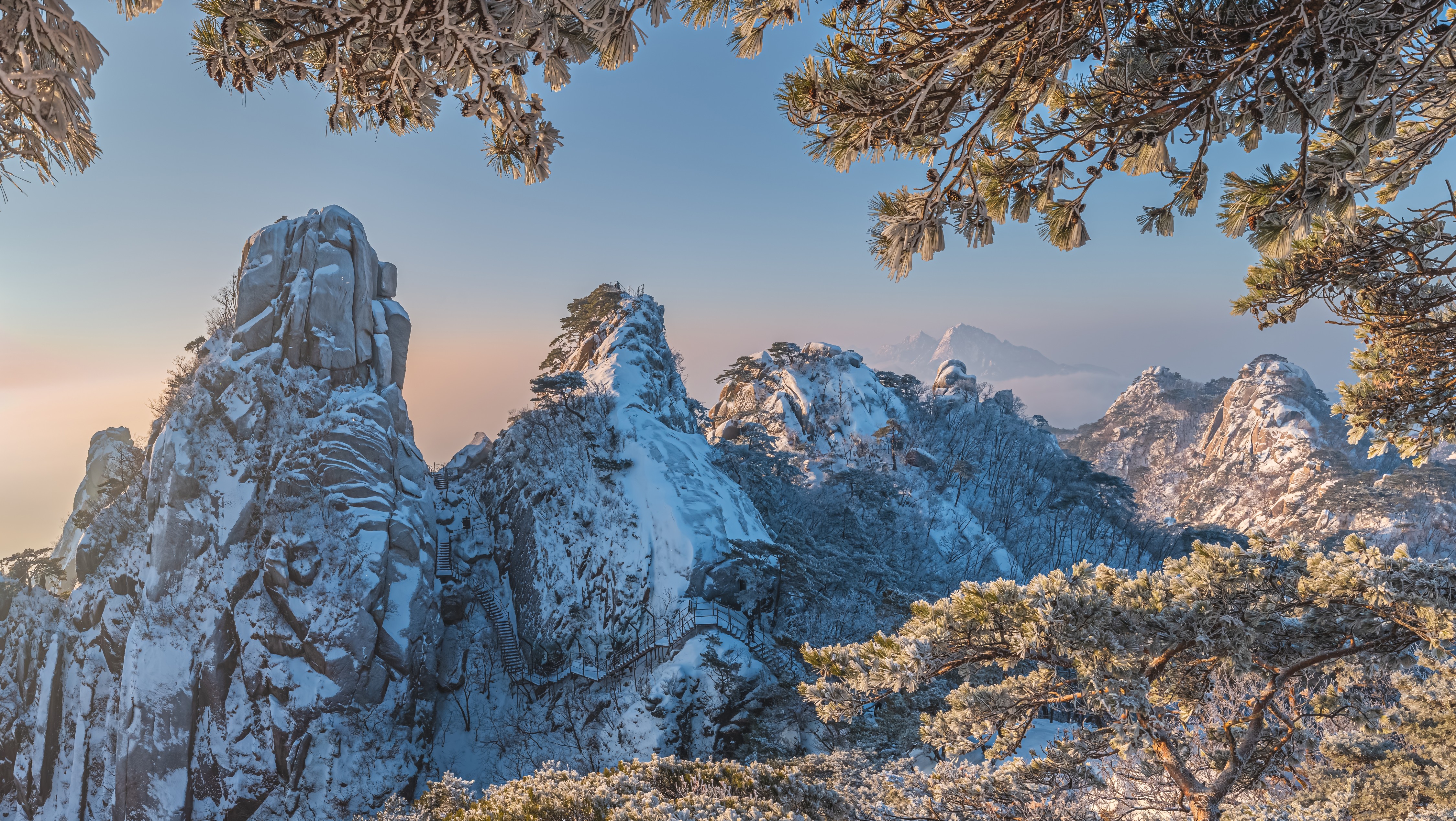
There’s a mountain inside Seoul. Not near Seoul — inside it. Bukhansan National Park sits right at the northern edge of the city, its granite peaks rising sharp against a skyline of apartment towers and neon signs. For visitors, it’s one of the most surprising things about the Korean capital: that you can eat bibimbap in Insadong, hop on the subway, and within an hour find yourself clutching a steel cable on a granite ridgeline with the entire city spread below you.
Seoul ranked #9 in Time Out’s World’s 50 Best Cities in 2026 — and Bukhansan is one of the reasons why.
Quick Reference: Bukhansan National Park
| Detail | Info |
|---|---|
| Location | Northern Seoul, accessible by subway |
| Entrance fee | Free |
| Best seasons | April–May (spring), October–November (autumn) |
| Difficulty range | Easy (Dullegil) to Moderate-Hard (Baegundae summit) |
| Highest peak | Baegundae, 836.5 m |
| Annual visitors | ~5 million |
| What to bring | Grip shoes, 1L+ water, cash for snacks |
Why Koreans Hike Bukhansan
Hiking isn’t just a hobby in Korea — it’s a national ritual. On weekends, Koreans of all ages pull on brightly coloured hiking gear (Koreans take their trail fashion seriously), pack kimbap and thermoses, and head for the hills. Bukhansan, being both subway-accessible and genuinely beautiful, draws an estimated 5 million visitors a year, making it one of the most visited national parks per square kilometre in the world.
For travellers, it offers something most city trips don’t: physical effort, real altitude, mountain air, and a view that puts everything — the Han River, the N Seoul Tower, the sprawl of 25 million people — into perspective.
Choosing Your Bukhansan Trail
Bukhansan has trails for every level. Here are the four worth knowing.
For Beginners: Bibong Course via Geumseongsa Temple (비봉 코스)
Distance: ~6 km round trip | Time: 3–4 hours | Difficulty: Easy-Moderate
If you’ve never hiked in Korea before, start here. The Bibong Course takes you up to Bibong Peak (비봉, 560 m) via the forested approach from Geumseongsa Temple (금선사), a working Buddhist temple tucked into the hillside. The path is well-maintained, the gradient is gentle compared to the summit routes, and the views from the top — across the Eunpyeong district and north Seoul — are genuinely rewarding without requiring mountaineering legs to reach them.
At the summit, look for a small stone stele that has stood for nearly a thousand years. Legend says it was inscribed by a Silla-dynasty monk, though historians still debate its true origins. Either way, it makes for a good photograph.
The Geumseongsa approach also puts you in the company of neighbourhood regulars rather than weekend crowds. Mornings on weekdays are especially peaceful.
Getting there: Take Subway Line 3 (orange) to Gupabal Station, then Bus 8775 to Geumseongsa. Alternatively, take the Bukhansan Ui Light Rail to Bukhansan-ui Station and connect by foot or taxi to the Geumseongsa trailhead.
For Casual Walkers: Bukhansan Dullegil (북한산 둘레길)
Distance: Sections range from 2–8 km | Time: 1–3 hours per section | Difficulty: Easy
The Dullegil (둘레길 means “circumference trail”) is a flat path that circles the base of the mountain through forest, small streams, and traditional villages — with no summit attempt required. It’s divided into 21 sections and is ideal for those who want a long, meditative walk in the woods rather than a hard climb.
Several sections pass through Eunpyeong Hanok Village, where you can stop for traditional tea or a bowl of sikhye (sweet rice punch) before or after your walk. This is the trail to choose if you’re travelling with children, older companions, or simply don’t want to spend your Seoul afternoon with burning thighs.
Getting there: Multiple entry points across the mountain. The Eunpyeong section is accessible from Subway Line 3 → Gupabal Station.
For the Full Experience: Baegundae Summit Course (백운대 코스)
Distance: ~7.7 km round trip | Time: 4–6 hours | Difficulty: Moderate-Hard
This is the one everyone means when they say they’ve “done Bukhansan.” Baegundae (백운대, 836.5 m) is the highest peak in the park and the signature Seoul hike — a granite dome that requires steel cables and iron handholds near the summit, but rewards you with an unobstructed 360-degree view of the capital that is, frankly, difficult to match anywhere in the world.
The most popular approach starts from Doseonsa Temple (도선사) in Ui-dong. From the temple — itself worth a few minutes of your time, with its giant stone Buddha carved into the cliffside — the trail climbs steadily through forest before opening onto bare granite. The cables begin about 45 minutes below the summit. Take your time on these; the rock can be slippery in damp conditions.
At the top, on a clear day, you’ll see the Han River glinting to the south, the Dobongsan ridge to the northeast, and a continuous carpet of apartment blocks stretching to every horizon. It’s a genuinely moving view — the city that built itself in fifty years, seen from a mountain that was here long before any of it.
Getting there: Take the Bukhansan Ui Light Rail to Solsam Station, then follow signs to the Doseonsa trailhead (about 20 minutes on foot). Alternatively, take Subway Line 4 to Suyu Station, then Bus 120 to the Ui-dong entrance.
For History Lovers: Bukhansanseong Fortress Trail (북한산성 코스)
Distance: ~8 km loop | Time: 3–5 hours | Difficulty: Moderate
For those who want history alongside their hiking, the Bukhansanseong Fortress trail traces the remains of a 17th-century mountain fortress that once defended the Joseon dynasty capital from invasion. Sections of the original stone wall still run along the ridgeline, with guardhouses and gates punctuating the route. You’re walking inside a fortification that stretches 9 km around the peaks — a remarkable thing to encounter this far up a mountain.
The trail starts from the Bukhansanseong Visitor Centre, accessible by Bus 704 from Gupabal Station (Line 3).
The Best Part: Mid-Trail Snacks
No Korean hiking experience is complete without stopping at a trail-side snack stall. This is not optional — it is the point.
Scattered along the main routes into Bukhansan (particularly near the Doseonsa and Bukhansanseong entrances), small outdoor stalls and mountain snack bars serve a shortlist of things that taste disproportionately good after two hours of walking uphill.
삶은 달걀 (Samun Dalgyal) — Boiled Eggs The quintessential Korean hiking snack. Sold pre-boiled and lightly salted, usually two or three to a bag for around 1,000–2,000 KRW each. Eat them standing up, ideally with a view. Don’t skip these.
산 라면 (San Ramyeon) — Mountain Ramyeon Instant noodles cooked fresh at a trail shelter, served bubbling hot in a metal pot. This is a dish that defies all logic — ramyeon is cheap and simple — yet somehow becomes the best bowl of noodles you’ve ever eaten when there’s cold mountain air on your face. Expect to pay 3,000–5,000 KRW. Look for small tarpaulin-covered rest areas near the Doseonsa approach and around the Bukhansanseong entrance.
막걸리 (Makgeolli) — Rice Wine At some stalls near the trailhead and mid-mountain rest areas, you’ll find plastic cups of milky, lightly fizzing makgeolli. Many Korean hikers consider this a mandatory part of the descent. At around 3,000–4,000 KRW for a generous serving, it’s a reasonable argument.
도토리묵 (Dotori Muk) — Acorn Jelly A savoury, lightly bitter grey jelly seasoned with soy sauce, sesame oil, and spring onions. A traditional mountain food found at sit-down trail restaurants near the main entrances. A full meal here — dotori muk, ramyeon, and makgeolli — costs under 15,000 KRW and takes on the quality of a feast.
Tip: Most trail stalls are cash only. Bring small bills.
Practical Information
| Entrance fee | Free |
| Park hours | Sunrise to sunset (gates close approx. 2 hours before sunset) |
| Best seasons | April–May (spring blooms), October–November (autumn foliage) |
| What to bring | Shoes with grip, water (min. 1 litre), cash for snacks |
| Navigation | Download the trail map at the entrance; Naver Maps and Kakao Maps both have trail data |
| Crowds | Go early on weekdays for quieter trails; weekend mornings fill fast |
Getting to Bukhansan from Central Seoul
| Route | Directions | Travel Time from City Centre |
|---|---|---|
| Baegundae / Doseonsa | Bukhansan Ui Light Rail → Solsam Station | ~50 min |
| Bibong / Geumseongsa | Line 3 → Gupabal Station → Bus 8775 | ~45 min |
| Bukhansanseong | Line 3 → Gupabal Station → Bus 704 | ~45 min |
| Dullegil (Eunpyeong) | Line 3 → Gupabal Station | ~40 min |
Bukhansan asks nothing of you except a pair of decent shoes and a willingness to look up. Seoul will be exactly where you left it when you come back down — only slightly smaller than you remembered.
Planning a full Seoul day? See our Seoul First-Timer’s Guide for what to pair with a Bukhansan hike. For more outdoor adventures in Korea, check out the Wonju Sogeumsan Suspension Bridge — another spectacular day trip from Seoul.
Frequently Asked Questions
How hard is hiking Bukhansan for beginners? Bukhansan has routes for all fitness levels. The Dullegil circumference trail is completely flat and suitable for anyone. The Bibong Course (Geumseongsa approach) is a gentle 3–4 hour hike. The Baegundae summit route is Moderate-Hard and involves steel cables near the top — not for those afraid of heights, but manageable for fit hikers with proper footwear.
Can I hike Bukhansan without a guide? Yes. All trails are well-marked and detailed trail maps are available at the park entrance. Download Naver Maps or Kakao Maps before you go — both include Bukhansan trail data. The Bukhansan Ui Light Rail also has English signage. No guide is needed.
What is the best time to visit Bukhansan in 2026? Spring (April–May) and autumn (October–November) are the best seasons. Spring brings cherry blossoms and fresh greenery; autumn turns the slopes amber and red. Both seasons offer clear skies and comfortable temperatures for hiking. Avoid summer weekends when the heat and humidity make the ascent to Baegundae exhausting.
Is Bukhansan National Park free? Entry to Bukhansan National Park is free. You pay nothing to hike any of the trails. The only costs are snacks and drinks along the trail, which are cash-only at most stalls.
How do I get to Bukhansan by subway? The easiest access is via the Bukhansan Ui Light Rail (연장선), which opened in 2017 and connects directly to trail entrances. For the Baegundae summit route, take the light rail to Solsam Station. For the Dullegil and Bibong courses, take Line 3 to Gupabal Station then a connecting bus.
Can I eat on the mountain? Absolutely — trail-side snack stalls are part of the Bukhansan experience. Look for stalls selling boiled eggs, mountain ramyeon (instant noodles cooked fresh), makgeolli rice wine, and acorn jelly near the Doseonsa and Bukhansanseong entrances. Most stalls are cash only, so bring small bills.