South Korea’s second-largest city is also its most visually dramatic. Busan sits at the southeastern tip of the peninsula, wedged between granite mountains and an open sea, its neighbourhoods stacked improbably up hillsides or pressed against beaches that the rest of the country travels south to reach. It has a character quite unlike Seoul — warmer in climate and temperament, prouder of its local food, and refreshingly unapologetic about being a port city.
In 2026, Busan is confidently past its brief pandemic slowdown and busier than ever. A new generation of cafés and restaurants has settled into Gwangalli and the Jeonpo district. The Haeundae Blueline Park continues to draw serious crowds. Michelin Guide Busan now runs alongside the Seoul edition. And the annual fireworks festival over Gwangan Bridge in October remains one of the single best free spectacles in Asia. If you have not been in a few years, the city rewards a fresh look.
Quick Reference: Busan
| Detail | Info |
|---|---|
| From Seoul | KTX ~2 hrs 20 min from Seoul Station (₩59,800); express bus ~4.5 hrs (₩23,800) |
| By air | Gimhae International Airport (PUS); direct international flights from Japan, China, Southeast Asia |
| Getting around | Metro (4 lines), city buses, taxis, City Tour Bus |
| Subway fare (2026) | Zone 1: ₩1,600 (card) / Zone 2: ₩1,800 (card); children aged 6–12 ride free |
| Best time to visit | Spring (May–Jun) and autumn (Sep–Nov) |
| Don’t miss | Haeundae Blueline Park, Jagalchi Market, Gwangalli at night, Gamcheon Culture Village, Haedong Yonggungsa |
| Signature dishes | Dwaeji gukbap, milmyeon, ssiathotteok, hoe (raw fish) |
Getting to Busan
KTX (Recommended)
The default choice for most visitors arriving from Seoul. Seoul Station to Busan Station takes approximately 2 hours 20 minutes on the KTX. Standard-class tickets cost around ₩59,800; first class (일반실+) is about ₩87,000. Book through the Korail website or the Korail Talk app — early-bird seats go on sale up to 30 days ahead and can be discounted up to 50% off the base fare. Youth (만 13–25), senior, and family discounts are available year-round.
Tip: If you are showing a same-day KTX ticket at Busan Station, you qualify for a 20% adult discount on the Busan City Tour Bus (Green Line to Haeundae).
Gimhae International Airport (PUS)
International travellers landing at PUS can take Airport Bus Line 1 directly to Haeundae (about 50 minutes, ₩6,200) or the Gimhae Light Rail to connect with Busan Metro Line 2. Taxis from the airport to Haeundae cost roughly ₩35,000–45,000.
Express Bus
From Seoul Express Bus Terminal (Banpo) or Dong Seoul Terminal, buses run frequently to Busan’s Nopo Terminal (4.5 hours, from ₩23,800). Slower than KTX but significantly cheaper and perfectly comfortable for an overnight departure.
Getting Around Busan
Metro
Busan Metro has 4 lines with English-language signage and announcements throughout. The most useful for visitors:
- Line 1 (Orange) — runs through the city spine, connects Nopo Terminal, Seomyeon (transfer hub), Nampo-dong, and down toward the university area
- Line 2 (Green) — the beach line; runs east from Seomyeon through Gwangalli, all the way to Haeundae, Jangsan, and then north past BEXCO
A T-money or Cashbee card (topped up at any convenience store or metro station) covers metro, bus, and taxi connections. Fares in 2026: ₩1,600 per zone 1 ride by card (cash ₩1,700), Zone 2 ₩1,800. Daily transit discounts cap at ₩600 — use the card consistently throughout the day and the savings add up.
From Haeundae to Seomyeon: Line 2, approximately 30–40 minutes. From Seomyeon to Nampo-dong (Jagalchi area): Line 1, about 10–15 minutes.
City Tour Bus
The Busan City Tour Bus runs two main routes — Green Line (Haeundae direction) and the historic city loop. Day passes offer good value if you plan to cover multiple sights without consulting metro maps constantly. KTX same-day discount applies.
Taxis
Plentiful and inexpensive. A cross-city ride typically costs ₩5,000–12,000. Kakao T (app, English available) is the easiest way to book without Korean; standard taxis can also be hailed on the street in any commercial area.
Note on traffic: Haeundae and Gwangalli are heavily congested on weekends and summer evenings. The metro is faster than a taxi between these two areas almost every time.
Key Areas & Neighbourhoods
Haeundae (해운대) — Beaches, Luxury & Ocean Views
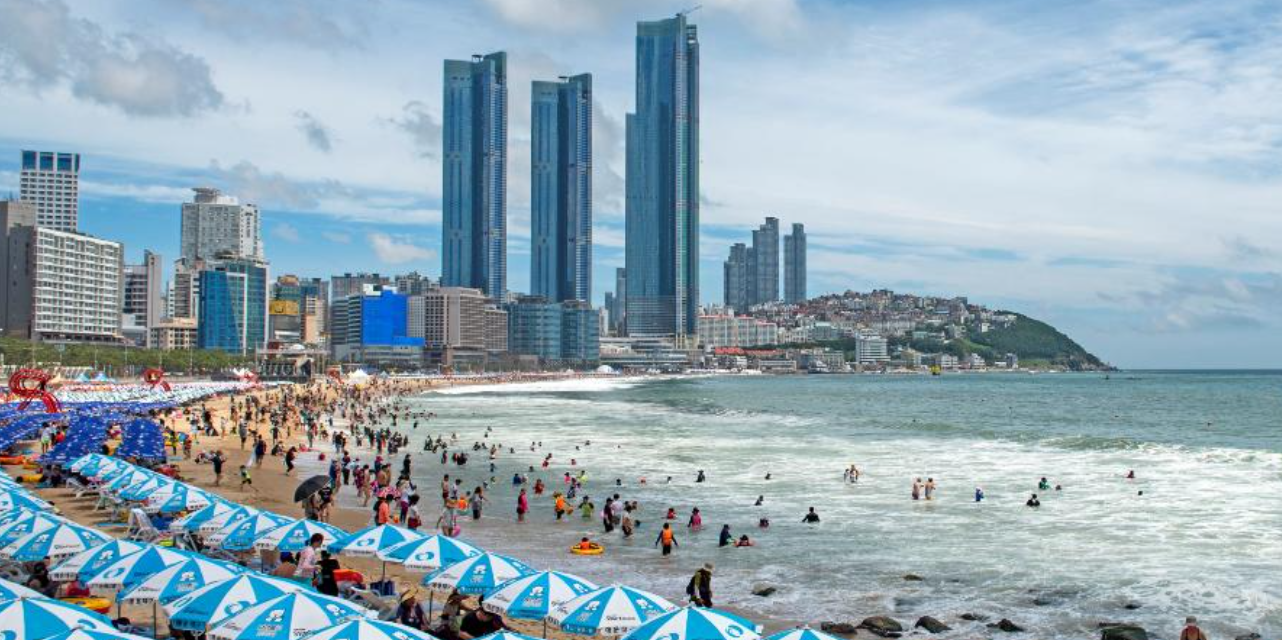
Busan’s most famous address. Haeundae Beach is wide and clean, and in summer becomes genuinely packed — Korea’s most visited beach draws over a million visitors on peak August weekends. In spring and autumn, the same stretch of sand is remarkably peaceful.
Beyond the main beach, the Marine City high-rise district to the west is where Busan’s skyline money shot lives: towers of glass reflected in the sea, and the Busan X the Sky observatory at EL City offering panoramic views across Haeundae and Gwangan Bridge from the 98th–100th floors.
Haeundae Blueline Park (해운대 블루라인파크) is the headline attraction of 2026. The old Donghae South Line railway has been converted into a leisure rail: the Sky Capsule (스카이캡슐) at Cheongsa Station runs colourful glass pods along a clifftop track directly above the sea, while the Beach Train (해변열차) trundles along at sand level. Both are heavily booked — reserve online in advance, especially on weekends.
Dongbaek Island (동백섬) is a short walk from the western end of the beach: a forested peninsula with the APEC House (used for the 2005 summit), walking trails, and one of the better sunset views on the coast. The path continues to Mipo and on to the eastern end of the beach route.
Where to stay in Haeundae: Signiel Busan occupies the upper floors of the LCT Landmark Tower and is the obvious luxury choice. Airbnb residences in Marine City offer high-floor ocean views at a fraction of hotel rates. For budget options, guesthouses cluster around the beach’s eastern end near Jungdong.
Gwangalli (광안리) — Night Views, Cafés & Atmosphere
Gwangalli is smaller and less touristy than Haeundae, and most Busan residents will tell you it has the better atmosphere. Gwangalli Beach faces directly onto Gwangan Bridge (광안대교), a two-level suspension bridge that becomes a near-hypnotic sight after dark, especially when lit for festivals.
Millak Waterside Park (민락수변공원), just east of the beach, is Busan’s outdoor living room on warm evenings: locals park themselves on the low wall with convenience store drinks while the bridge reflects on the water in front of them. It is one of the best free experiences in the city.
The café street running back from the beach has matured into one of the most interesting in Korea — independent roasters, natural wine bars, and concept bakeries sit alongside old-school hoe (raw fish) restaurants and the famous Nampcheon-dong Baguette Street nearby.
The Gwangalli Fireworks Festival in October is the calendar highlight: one of the largest fireworks shows in Asia, fired directly off the bridge itself. Book accommodation months ahead if you plan to attend.
Where to stay in Gwangalli: Several Airbnb apartment residences with full bridge views; Hotel Aquamarine for a comfortable mid-range option.
Seomyeon & Jeonpo (서면·전포) — Transport Hub, Food & Nightlife
Seomyeon is Busan’s commercial centre and its best-connected subway interchange. It is not particularly scenic, but it puts you within 10–20 minutes of every major area — and its food options, shopping streets, and nightlife give it an energy distinct from the beach districts.
Jeonpo Cafe Street (전포 카페거리) is the area’s breakout success story. What was once a light manufacturing district has been colonised, building by building, by independent cafés, concept stores, wine bars, and small restaurants. It draws a young crowd and feels genuinely creative rather than staged — the go-to neighbourhood for anyone interested in where Busan’s 20s and 30s actually spend their evenings.
Seomyeon Station Underground Shopping — the connected underground mall beneath Seomyeon station is vast, practical for clothing and accessories, and open late.
Where to stay in Seomyeon: Ibis Hotel Busan City Centre is a reliable budget-to-mid option. Toyoko Inn Seomyeon is the most compact and transit-convenient.
Nampo-dong, Jagalchi & BIFF Square (남포동·자갈치·BIFF광장)
The old downtown. This is where Busan’s history, seafood, and cinema culture overlap in a few dense blocks.
Jagalchi Market (자갈치시장) is Korea’s largest seafood market, and essential. The ground floor has vendors selling live fish, shellfish, sea cucumbers, and everything the sea produces. Head upstairs to the restaurant floors, where you can have your selection cooked or eat what they’re already preparing — tables of halmeoni (grandmothers) grilling clams and slicing sashimi at speed. The speciality snack to leave with is jagalchi-ppang (자갈치빵), a fish-shaped bread with flavoured cream fillings. Note: Jagalchi Market is closed on the 1st, 3rd, and 5th Tuesdays of each month.
BIFF Square is the founding site of the Busan International Film Festival and the year-round version of that excitement — a pedestrian street lined with handprints of Korean film stars, street food carts, and mini hotteok vendors (the ssiathotteok here are among the best in the city).
Gukje (International) Market (국제시장) connects directly to BIFF Square. A covered traditional market selling everything from military surplus (left from the Korean War era) to hanbok, kitchenware, food, and sundries. Adjoining the market, Bupyeong Kkangtong Market (부평깡통시장) operates into the evening and specialises in food stalls and local produce.
Busan Tower (부산타워) at Yongdusan Park overlooks the port and the Yeongdo district from a small hilltop — a leisurely afternoon walk from the market area.
Gamcheon Culture Village (감천문화마을)
Among the most photographed places in Korea. Built as housing for refugees and followers of the Taegeukdo religious movement during the Korean War, Gamcheon’s terraced hillside of small houses was gradually brightened by community art projects beginning in 2009. The result is a maze of pastel-painted alleyways with murals, sculptures, small galleries, and cafés — sometimes called “Korea’s Santorini,” though it has a character entirely its own.
Go early in the morning (before 10 AM) or on a weekday to experience it without the densest tourist crowds. The village has free maps at the information centre near the main entrance. Key Instagram spots — the Little Prince statue, the fish staircase mural, the alley of colourful painted doors — are marked on most maps. Admission is free; some galleries have small entry fees.
Songdo (송도)
Busan’s original beach resort district, predating Haeundae as the city’s beach. The Songdo Ocean Cable Car (송도해상케이블카) runs out over the sea between two cliff stations — the glass-floored cabins provide a bracing view straight down to the water. There are walking trails along the coastal cliffs, a modest beach, and fewer crowds than Haeundae.
Haedong Yonggungsa Temple (해동용궁사)
One of the few Buddhist temples in Korea built directly on the sea cliffs. The approach along a stone path from the coastal road, the sound of waves beneath the main hall, and the general setting — dragons, sea spray, carp in pools — make this one of the most atmospheric religious sites in the country.
Located in Gijang-gun, northeast of the main city, it takes about 35–45 minutes from Haeundae by bus (Bus 181 from Haeundae Station or a taxi, ~₩15,000–18,000). The temple is free to enter. Go at sunrise if you can — it is particularly beautiful and significantly less crowded than mid-morning.
What to Eat in Busan
Busan has a food culture distinct from Seoul’s, rooted in the sea and in the cooking of migrants who arrived during the Korean War. The city now sits on the Michelin Guide Busan map alongside Seoul, and the 2026 edition reflects a maturing dining scene alongside the longstanding street-food classics.
The Classics
Dwaeji Gukbap (돼지국밥) — Busan’s most beloved dish: a milky, clean-flavoured pork bone broth served with rice, which you can stir in or eat separately. Every Busan local has a strong opinion about which restaurant is best. Reliable options include Yeonggin Dwaeji Gukbap (영진돼지국밥, Sinpyeong branch), Jamae Gukbap (자매국밥), and Subyeonchoego (수변최고, Haeundae branch).
Milmyeon (밀면) — Cold wheat noodles served in a chilled, slightly sweet-savoury broth; a Busan institution with no real equivalent elsewhere. The flagship venues are Choryang Milmyeon (초량밀면) near Busan Station and Naeho Naengmyeon (내호냉면), which has been run by the same family for three generations.
Ssiathotteok (씨앗호떡) — The Busan upgrade on the standard fried sweet pancake: stuffed with seeds (sunflower, pumpkin) and brown sugar, crunchier and more complex. The original hotteok vendors at BIFF Square and near Gukje Market are the reference points.
Hoe (회) — Korean-style raw fish sashimi. At Jagalchi Market you can select your own fish and have it sliced at the table. Along Gwangalli, Samsam Hoejip (삼삼횟집) is consistently recommended by locals.
Jjigae at Cheongsa-po: The fishing village of Cheongsa-po (청사포), near Haeundae, is known for grilled clams eaten over coals at informal seafront restaurants. Sumininyeo (수민이네) is one of the most well-regarded spots.
Newer & Notable
Jeonpo Cafe Street dining: The neighbourhood around Jeonpo has accumulated serious restaurants alongside its cafés. For something different, Dimtao (딤타오) on Haeridan-gil (해리단길) serves quality dim sum in a Busan context; Gohasun (고하순) in Gwangalli does suckling pig in a way that reads nothing like its Korean surroundings.
Busan Michelin 2026: The current Michelin Busan selection concentrates on Japanese-influenced omakase, Korean tasting menus, and a handful of traditionally-rooted spots in the market areas. The guide updates annually; check michelin.com/en/busan for the live list.
2026 Festival Calendar
Busan’s event calendar is one of the most varied of any Korean city.
| Season | Festival | Notes |
|---|---|---|
| March | Haeundae Sand Festival (해운대 모래축제) | Sand sculpting on the beach |
| Mar–Apr | Nakdonggang Cherry Blossom Festival (강 낙동강 30리 벚꽃축제) | Daejeo Ecological Park; 30-ri riverside blossom route |
| Apr | Nakdong River Canola Flower Festival | Bright yellow fields along the river |
| May | Daejeo Tomato Festival (대저토마토축제) | Local produce festival; tastings and activities |
| June | Busan Mobility Show | Large-scale international automotive exhibition |
| Aug 27–28 | Busan One Asia Festival (BOF) with NOL | Two-day K-POP concert event; major international acts |
| Jul–Aug | Haeundae & Gwangalli Beach Season | Official beach season; outdoor concerts, events nightly |
| October | Busan International Film Festival (BIFF) | biff.kr; largest film festival in Asia |
| October | Gwangalli Fireworks Festival (부산불꽃축제) | Fired from the bridge; one of Asia’s best free events |
| Oct–Nov | Busan International Rock Festival | Outdoor concert; various venues |
| December | Busan Christmas Tree Culture Festival | Nampo-dong street illuminations |
| January | Haeundae Polar Bear Swimming Festival | Traditional New Year sea swim; wildly popular |
Day Trips from Busan
Gyeongju — The ancient Silla Kingdom capital is only 22 minutes by KTX from Busan Station (₩10,400 to Singyeongju Station). Royal burial mounds, Bulguksa Temple, and one of Korea’s best growing food scenes make this an outstanding day trip — or better, an overnight. See our full Gyeongju travel guide.
Tongyeong — A 90-minute bus ride west; a port city with views across the Hallyeohaesang Marine National Park, the Dibi Tunnel underwater pedestrian crossing, and an excellent raw fish market.
Geoje Island — South of the peninsula, accessible by bridge; scenic coastline, shipyard history, and quiet coastal walking trails.
Practical Tips for Busan in 2026
Best time to visit: May–June and September–November. Summer (July–August) is energetic but very hot, humid, and crowded at the beaches. Winter is mild by Korean standards — cold enough for a coat but rarely snowing — and accommodation is cheapest.
KTX savings: Book early through letskorail.com for up to 50% off. The Korail Pass (for international visitors) can be loaded with a T-money transit card function — useful to confirm when purchasing.
Transit card: A T-money card (available at any CU, GS25, or 7-Eleven) covers metro, city bus, and taxi supplementary charges. Daily discount cap: ₩600. Children aged 6–12 ride public transport free.
Jagalchi Market: Closed on the 1st, 3rd, and 5th Tuesdays of each month. Plan accordingly.
Crowds at Gamcheon: Arrive before 10 AM or on a weekday. The village is small and narrow; midday on weekends becomes uncomfortably busy.
Haedong Yonggungsa: Sunrise is the best time — dawn worshippers and soft light, with a fraction of the midday crowds.
Blueline Park: Book Sky Capsule tickets online at least a week ahead for weekends. Sells out reliably.
Seomyeon to Haeundae: Subway Line 2 is almost always faster than a taxi on weekends.
Frequently Asked Questions
How many days do I need in Busan?
Two nights and two full days covers the core: Haeundae and the Blueline Park, Gamcheon, Jagalchi/BIFF Square, and one evening at Gwangalli. Add a third day for Haedong Yonggungsa, Songdo, or a day trip to Gyeongju. Busan also works as a one-night stop on a Seoul–Busan–Jeju route.
What is the best area to stay in Busan?
Haeundae for the beach, swimming, and ocean view hotels. Gwangalli for atmosphere, the bridge view, and a strong independent café scene. Seomyeon for transport convenience, a wider food range, and lower accommodation prices. Nampo-dong/Jagalchi for traditional market proximity and a local feel.
Is Busan easy to navigate without Korean?
Yes. Metro signage and announcements are in English throughout. Google Maps works reliably for transit routing. Kakao T operates in English and is practical for taxis. Tourist-facing staff in Haeundae and Gamcheon generally speak basic English.
Can I do Busan as a day trip from Seoul?
It is possible — the KTX puts Busan about 2 hours 20 minutes each way from Seoul — but very tiring and limiting. You would have time to see only one or two areas properly. A one- or two-night stay is strongly preferable.
How do I get from Busan to Gyeongju?
KTX from Busan Station to Singyeongju Station: 22 minutes, ₩10,400. From Singyeongju, a taxi or Bus 700 into central Gyeongju takes another 20–25 minutes. Total journey under one hour, and entirely feasible as a day trip from Busan.
What should I eat first in Busan?
Start with dwaeji gukbap (pork bone soup with rice) at one of the classic old joints near Busan Station — it is the most distinctively Busan meal there is and costs under ₩12,000. Then work toward Jagalchi for fresh hoe, and end the evening at Gwangalli with ssiathotteok from a street cart and a convenience store drink on the waterfront wall.
For a combined Seoul and Busan itinerary, see our Seoul and Busan Beginners’ Itinerary. For the best times to visit Korea by month, see The Best Time to Visit Korea.