Gangnam has a problem with its own reputation. Ever since Psy’s 2012 viral hit made the district’s name known worldwide, it has been shorthand for a kind of over-the-top Korean wealth — and the neighbourhood’s reality, which is considerably more interesting than the caricature, has been obscured ever since.
The truth is that Gangnam-gu (강남구), the administrative district south of the Han River, is one of the most rewarding parts of Seoul to actually spend time in. The streets around Gangnam Station (강남역) are dense with restaurants that locals queue for at lunch. The alleyways between Apgujeong (압구정) and Cheongdam (청담) house some of the city’s best cocktail bars. The boulevard leading toward COEX contains a thousand-year-old Buddhist temple tucked between glass-fronted office towers. And beneath it all runs one of Asia’s better shopping malls.
None of this requires wealth to access, and most of it is missed entirely by visitors who spend only an evening here on a day trip from the north bank. Gangnam rewards a full day, ideally two — and in 2026 it remains one of Seoul’s most dynamic districts.
Getting to Gangnam
By Metro: Gangnam Station (강남역) is on Line 2 (the green circular line) — the most useful single line in Seoul, connecting it to Hongdae, Sinchon, and City Hall. From Myeongdong, it’s roughly 25 minutes direct. Sinnonhyeon Station (신논현역, Line 9) and Apgujeong Rodeo Station (압구정로데오역, Bundang Line) are better entry points for the upscale western half of the district. Samsung Station (삼성역, Line 2) puts you directly at COEX.
By Taxi: From central Seoul (Myeongdong, Insadong), a taxi to Gangnam Station costs approximately ₩12,000–18,000 depending on traffic. The Hannam Bridge and Banpo Bridge routes both get congested during rush hour — allow extra time.
Line 9 Express: For visitors staying near Gimpo Airport or western Seoul, Line 9’s express service reaches Sinnonhyeon in around 35 minutes — one of the fastest cross-city journeys in Seoul.
Gangnam Neighbourhoods: Where to Go
Gangnam-gu covers a large area, and its character shifts significantly depending on where you are.
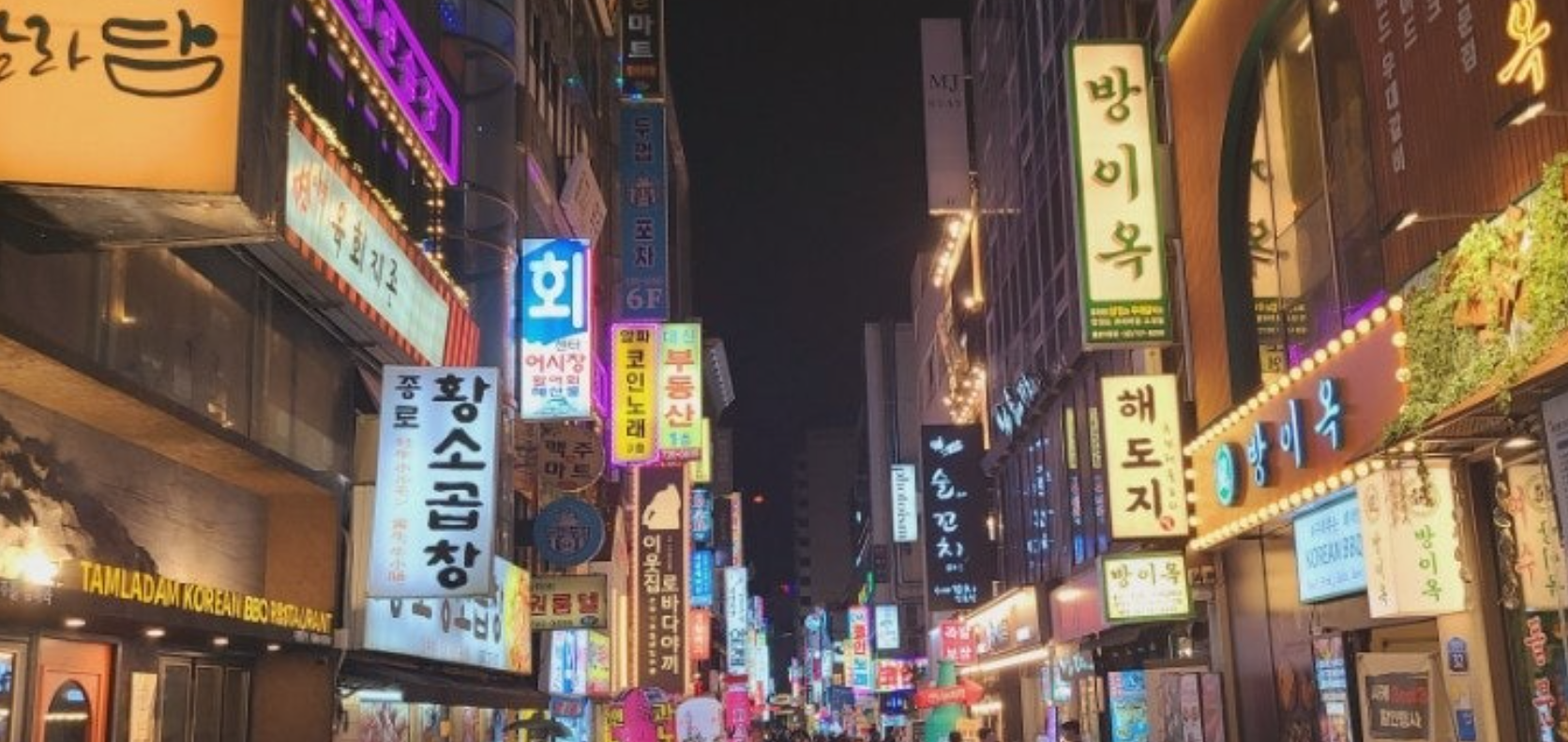
Gangnam Station (강남역) is the commercial and food hub — the stretch of streets between Gangnam and Sinnonhyeon stations is dense with restaurants, pojangmacha-style outdoor stalls, norebang (노래방, karaoke rooms), and late-night bars. This is where you come to eat well without spending much, and to stay out until 4am on a Friday.
Apgujeong (압구정) and Cheongdam (청담) are the luxury corridor, lined with flagship stores for Louis Vuitton, Chanel, Bottega Veneta, and every major Korean fashion label. The Apgujeong Rodeo Street (압구정 로데오거리) mixes high-end boutiques with small independent cafés and the kind of dessert shops that attract queues.
Samsung / COEX (삼성) is the convention and culture zone, anchored by the vast COEX mall and exhibition centre, the Bongeunsa temple, and the SM Town entertainment complex.
Sinnonhyeon (신논현) sits between the commercial bustle of Gangnam Station and the upscale belt further west, and has developed in recent years into one of the better restaurant and bar neighbourhoods in the city — slightly lower rents have attracted interesting independents.
Where to Eat in Gangnam
Korean Barbecue
다몽집 신논현본점 (Damong-jip) is among the best pork barbecue restaurants in the Gangnam area, and one of the harder ones to get into without planning. The signature cut is the kkakduk hang-jeong-sal (깍둑항정살) — jowl pork, cubed rather than sliced, dense and fatty and deeply flavoursome. It arrives part-cooked and is finished on the tabletop grill; the technique keeps the oil splatter down and the stress level low. The yangnyeom bon-galbi (양념본갈비, marinated short rib) is excellent and best eaten wrapped in perilla leaf with a touch of the accompanying fermented soybean paste.
Arrive before 6pm on weekdays to avoid a wait. Weekends fill fast.
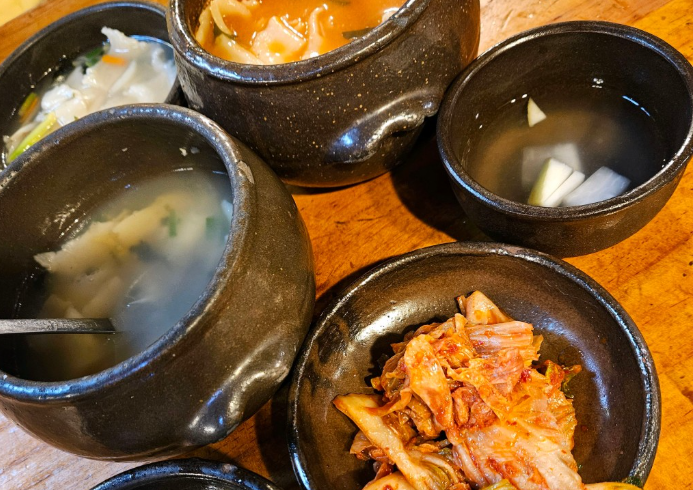
1992덮밥 & 짜글이 강남점 occupies a narrow building a few minutes from Gangnam Station Exit 3, and the interior — traditional screen partitions, earthenware pots, low wooden furniture — is an unusual find in this part of the city. The jageuri (짜글이) is the thing to order: a bubbling, spicy pork stew arrived at the table on a portable burner, sour and fermented from the well-aged kimchi base, best eaten with the complimentary rice and a cold bottle of soju. The lunch crowd is dense — before 11:40am or after 1:30pm is noticeably calmer.
Seafood in Gangnam
김선생 조개찜 (Teacher Kim’s Steamed Clams) does one thing: a large pot of clams, shrimp, octopus, and seasonal vegetables that arrives on a portable burner and is cooked at the table. The pot is generous enough for two. Once the seafood is done, the leftover broth becomes the base for noodles or rice — order the rice-based version (볶음밥) and the server will come and stir-fry it tableside with the remaining sauce. The result is better than it sounds. Small, cash-preferred, closes when the shellfish runs out.
Fusion & International
녘 (Nyeok) is the project of two chefs with backgrounds in New York, and it shows in the way the menu resists categorisation. The cooking draws from Korean flavour combinations but applies techniques and plating from a different tradition entirely. The bar programme is more serious than most Seoul restaurants manage. Reservations recommended for dinner; the lunch set is good value and considerably easier to walk into. 📍 봉은사로4길 32, 2층
구구당 (Gugu-dang) is a fusion Asian restaurant built around an open kitchen with a counter facing it — useful both as entertainment and as reassurance about the cooking conditions. The menu runs from Hong Kong-style cube steaks in a mara-garlic sauce to Thai-inflected noodle soups. The cube steak is the signature and earns it.
타이엘리펀트 (Thai Elephant) handles Thai cuisine with a seriousness unusual for Korean interpretations of Southeast Asian food. The khao kha moo (카우카무 — Thai braised pork leg on rice) is the dish to order first; after that, the pad kra pao (팟카파우) and whatever the day’s fresh noodle dish is. The space is small and the décor restrained. Prices are fair for the quality.
Gangnam Bars & Nightlife
Best Cocktail Bars in Gangnam
르챔버 (Le Chamber) has appeared on the World’s 50 Best Bars extended list and is the cocktail bar Gangnam residents cite first when asked. The entrance is unmarked — a deliberate choice — and the interior channels a private members’ club aesthetic: dark wood, leather seating, low lighting, bartenders who take the job seriously. The cocktail list draws from Korean ingredients (omija berries, cheongju, citrus varieties you won’t find elsewhere) combined with classical techniques. Book ahead for weekends; walk-ins are accommodated at the bar if space allows.
Rooftop Bars in Gangnam
The stretch between Gangnam Station and the Han River has several rooftop venues with views of the district’s skyline. KLOUD is the most consistent — a beer and cocktail bar with open-air terracing that works particularly well in spring and autumn when the temperatures are mild. The beer list leans toward Korean craft; the cocktails are uncomplicated but solid.
Izakaya & Wine Bars
이자카야 열 (Yeol Izakaya) is the Japanese-style pub that regulars return to. Small, loud when full, excellent bar snacks — the grilled skewers (kushiyaki) and cold tofu with a spiced oil are worth ordering early before the kitchen gets backed up. Rated among the top izakaya in the area on multiple review platforms (★4.8 on Diningcode).
29펍 (29 Pub) keeps a serious whisky list — bottles from Scottish, Irish, Japanese, and Korean distilleries, with the occasional Taiwanese or Indian expression — in a setting that doesn’t take itself too seriously. The bar staff know their stock. Good for a long, unhurried evening.
Things to Do in Gangnam
봉은사 (Bongeunsa Temple)
The single most surprising thing about Gangnam is this: a thousand-year-old Buddhist temple stands on a tree-covered hillside a short walk from the COEX convention centre, its stone lanterns and wooden halls absorbed into the city without fanfare.
Bongeunsa was founded in 794 CE and has survived invasions, fires, and the construction of a modern megacity around it. The current complex dates mostly from the Joseon period, rebuilt repeatedly after destruction. The 23-metre stone Maitreya Buddha at the entrance, carved directly into the rock face, is striking by any measure.
Come early morning if you can — the light is better, the crowd is lighter, and the monks’ chanting from the main hall carries across the courtyard. The temple offers regular templestay programmes (사찰 체험) for those who want to spend a night, participate in meditation sessions, and wake before dawn for the morning ceremony.
코엑스 & 코엑스 아쿠아리움 (COEX & COEX Aquarium)
The COEX complex is the practical hub of the Samsung neighbourhood — a convention centre, hotel cluster, and subterranean mall connected directly to the metro. The Starfield Library (별마당 도서관) inside the mall is worth seeing: a three-storey atrium bookshelf that has become one of the most photographed interiors in Seoul, which is a strange thing for a library to be but seems not to have diminished its appeal.
The COEX Aquarium (코엑스 아쿠아리움) houses more than 650 species across a network of tanks and walkways that includes an underwater tunnel. It’s large enough to take a full two hours and holds the attention of visitors who are not usually drawn to aquariums.
The convention halls host exhibitions, fan events, and performances on a near-continuous rotation; check the current schedule before visiting, as the queues and energy in the neighbourhood shift dramatically when something major is on.
세빛섬 & 반포대교 야경 (Sevit Floating Islands & Banpo Bridge)
The Han River is a 10-minute taxi ride from most of Gangnam, and the southern bank between Banpo Bridge and the Sevit Islands is one of the better places to experience the city at night. Sebitseom (세빛섬) is a cluster of three artificial floating islands moored beside the Banpo Bridge — part LED sculpture, part event venue, part restaurant complex. The islands are illuminated after dark and the views across the river toward northern Seoul on a clear evening are genuinely impressive.
The Banpo Bridge Rainbow Fountain (반포대교 달빛무지개분수) runs water displays set to music during scheduled evening sessions from spring through autumn. Timing varies by season; check the Seoul city website for the current schedule.
압구정 로데오거리 & 청담동 (Apgujeong Rodeo Street & Cheongdam)
The Rodeo Street (로데오거리) is Gangnam’s high-fashion district — a grid of streets lined with flagship boutiques, concept stores, plastic surgery clinics, and some of the city’s better independent cafés. It is simultaneously a place locals take seriously and a spectacle entirely appropriate to visit with mild anthropological curiosity. The further you walk from the main strip, the more interesting the side streets become.
Cheongdam (청담동) immediately to the east is calmer and more expensive, with a higher concentration of fine dining, private galleries, and the kind of design-forward boutiques that don’t advertise prices.
롯데월드 & 서울스카이 (Lotte World & Seoul Sky)
Technically just outside Gangnam-gu in Songpa, Lotte World (롯데월드) is close enough to include in any Gangnam itinerary and substantial enough to fill a full day. The complex includes an indoor theme park (the largest in the world when it opened), an outdoor area, an ice skating rink, and the Lotte World Folk Museum chronicling Korean history in miniature.
Seoul Sky (서울스카이), the observation deck on the 117th–123rd floors of the Lotte World Tower next door, provides the most unobstructed 360-degree view of Seoul available. Book tickets in advance to skip the queue.
SM 타운 & K-POP 문화 (SM Town & K-Pop Culture)
SM Town COEX Artium (SM타운 코엑스 아티움) is the flagship venue for SM Entertainment — one of Korea’s three major K-pop labels — and functions as a combined museum, merchandise store, restaurant, and fan experience centre. Even visitors with limited interest in K-pop will find the scale of the Korean entertainment industry more legible here than it is from the outside. HOLOgram concerts (holographic performances by SM artists) run at scheduled times throughout the day.
Practical Tips for Visiting Gangnam
Getting around within Gangnam: The district is walkable in its core zones, but the key areas — Gangnam Station, Apgujeong, and Samsung/COEX — are far enough apart that taxis between them make sense. A taxi from Gangnam Station to COEX takes around 10 minutes and costs ₩4,000–6,000. Kakao T (the local ride-hailing app) is more reliable than flagging cabs during peak hours.
Parking: Difficult and expensive. Arrive by metro or taxi if possible.
Language: Most restaurants and bars in the area have English menus or picture menus. Staff at major venues speak functional English; independent spots vary. Google Translate’s camera function handles Korean menus reliably.
Reservation culture: The better restaurants in Gangnam — especially for dinner — fill quickly on Thursday through Saturday. For pork barbecue and casual spots, a same-day visit is usually fine before 6pm. For cocktail bars and fine dining, book 2–3 days ahead.
Best time to visit: Spring (late March–May) and autumn (September–November) are the most comfortable seasons. The Banpo Bridge fountain and Han River parks are at their best in these windows. Summer (June–August) is hot and humid but the nightlife energy peaks. Winter is cold but the indoor scene — barbecue, hot pot, cocktail bars — makes sense of it.
For a broader Seoul itinerary that takes in areas north of the river, see our First-Timer’s Guide to Seoul. For more on the restaurant scene across the city, see our Seoul Restaurant Guide 2026.
Frequently Asked Questions
Is Gangnam worth visiting in Seoul? Absolutely. Beyond the famous name, Gangnam has some of Seoul’s best restaurants, internationally recognised cocktail bars, a 1,000-year-old temple (Bongeunsa), the COEX Starfield Library, and Lotte World Tower. A full day in Gangnam — eating, drinking, and exploring — is one of the most rewarding days you can have in Seoul.
Where should I eat in Gangnam for the best local experience? Skip the main tourist strips and head to the alleys around Gangnam Station and Sinnonhyeon Station for the most local experience. Damong-jip (pork barbecue) and the 1992 jageuri stew restaurant are strong choices. For cocktails afterward, Le Chamber (World’s 50 Best Bars) is the benchmark in the district.
How do I get from central Seoul to Gangnam? Take Line 2 (green) directly from Myeongdong, Sinchon, or Hongdae to Gangnam Station — about 20–30 minutes. For COEX and the Samsung area, take Line 2 to Samsung Station. From northern Seoul, Line 9 express to Sinnonhyeon is fast (around 35 minutes from the airport area).
What is Bongeunsa temple in Gangnam? Bongeunsa is a 1,200-year-old Buddhist temple in the heart of Gangnam, a short walk from COEX mall. It’s one of the most surprising sights in Seoul — ancient temple halls and a giant stone Buddha surrounded by glass office towers. Entry is free, and the temple’s morning chanting sessions and templestay programmes are open to visitors.
Are there good shopping areas in Gangnam? Yes. The Apgujeong Rodeo Street has luxury boutiques and independent cafés. COEX Mall is one of Asia’s largest underground malls with 260+ stores and the famous Starfield Library. The area around Gangnam Station has mid-range and affordable options. For K-beauty shopping in Gangnam, check the shops along Garosu-gil.
What is the Banpo Bridge Rainbow Fountain? The Banpo Bridge Rainbow Fountain is the world’s longest bridge fountain, shooting water in coloured arcs from both sides of the bridge into the Han River. It runs on a schedule during spring through autumn evenings. From the Sebitseom floating islands on the riverside, the view of the illuminated bridge at night is one of the most distinctive sights in Seoul.