Korea’s summer is not gentle. From late June, a monsoon front parks itself over the peninsula and delivers weeks of relentless rain and humidity that makes stepping outside feel like walking into a warm towel. Then August arrives — the rain mostly clears, the temperature climbs to 33°C or higher, and the entire country migrates to the coast. In between, there are festivals, baseball games under stadium lights, the best shaved-ice dessert you will ever eat, and evening river walks that rank among the most pleasant urban experiences in Asia.
It is not a season for the faint-hearted. But if you know what you’re getting into, Korean summer rewards accordingly. This guide covers everything you need to know before traveling to Korea in summer — from the monsoon timeline to what to pack, where to go, and what to eat.
| Summer months | June, July, August |
| Temperature range | 18–37°C (64–98°F) |
| Monsoon (jangma) | Late June – late July |
| Peak season | August |
| Typhoon risk | August – September |
| Best month for first-timers | June |
Korea Summer Weather: What to Expect Month by Month
June: The Good Month
June is the hidden gem of Korean summer. The temperature sits between 18°C and 26°C, the crowds have not yet arrived, and the monsoon has not yet set in. You can walk around Seoul comfortably in the morning, eat outside at lunch, and sit on a Han River park in the evening without sweating through your clothes. Cherry blossom season is long over, but the city is green and energetic.
By the final week of June, the jangma (장마) front typically arrives from the south. When it does, the character of the season changes completely.
July: Monsoon Season (장마)
Jangma is Korea’s monsoon period — a sustained weather system, not a daily afternoon shower. Rain falls for days at a time, sometimes for weeks. July average temperatures sit around 22–29°C but the humidity climbs to 78%, which means the effective heat feels considerably higher. You are wet from rain or wet from sweat; usually both.
The jangma front typically clears by late July or early August, often with dramatic suddenness. One day it is grey and streaming; the next, the sun is back and the sky is a particular shade of blue that only appears after prolonged rain.
A few practical realities: flooding is possible in low-lying areas after heavy rain; always check weather apps before hiking or visiting riverside parks. The subway and indoor spaces are heavily air-conditioned — sometimes aggressively so — and the temperature contrast between outside and inside is extreme enough to warrant a light layer.
August: Peak Heat, Peak Season
August is the hottest month. Temperatures regularly reach 30–34°C in Seoul, and on the worst days can push 37°C. Humidity remains high even after the monsoon clears. This is also when the majority of Koreans take their summer holidays — beaches are full, KTX trains to Busan and Gangneung book out, and Jeju accommodation prices spike.
Typhoons are a real consideration from August through September. Korea experiences approximately one significant typhoon per year, though paths vary considerably. Most typhoons pass to the east or south; occasionally one makes direct landfall or clips the peninsula. Check the Korea Meteorological Administration (기상청) app or website if you’re visiting in this window.
The heat, paradoxically, is also when some of the best summer experiences are available — cold noodles taste best in 35°C heat, baseball under stadium lights in August is peak atmosphere, and evening Han River walks are glorious once the sun goes down.
What to Pack for Korea in Summer
Korean summer requires a different mindset from most warm-weather packing. Humidity means fabric choice matters more than warmth.
Clothing
- Lightweight linen or moisture-wicking fabrics only. Cotton holds sweat; synthetic performance fabrics or linen breathe. Pack loose-fitting rather than structured.
- Koreans dress neatly even in heat — overly casual clothing stands out in restaurants and indoor venues. Breathable trousers or midi skirts are more versatile than shorts in most settings.
- One light layer for indoor spaces. The subway, department stores, and malls are air-conditioned to temperatures that feel arctic after the street.
Rain gear
- A compact folding umbrella that fits in a day bag is essential from late June through July. A large golf umbrella is better in the jangma — but a small one beats none.
- Waterproof sandals or shoes with good grip for wet streets. Flip flops work but become treacherous on wet tile.
- Skip the heavy rain jacket. The humidity makes waterproof shells miserable to wear.
Heat survival
- Portable fan (손풍기, son-pung-gi): One of the best purchases you can make in Korea for summer. Small, rechargeable handheld fans are sold at every convenience store and Daiso for ₩5,000–₩20,000. Every Korean uses one. Buy one on your first day.
- Korean sunscreen: Korea’s SPF formulations are among the best in the world — lightweight, non-greasy, and genuinely effective. Pick one up at any Olive Young or pharmacy. The K-beauty guide covers what to look for.
- Hat and sunglasses for outdoor midday exposure.
Shoes Waterproof or quick-drying footwear is worth prioritising. Sneakers that take days to dry after a monsoon downpour will make you miserable for the rest of the trip.
Best Places to Visit in Korea in Summer
The Beaches
Summer is beach season, and Korea has good ones — most of them accessible by public transport or a short domestic flight.
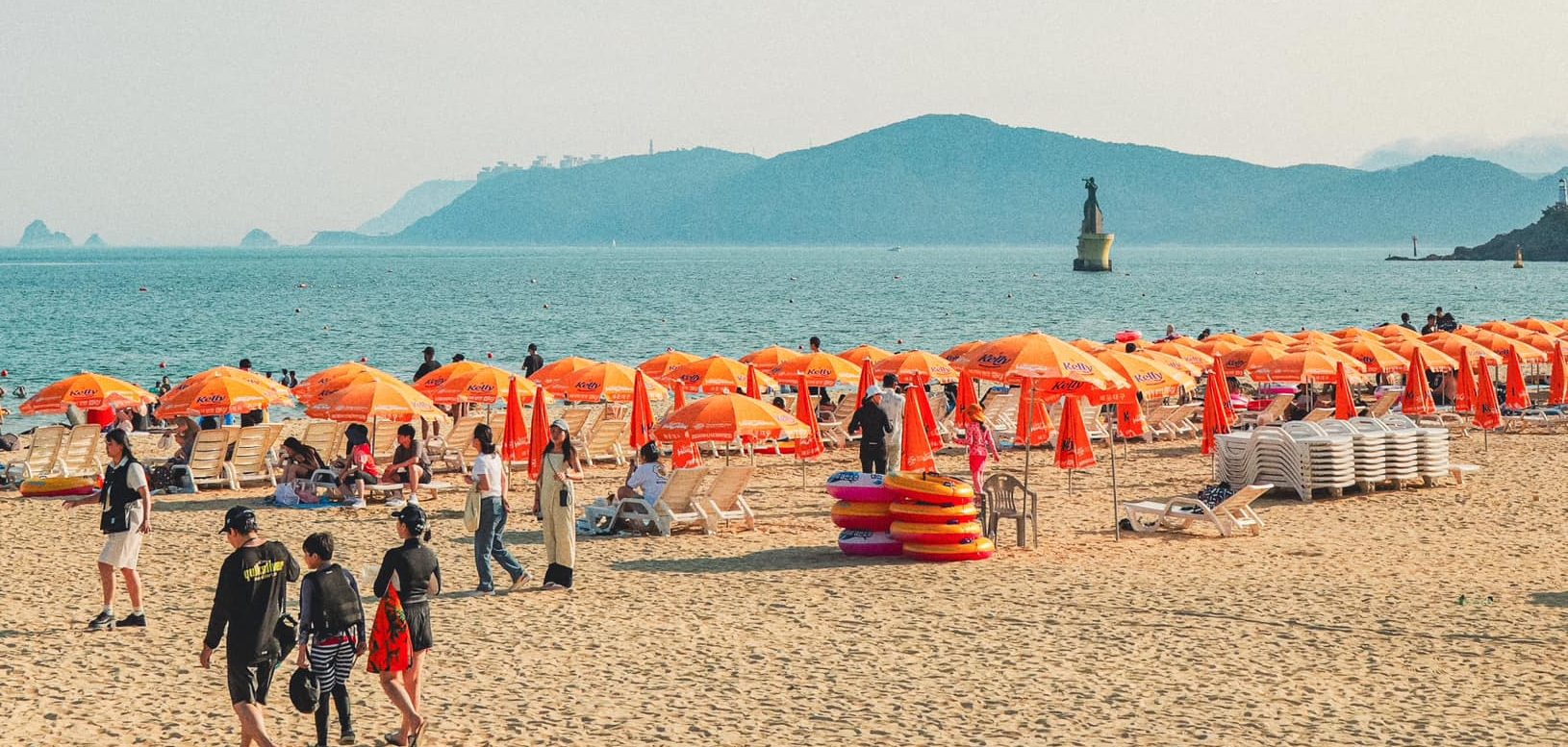
Haeundae Beach (해운대), Busan is the most famous: a wide, white-sand bay backed by a luxury hotel skyline, with warm water from August and the full infrastructure of a major beach resort. It gets extremely crowded in August. The surrounding neighbourhood — restaurants, bars, the Haedong Yonggungsa temple on the rocky headland — rewards time beyond the sand itself. The Busan guide covers the full city.
Jeju Island offers a different beach character — volcanic rock coastlines, turquoise coves, and the haenyeo (해녀) freediving culture that is unique to the island. It is also Korea’s domestic holiday destination, which means August flights and accommodation book out months ahead. The Jeju guide is the reference.
Gyeongpo Beach (경포해변), Gangneung on the East Coast is popular with Seoulites for its clean water and pine-forest backdrop. Gangneung is also the city worth knowing for its coffee culture — the east coast café scene here is quietly excellent.
Han River Parks, Seoul
The Han River parks (한강공원) are how Seoul handles summer. From late afternoon, Yeouido, Banpo, and Mangwon parks fill with locals who bring convenience store food, lay out mats, fly kites, and cycle the riverside paths until midnight. The parks are free, the atmosphere is genuinely local, and the city skyline at dusk from the riverbank is hard to beat. The Banpo Bridge Rainbow Fountain runs on a set schedule each evening from spring through autumn. The Seoul Guide has more on getting around the city in summer.
Hiking (Early Morning Only)
Summer hiking in Korea is not an activity to attempt between 10am and 4pm. The humidity makes midday trail conditions genuinely unpleasant and potentially dangerous on exposed ridgelines. The correct approach: arrive at the trailhead by 7am, summit by 10am, and be off the mountain before the heat peaks. Bukhansan National Park is Seoul’s most accessible mountain and worth the early start — full hiking guide here.
Day Trips
Wonju’s Sogeumsan Grand Valley — two suspension bridges over a river gorge in Gangwon Province — is at its greenest in summer. The forest is fully leafed out, the river below the bridges is high from monsoon rain, and weekday mornings are relatively quiet. Full guide here.
Korean Summer Festivals 2026
Boryeong Mud Festival (보령 머드축제) · Boryeong, South Chungcheong The most famous Korean summer festival, running annually in late July to early August (2026: July 24–August 9). Held on Daecheon Beach, it centres on mineral-rich mud from the surrounding coastal flats — mud wrestling, mud slides, mud pools, and various stages of mud-related chaos. It started as a promotional event for a local cosmetics company and became one of Korea’s most attended summer events. Worth the trip if your dates align and you don’t mind the clean-up.
Waterbomb Festival (워터밤) · Seoul and other cities An outdoor music festival where the act of festival-going involves large-scale water-gun fights and actual hoses. Run across multiple cities throughout July and August; Seoul dates sell out quickly. The combination of electronic music, heat, and being soaked through is precisely as entertaining as it sounds.
KBO Baseball Season · Jamsil Stadium, Seoul and nationwide Baseball season runs from late March through October, and summer evenings at the stadium are the peak. Under floodlights at 30°C with backpack beer vendors and coordinated fan chants, a KBO game in August is one of the best ₩12,000 experiences in Korea. 2026 is the final season at Jamsil Stadium before demolition — worth prioritising if you’re visiting Seoul in summer. Full guide to attending a Korean baseball game.
Korean Summer Food: What to Eat and Drink
Summer in Korea has a clearly defined food vocabulary. These are the dishes that make the heat bearable.
Bingsu (빙수)
The defining Korean summer food. Shaved ice — finely textured, almost snow-like when done properly — served over a base of sweetened condensed milk or cream, topped with red bean paste (patbingsu, 팥빙수), fresh fruit, mochi pieces, or flavoured syrups. The traditional version is patbingsu (red bean shaved ice). The contemporary version, served at cafés across Seoul, uses premium fruit — Jeju apple mango bingsu has become the luxury version of choice, priced at ₩18,000–₩35,000 at serious cafés and astronomically more at hotel rooftops.
Every café and dessert shop has a version. The quality varies widely; the best bingsu has ice shaved so finely it dissolves on the tongue rather than crunching.
Naengmyeon (냉면)
Cold buckwheat noodles, either in an iced beef broth (mul naengmyeon, 물냉면) or dressed in a gochujang sauce (bibim naengmyeon, 비빔냉면). Naengmyeon is one of those foods that tastes unremarkable in spring and becomes exactly what you want in 35°C heat. The broth version — cold, slightly tangy, deeply savoury — is a complete reset for a body that has been sweating since breakfast.
Kong-guksu (콩국수)
Cold wheat noodles served in chilled soy milk broth. The soy milk is blended from soaked soybeans and has a nutty, slightly sweet, creamy quality that does not sound appetising until you eat it in the right conditions. Order it anywhere that makes it in-house; the pre-made versions are thinner and less interesting.
Samgyetang (삼계탕)
Hot ginseng chicken soup, eaten in the middle of summer on purpose. Korean food culture has a concept called 이열치열 (i-yeol-chi-yeol) — fighting heat with heat — the idea being that warming your body from inside actually cools it more effectively than eating cold food. Whether or not the logic holds, samgyetang is one of the most genuinely restorative things you can eat in August: a whole small chicken stuffed with glutinous rice, ginseng, jujubes, and garlic, simmered until falling off the bone. The broth is pale gold and deeply nutritious. Koreans eat it specifically on the three hottest days of the lunar calendar (삼복, sam-bok), but it is available year-round at specialist restaurants.
Seasonal Fruit
Korean summer fruit is excellent and worth seeking out at markets and convenience stores. Chamoe (참외, Korean oriental melon) — a small yellow melon with a distinctive flavour, different from any melon variety available outside Korea — peaks in June and July. Peaches from Chungcheong Province are in season through August. Watermelon at any convenience store is available pre-cut, cold, and inexpensive.
Jeju apple mangoes (애플망고) are in peak season from July to September — small, intensely flavoured, and the basis for many café drinks and bingsu toppings throughout summer.
Cold Drinks
Seoul’s café culture is serious year-round, but summer adds specific options worth knowing: yuzu ade (유자에이드, yuzu sparkling drink) is cooling and citrus-sharp; sikhye (식혜, sweet rice punch) is available cold at convenience stores; and makgeolli drunk ice-cold is a different drink from the room-temperature version. The Seoul café guide covers the broader coffee scene.
How to Beat the Heat in Korea: Practical Tips
Convenience stores are your friend. CU, GS25, 7-Eleven, and Emart24 are everywhere, air-conditioned, and stocked with cold drinks, ice cream, fans, and pre-cut fruit. Treating them as a cooldown stop every hour is a legitimate and cost-effective strategy.
Jjimjilbang for recovery. A heated public bathhouse sounds like the wrong call in summer, but the bathing areas are cool, the ice rooms are exactly what they sound like, and spending two hours horizontal in a cold communal hall is one of the most effective heat-recovery strategies available. The jjimjilbang guide explains how they work.
Malls and department stores. Lotte Department Store, The Hyundai Seoul, COEX Mall, and similar complexes are air-conditioned to extreme comfort. They also have good food halls, rooftop gardens (open until late), and exhibition spaces. A summer afternoon in Seoul can reasonably be spent between a museum, a mall food hall, and a Han River park — moving between air-conditioned spaces and outdoor green space as the temperature allows.
Time outdoor activities correctly. The Korean summer follows a rhythm: active from 7–10am, indoors or quiet from 11am–4pm, active again from 5pm until midnight. Adjusting your sightseeing schedule to match this rhythm makes an enormous difference to how comfortable the trip feels.
Practical Notes
Book accommodation early. August is peak domestic travel season. Jeju, Busan, and Gangneung fill up months in advance. Seoul accommodation is more forgiving but beach-adjacent neighbourhoods in Busan book out quickly.
Typhoon awareness. If a typhoon warning is issued while you are in Korea, follow local guidance. Indoor venues remain open; outdoor activities, coastal areas, and elevated trails close. The Korean Meteorological Administration app (기상청) has English and is the authoritative source.
Transport. KTX high-speed trains to Busan (2h 15m), Jeju flights (1h from Gimpo), and the subway to Gangneung (2h 30m via ITX-Cheongchun) all function well but book up on summer weekends. Trains in particular should be booked at least a week ahead for August weekend travel.
Navigation. Use Naver Map rather than Google — see why here.
Everything you need before arrival — SIM cards, T-money, currency, what to prepare — is covered in the Korea travel essentials guide. For timing your trip against other seasons, the best time to visit Korea breaks down the full year.
Frequently Asked Questions: Visiting Korea in Summer
Is Korea a good destination to visit in summer?
Yes — with the right expectations. June is genuinely excellent: mild temperatures, no crowds, and no monsoon. August is the most dramatic month, with beach culture, festivals, and peak atmosphere at the cost of heat and crowds. July requires tolerance for sustained rain and humidity, but the food, indoor experiences, and cities are fully operational regardless of weather.
How hot does Korea get in summer?
Seoul averages 30–34°C in August, with occasional spikes to 37°C. The bigger factor is humidity — July sits around 78% humidity, which makes the effective temperature feel considerably higher than the thermometer suggests. Coastal cities like Busan are slightly cooler; Jeju is warmer and more humid.
When exactly is monsoon season in Korea?
The jangma (장마) monsoon typically begins in the last week of June and clears by late July or early August. It is a prolonged weather system — not a daily afternoon shower — and can deliver continuous rain for days or weeks at a stretch. The clearing is usually sudden: one day grey, the next bright blue.
Is Korea crowded in summer?
August is the most crowded period. This is when Koreans take their main summer holidays, so beaches, trains, and Jeju flights fill up fast. June is the opposite — comfortable temperatures and low crowds make it the hidden gem of Korean summer travel. July is mid-range: fewer tourists than August, but the monsoon keeps some travellers away.
What is the best month to visit Korea in summer?
June for first-timers — the weather is the most forgiving, crowds are low, and there’s no monsoon yet. August for those who want full Korean summer immersion: beach culture, baseball under floodlights, bingsu everywhere, and the energy of peak season. Avoid the first two weeks of August if you dislike crowds.
What should I pack for Korea in summer?
Prioritise moisture-wicking or linen fabrics over cotton, a compact umbrella (essential from late June through July), waterproof or quick-drying footwear, and a portable rechargeable fan (손풍기) — buy one on arrival for ₩5,000–₩20,000 at any convenience store or Daiso. One light layer for heavily air-conditioned indoor spaces is also worth packing.