A Korean baseball game is nothing like watching sport in a stadium back home. The moment you walk through the turnstiles, you are hit with coordinated chanting from thousands of fans, cheerleaders dancing on the dugout roofs, beer vendors weaving through the crowd with tanks strapped to their backs, and the smell of fried chicken drifting across every section. Nobody is sitting quietly watching the game. The game is almost secondary to everything else happening around it.
I grew up going to Jamsil Stadium with my father. Back then it was just what families did on warm weekend evenings. Now I watch foreign visitors discover it for the first time and get the same reaction every time: genuine surprise at how much fun it is. A KBO game costs less than a cinema ticket in most cities, and the atmosphere — if you sit in the right section — is unlike anything you will find in Major League Baseball or European football.
If you are spending any time in Korea between April and October, going to at least one game should be non-negotiable. This guide covers everything you need to know to make it happen in 2026.
Quick Reference: Korean Baseball (KBO)
| Detail | Info |
|---|---|
| Season | Late March – October (playoffs into November) |
| Cheapest tickets | ₩9,000 (outfield bleachers) |
| Best stadium for first-timers | Jamsil Baseball Stadium, Seoul |
| Ticket platforms | Interpark, Ticketlink, Klook (English-friendly) |
| Start times | Weeknights 18:30, weekends 14:00 or 17:00 |
| Game length | 2–3 hours |
A Brief History of Baseball in Korea
Baseball arrived on the Korean peninsula during the Japanese colonial period in the early twentieth century and took root in a way that outlasted everything else from that era. By the 1950s, high school and university baseball had developed a genuinely devoted following. When the professional Korea Baseball Organization (KBO) League was founded in 1982 under six original teams, it became the first professional sports league in the country.
The founding circumstances were politically complicated — some historians argue the Chun Doo-hwan government partly used professional sport to distract from its authoritarian consolidation of power — but whatever the origins, the league genuinely caught on. By the 1990s, KBO games were a major part of Korean summer culture. The league has grown to ten teams and regularly draws among the highest per-capita baseball attendance figures anywhere in the world.
What has changed most significantly in recent years is the fan base. Young women, once a small share of stadium attendance, now account for close to half of all spectators. Games have become a social event as much as a sporting one — somewhere to go with friends on weeknights, somewhere couples go on dates. The food, the noise, and the organised chaos of the cheering sections have become the draw as much as the baseball itself. In 2024, the KBO crossed 10 million cumulative season attendance for the first time in years, a number that reflects just how central the league has become to Korean leisure culture.
KBO Teams and Where to Watch in Korea
The KBO League runs ten teams across the country. Seoul has the densest concentration of options, which makes it the most accessible starting point for travellers.
Seoul and the Capital Area
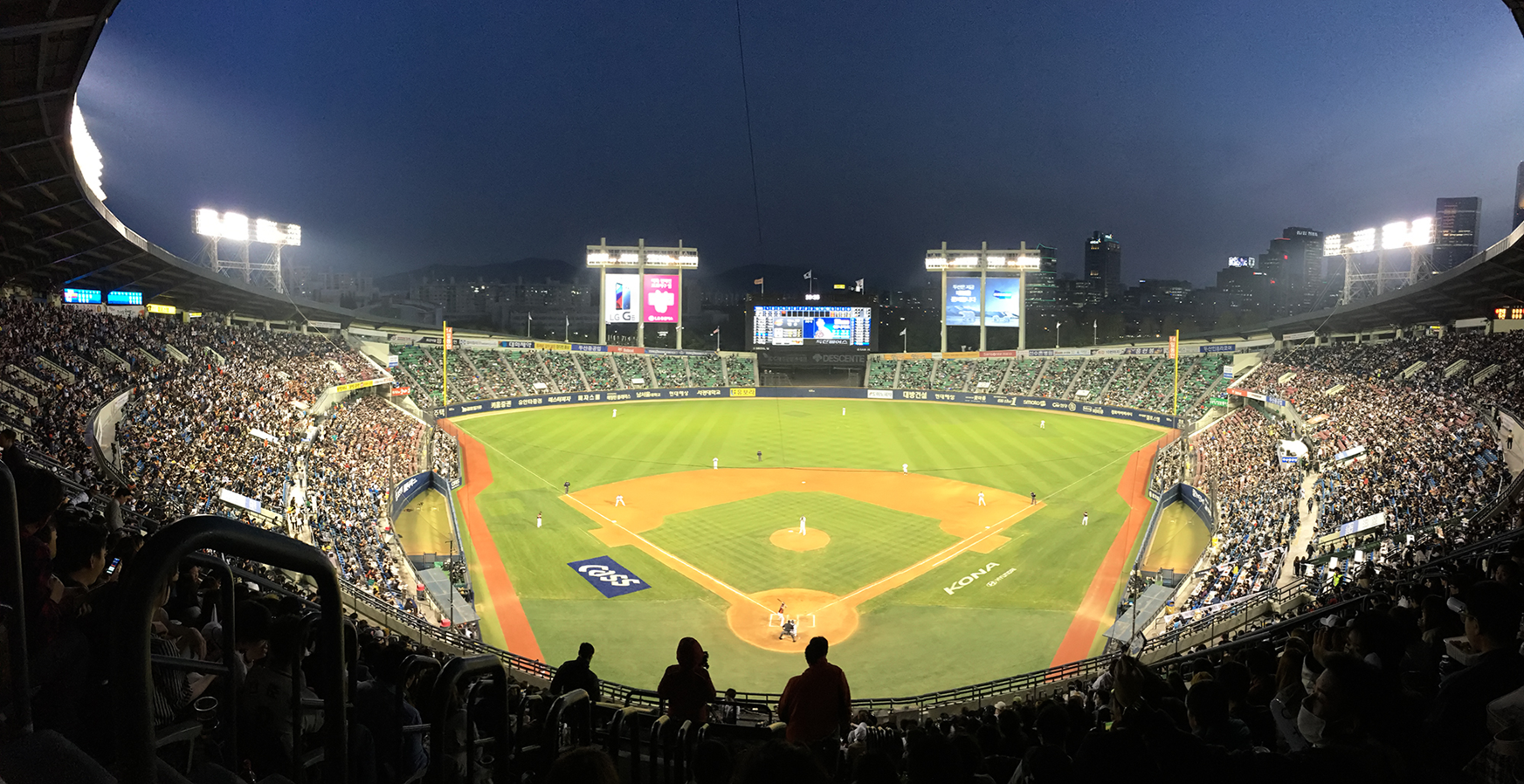
LG Twins and Doosan Bears share Jamsil Baseball Stadium (잠실야구장) in Songpa-gu. This is the best starting point for first-timers. It is a large, open-air stadium with a capacity of around 25,000, easy subway access, and enough food vendors and atmosphere to make any game worth attending regardless of which teams are playing. When LG and Doosan face each other — which happens multiple times each season — tickets sell out days in advance and the stadium becomes one of the louder sports venues in Asia.
One practical note worth stating clearly: Jamsil Stadium is scheduled for demolition at the end of the 2026 season. From 2027, both LG and Doosan will play at Seoul Olympic Stadium while a new facility is built on the Jamsil site, a process expected to take several years. If you are visiting Korea in 2026, this is your last chance to see a game in what has been the home of Seoul baseball for forty years. That is a reasonable argument for prioritising it.
Kiwoom Heroes play at Gocheok Sky Dome (고척스카이돔) in Guro-gu — Korea’s only domed baseball stadium. The acoustics inside a dome take some adjusting to: the crowd noise bounces and amplifies in a way that can feel overwhelming in the best possible sense during a close game. Rain or heat is never a factor, and the air conditioning makes it by far the most comfortable stadium option in the July–August heat.
SSG Landers play at Incheon SSG Landers Field in Incheon — close enough to Seoul to reach easily on the subway, and worth considering if you want a slightly less crowded experience than Jamsil.
KT Wiz are based in Suwon at KT Wiz Park, about an hour from Seoul by subway. This is a good option if you happen to be spending time in Suwon anyway.
Outside Seoul
Lotte Giants play in Busan at Sajik Baseball Stadium (사직야구장), and Busan fans are among the most vocal in the league. If you are heading to Busan, a Lotte Giants home game is an entirely different atmosphere from anything in Seoul — regional pride runs deep, and Lotte is the team that carries it.
Samsung Lions are in Daegu, Hanwha Eagles in Daejeon, NC Dinos in Changwon, and Kia Tigers in Gwangju. Any city you visit during baseball season will have at least one team nearby. Check the schedule and fit a game into your itinerary if the dates align.
How to Buy KBO Baseball Tickets in Korea
Online platforms
The main ticketing platforms are Interpark Ticket (인터파크 티켓, ticket.interpark.com) and Ticketlink (티켓링크, www.ticketlink.co.kr). Both are in Korean, but both work with overseas credit cards once you navigate through the interface. Most travellers manage using a browser translation plugin or simply by clicking through the steps carefully — the purchase flow follows a familiar pattern once you are on the seat selection page.
Each team also sells tickets through its own official website and app, which can sometimes have better availability for popular games, though the apps are more difficult to navigate without Korean language ability.
Klook and Trazy list KBO game tickets aimed at foreign travellers, often for specific matchups and with English-language support. You will typically pay a small service premium over the face price, but the convenience is worth it if you find the Korean-language platforms frustrating.
At the gate
Walk-up tickets (현장 판매) are sold at the stadium box office on game day. This works reliably for weeknight games between lower-ranked teams. For weekend games — especially any matchup involving LG, Doosan, or the Heroes in Seoul — do not rely on the box office. Those games sell out online days in advance and the box office inventory is small.
If you arrive and the game is sold out, scalpers operate near the entrances at most stadiums. Prices go up for sold-out games; treat it as a judgment call based on how much you want to be there.
Ticket prices and seating categories
Korean baseball tickets are cheap by international standards. The main seating categories:
| Section | Korean Term | Approximate Price |
|---|---|---|
| Outfield bleachers | 외야 (waeya) | ₩9,000–₩12,000 |
| Infield general | 내야 일반 (naeya ilban) | ₩13,000–₩16,000 |
| Infield reserved | 내야 지정 (naeya jijung) | ₩14,000–₩18,000 |
| Premium / table seats | 테이블석 / 프리미엄 | ₩25,000–₩50,000+ |
| Bleacher seats | 블리처 | ₩9,000–₩11,000 |
For your first game, sit in the outfield bleacher section (외야응원석) behind either team’s outfield fans. This is the cheapest section and by far the liveliest. You will be in the middle of the organised cheering, surrounded by fans in full kit, with a direct sightline to the cheerleaders on the dugout roof. The baseball purist in you may prefer an infield seat with a better angle on the field; the person who wants to understand what Korean baseball actually feels like should go to the outfield.
Note that the outfield is split: one side belongs to the home team’s fans, the other to the visiting team’s fans. If you have no particular allegiance, home team side is usually the larger and louder section.
When to buy
Popular weekend matchups in Seoul — especially anything involving LG vs. Doosan — sell out within hours of tickets going on sale, which typically happens three to seven days before the game. Mid-week games between teams not fighting for a playoff spot are almost always available on the day of the game, including at the box office.
The season runs from late March or early April through late October, with the playoffs extending into November in some years. The peak season for attending a game is May through September, when the weather is warm enough to make an open-air stadium comfortable for an evening game. July and August are the hottest months; if you go during this period, a domed game at Gocheok or an evening start is more comfortable than sitting in direct sun at Jamsil.
Getting to Seoul Baseball Stadiums
Jamsil Baseball Stadium is the easiest to reach. Take Line 2 or Line 8 to Jamsil Station (잠실역) and use Exit 5 or Exit 6. The stadium is a five-minute walk from the exit, and you will know you are going the right direction because half the train carriage will be heading the same way.
10 Jamsil-dong, Olympic-ro, Songpa-gu, Seoul
Jamsil Station, Line 2 / Line 8, Exit 5 or 6
Naver Map
Gocheok Sky Dome is closest to Guil Station (구일역) on Line 1 — about a ten-minute walk from the exit. Alternatively, Sindorim Station on Line 1 and Line 2 is a short taxi ride away.
Gocheok-dong, Guro-gu, Seoul
Guil Station, Line 1, approx. 10-minute walk
Naver Map
Sajik Baseball Stadium in Busan is a twenty-minute subway ride from central Busan on Line 3 to Sajik Station (사직역), Exit 5.
25 Sajik-ro, Dongnae-gu, Busan
Sajik Station, Line 3, Exit 5
Naver Map
Food and Drink at a Korean Baseball Game
Korean baseball stadium food culture is its own subject and worth knowing about before you go.
What you can bring in
Unlike many international sports venues, Korean baseball stadiums allow spectators to bring in their own food from outside. People bring full meals — kimbap rolls, sandwiches, chips, convenience store snacks, entire chicken boxes. Security checks bags at the entrance but food is generally waved through. What is not allowed is outside alcohol; you can bring in soft drinks and non-alcoholic beverages, but beer and soju from outside will typically be confiscated.
Stadium food highlights
Every stadium has food stalls and counters inside. The staples:
Fried chicken (치킨) is the defining stadium food. Multiple vendors operate inside most stadiums, and fried chicken is ordered by the piece or by the box. At Jamsil, you can sometimes order delivery directly to your seat via the Baemin (배달의민족) delivery app — a uniquely Korean arrangement where a delivery rider brings your order to a stadium gate and a runner brings it to your row.
Cup noodles (컵라면) are sold at stadium concession stands. You fill them with hot water from a dispenser on the counter. At ₩1,500–₩2,000, they are one of the cheapest and most practical stadium meals available.
Sausages, squid skewers, and hot dogs are available from carts around the stadium. Prices are generally reasonable — ₩3,000–₩6,000 range for most items.
Combo meals at the concession counters typically include a main, side, and drink for ₩12,000–₩18,000.
Beer at the stadium
Beer is sold inside every stadium, and the stadium beer experience is one of the things people remember most. Vendors carry large backpack-mounted beer tanks through the seating areas, pouring foam-topped cups on the spot. Wave one down, hand over cash or tap your card, and you have a beer in under a minute without leaving your seat. Hite, Cass, and OB are the most common options. Prices run ₩4,000–₩5,500 per cup.
The Cheering Culture: What Makes KBO Different
This is what separates a Korean baseball game from any other stadium experience in the world.
Every team has a dedicated cheering section (응원단) led by a cheermaster (치어마스터) — an MC figure standing at a podium near the front of the outfield section, microphone in hand, coordinating the crowd with the precision of a conductor. The cheermaster calls the chants, signals transitions, and keeps energy levels from dropping between pitches. If you sit in the outfield section, you will spend as much time watching this person work as you do watching the game.
Cheerleaders (치어리더) perform on platforms above the home team’s dugout. They are not peripheral — they are a core part of the broadcast and the live experience, dancing choreographed routines during rallies and between innings. Korean baseball cheerleading is a professional career, and the best-known cheerleaders develop significant fan followings of their own.
Walk-up chants: every batter in the KBO has their own personalised chant that the entire crowd sings in unison when that player steps up to bat. You will not know these chants on your first visit, but you do not need to. Sit in the outfield section, watch the cheermaster for cues, and follow along with what the people around you are doing. Within two or three innings, you will pick up the rhythm. By the seventh, you will be clapping along to songs you cannot identify and feeling inexplicably invested in a team you had never heard of four hours ago.
Thundersticks (막대풍선) — long inflatable sticks that fans clap together — are sold outside the stadium and at stalls inside. Bring your own from a convenience store near the stadium if you want them cheap; stadium prices are marked up slightly. They are not mandatory, but they are part of the atmosphere and the crowd noise they produce is substantial.
One important note: cheering sections are clearly divided between the home team and visiting team fans. If you sit on the wrong side — in the visiting team’s outfield section when you are cheering for the home team — you will quickly become aware of this. It is not dangerous, but it is socially uncomfortable and you will be the only person not standing during your team’s chants. Check your ticket and pay attention to the section designation when you enter.
What to Bring to a Korean Baseball Game
- Your ticket (on your phone is fine — QR codes scan at the turnstile)
- Cash for street food vendors outside the stadium and smaller concession stands inside; most large stands accept card, but not all smaller vendors do
- Layers — evening games get cool after the sun goes down, particularly in April, May, and September
- Sunscreen — afternoon games at open-air stadiums in summer can be brutal; the shaded infield sections are worth the price difference in July and August
- A light rain jacket for open-air stadiums — games are rarely cancelled for rain, and Korean crowds do not leave when it starts drizzling
- Your team’s merchandise — pick up a cap or a jersey from a stall outside the stadium before entry; it makes the cheering experience more immersive and you will look less like someone who wandered in by accident
Leave at the hotel: anything irreplaceable. Stadiums are safe, but bags get bumped and pockets are close together in crowded sections.
Practical Notes for Attending a KBO Game
Start times. Weeknight games typically kick off at 18:30. Weekend games usually start at 14:00 or 17:00. Arrive thirty minutes before the first pitch if you want to settle in, get food, and watch the warm-up. Night games under lights at Jamsil are the ideal format for a first visit.
Game length. KBO games run two to three hours. There is a ten-run mercy rule in the late innings that can shorten games. Extra innings are played with a runner already placed on second base from the tenth inning onward — a rule that limits games going beyond eleven or twelve innings.
Language. You do not need Korean to enjoy a game, but a few words help: 홈팀 (homtim, home team), 내야 (naeya, infield), 외야 (waeya, outfield), and 화장실 (hwajangsil, toilet). Stadium signage at the larger Seoul venues includes English. The concession menus are mostly accompanied by photographs.
Cashless payments. Larger stadiums have moved significantly toward card payment at food and drink counters. Some beer vendors only accept cash. Carry ₩30,000–₩50,000 in small notes to cover anything that does not take card.
Children. KBO games are extremely family-friendly. The food is accessible, the noise is more exciting than overwhelming for most children, and the atmosphere is cheerful rather than aggressive. Very young children typically enter free; check the team’s official site for age-specific pricing.
Foreigners buying tickets. Interpark and Ticketlink both allow overseas credit card purchases, though the process occasionally requires a workaround for the identity verification step. If you encounter this, use the Klook or Trazy options instead — the markup is small and the experience is straightforward.
KBO mobile app. The official KBO app is available in Korean only, but it provides live scores and schedules. English-language score tracking is available through MyKBO (mykbostats.com) and ESPN.
A Korean baseball game is, ultimately, a window into how Koreans choose to spend a weeknight in summer. It is affordable, it is communal, and it is loud in a way that feels celebratory rather than tense. You do not need to understand baseball to enjoy it. You barely need to follow the game. Sit in the outfield, order chicken, buy a cup of beer from the backpack vendor, and let the cheermaster tell you when to stand up and yell. That is the whole instruction set.
For more on getting around Seoul and planning a visit around local experiences, see the Seoul First-Timer’s Guide and Korea Travel Essentials.
Frequently Asked Questions
How much does a Korean baseball game ticket cost? Tickets start from ₩9,000 for outfield bleacher seats — the cheapest and most atmospheric section. Infield seats run ₩13,000–₩18,000. Premium table seats cost ₩25,000–₩50,000+. For first-timers, the outfield bleacher section is strongly recommended for the full KBO cheering experience, regardless of price.
Where can I buy KBO tickets as a foreigner? The easiest options for foreigners are Klook and Trazy, which offer KBO tickets with English-language interfaces and overseas credit card support (with a small service premium). Interpark and Ticketlink are the main Korean platforms — both accept overseas credit cards but require navigating a Korean-language interface. For popular Seoul games, book 3–7 days ahead.
Is Jamsil Stadium still open in 2026? Yes — Jamsil Baseball Stadium (잠실야구장) is still operating in 2026 as the home of the LG Twins and Doosan Bears. However, it is scheduled for demolition at the end of the 2026 season. This is your last chance to see a game in this historic venue before both teams move to Seoul Olympic Stadium from 2027.
What should I eat at a Korean baseball game? Fried chicken is the signature Korean baseball food — order it by the piece or box from stadium vendors. Cup noodles (₩1,500–₩2,000) are a budget classic. Beer from backpack-tank vendors is an essential experience. Bring your own snacks from a nearby convenience store before entering — outside food (but not outside alcohol) is allowed in KBO stadiums.
Can I go to a Korean baseball game if I don’t understand baseball? Absolutely. The appeal of a KBO game is the experience — the coordinated crowd chanting, the cheermaster conducting thousands of fans, cheerleaders on the dugout roof, backpack beer vendors. You don’t need to follow the action on the field to have an extraordinary time. Sit in the outfield section, follow what everyone around you does, and enjoy.
When is the best time to attend a KBO game in Korea? May through September is the sweet spot: warm enough for outdoor stadiums but before the worst August humidity. Evening games (18:30 on weekdays) are the most atmospheric. Avoid midday summer games at open-air stadiums like Jamsil if you’re heat-sensitive — the shaded sections are worth the upgrade. October is also excellent for playoff atmosphere if the dates align with your visit.