There is a phrase circulating on Korean social media right now: “2주 뒤면 못 먹는다” — you won’t be able to eat this in two weeks. It sounds like an advertisement, but it isn’t. It’s how young Koreans are describing spring vegetables to each other, and it’s the emotional engine behind the country’s biggest current food trend: 제철코어 (seasonal-core, jeolche-core).
The premise is as simple as food culture gets. 제철 (jeolche) means “in season.” 코어 (-core) is the internet suffix for an aesthetic identity — cottagecore, dark academia, that kind of thing. Together they describe a mindset that has taken hold among Korean millennials and Gen Z: the deliberate, almost urgent pursuit of ingredients that are only available for a narrow window each year, and a whole lifestyle built around marking the seasons through what you eat.
Why 제철코어 Is Dominating Korean Food Culture in 2026
Korea has had seasonal eating traditions for centuries — the Joseon-era custom of eating jeolsik (seasonal ritual food) was bound to the agricultural calendar. What’s new is why young Koreans are returning to it.
Climate change is the uncomfortable backdrop. As warmer winters and unpredictable weather blur the lines between seasons, the arrival of genuinely seasonal produce has become notable in a way it never used to be. When spring greens appear at the market, it feels like a small confirmation that the season has actually arrived. Eating them feels like paying attention.
There’s also a reaction against the previous generation of viral food trends. The cycle of 두바이 초콜릿 (Dubai chocolate), 탕후루 (candied fruit skewers), and 두쫀쿠 (a soy milk chewy cookie hybrid) moved so quickly — from queues around the block to forgotten in three months — that many younger consumers grew fatigued. 제철코어 offers the opposite: food rooted in something that genuinely changes, that has a reason to be eaten now, and that connects eating to time and place rather than novelty.
The result is that going to the market to find the first 봄동 of spring has become, on Korean social media, a form of content as compelling as any café visit.
What to Eat in Korea Right Now: Spring Seasonal-core
Spring is the richest season for 제철코어, and this is what’s driving the current wave. The window is short — most of these ingredients peak between late February and early April.
봄동 (Bomdong — Spring Cabbage)
The undisputed star of spring 2026. 봄동 is a variety of cabbage that grows through the frost of winter and is harvested in early spring. The leaves are flat and splayed rather than tightly headed, with a sweetness that comes specifically from surviving cold — the plant converts starch to sugar as protection against freezing. Once the weather warms, that flavour disappears.
봄동 비빔밥 has gone thoroughly viral. It’s nothing complicated — the tender leaves torn and dressed with doenjang (fermented soybean paste), sesame oil, garlic, and gochugaru, mixed into warm rice — but the specific flavour of this cabbage at this moment of year is what makes it memorable. Food personality Kang Ho-dong apparently declared his love for it almost two decades ago; Korean social media is only now catching up.
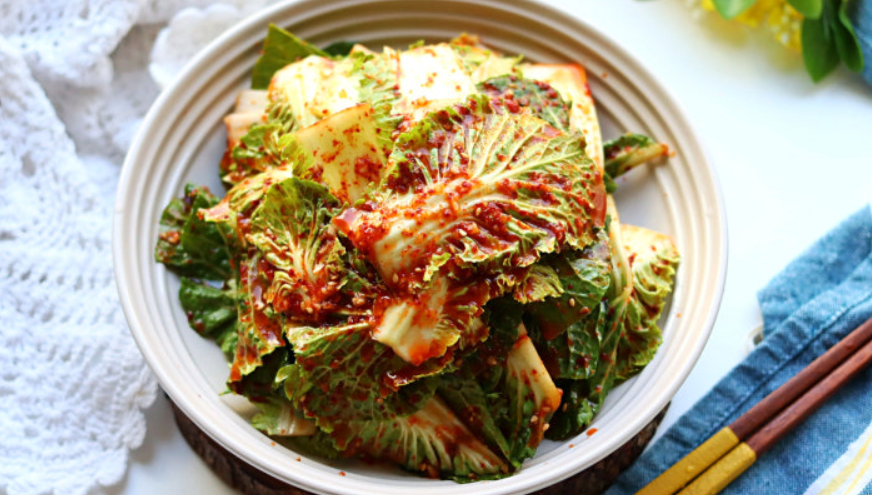
The commercial response has been immediate. Daesang (the food company behind Chongga Kimchi) sold 22 tonnes of 봄동 겉절이 (a fresh, lightly fermented kimchi made with bomdong) within two months of launch. Restaurants that put 봄동 비빔밥 on the menu this season report it outselling everything else.
Where to find it: Any neighbourhood restaurant serving home-style Korean food (hansik) will likely have it right now. Gwangjang Market (광장시장) in Jongno-gu is one of the most reliable places in Seoul to find seasonal vegetable dishes as they actually arrive — the banchan stalls here rotate with the season, not with a menu cycle.
냉이 (Naengi — Shepherd’s Purse)
A small spring herb with a deeply earthy, slightly bitter flavour that has no real Western equivalent. 냉이 is used most commonly in 냉이 된장국 (naengi doenjang-guk), a fermented soybean paste soup that gets most of its character from the herb. It’s also blanched and served as a namul (seasoned vegetable side dish), and occasionally used raw.
The season is brief — late February through March in most of Korea. Once it bolts and flowers, the flavour deteriorates.
달래 (Dallae — Wild Garlic Chives)
A thin, wild allium that smells faintly of garlic and has a sharp, clean bite when raw. 달래 간장 (a dipping sauce made with dallae, soy sauce, sesame oil, and chilli) is one of the most classically spring-specific condiments in Korean cooking — it’s eaten with tofu, used as a seasoning for 비빔밥, and stirred into soups. Catching it at peak season, when the chives are young and the flavour is bright rather than pungent, is part of the ritual.
딸기 (Strawberry)
Korea’s strawberry season runs from December through March, and the best fruit — particularly the large, fragrant varieties like 설향 (Seolhyang) and 죽향 (Jukhyang) — is available through the end of this month. The 제철코어 framing has made strawberry cafés and strawberry desserts unusually prominent this winter and spring: CU convenience stores launched 제철코어-targeted strawberry desserts in January, and coffee chains including 이디야 and 메가MGC introduced strawberry-specific menus in response to demand.
The more interesting version of the trend, though, is people buying mak-ttal (막딸기, lower-grade strawberries sold loose and cheaply at the end of the season) and eating them at home — the flavour is better than the beautiful café version, and the scarcity is the point.
The Seasonal-core Lifestyle: Beyond Just Korean Food
제철코어 has expanded beyond what’s on the plate.
Fashion. “봄동을 입고 딸기를 코디한다” — dress in bomdong colours, coordinate in strawberry hues — is a genuine aesthetic approach circulating on Instagram and KakaoTalk. The pale, slightly dusty green of spring cabbage, the flat red of ripe strawberries, the cream-white of early naengi: these are being used as palette references for outfits, interiors, and photography.
Hiking. 관악산 (Gwanaksan), the mountain at the southern edge of Seoul, has seen a noticeable uptick in young visitors this spring, partly because of its proximity to early spring wildflowers and partly because the 제철코어 mindset — being present for what the season offers, at the moment it’s available — maps naturally onto nature walks. The same logic that gets someone to the market before the 봄동 runs out also gets them on a trail before the forsythia finishes blooming.
Markets. Large discount supermarkets, normally treated as purely functional, have become destinations. The 오픈런 (queue-before-opening sprint) — previously associated with limited-edition sneaker drops or café desserts — is now something people do for seasonal produce. The urgency is real: 냉이 at a traditional market in late March will be visibly past its best; the same herb two weeks earlier is worth the early alarm.
Why Korean Gen Z is Obsessed with Seasonal Eating
Five reasons young Koreans give for being drawn to 제철코어, distilled from what’s circulating online:
It’s genuinely unrepeatable. The specific flavour of 봄동 this week, at this temperature, after this winter — it won’t exist again. That’s not marketing language; it’s accurate. The culture around limited-edition drops has primed Gen Z to understand scarcity, and 제철코어 redirects that instinct toward something natural rather than manufactured.
It’s a counter to overstimulation. After years of increasingly extreme food trends — each one more novel, more engineered, more photogenic — spring vegetables feel like a recalibration. The flavours are subtle. The experience requires attention.
It photographs beautifully. Pale green 봄동, vivid red 딸기, the tangle of 달래 against white rice — spring produce is genuinely photogenic, and the impermanence of the season gives every image a timestamp. “Ate this before it was gone” is a narrative structure that works on social media.
It connects to care about the environment. Eating with the season is a low-friction form of environmental behaviour that doesn’t require explanation or argument. For a generation that has grown up with climate anxiety as background noise, 제철코어 is a way of acting in accordance with values without it feeling like sacrifice.
It’s shareable without being expensive. A bowl of 봄동 비빔밥 at a neighbourhood restaurant costs ₩8,000–₩10,000. A bag of 냉이 at the market is a few thousand won. Unlike the café culture that defined the previous cycle of Korean food trends, 제철코어 is accessible at almost every price point — the premium is in the timing, not the cost.
How to Experience 제철코어 as a Visitor to Seoul
If you’re in Seoul right now, late March is the correct moment:
Gwangjang Market (광장시장) — The banchan stalls in the interior of the market are the most direct way to encounter spring seasonal vegetables as they actually arrive. Tell the vendor you want whatever is in season (제철 것 주세요) and eat whatever they point to.
Any 한식집 (hansik restaurant) with handwritten daily menus — chalk boards or paper notices outside a restaurant listing 봄동 비빔밥 or 냉이 된장국 are a reliable indicator that the kitchen is tracking the season. Tourist-facing restaurants with printed English menus are less likely to have seasonal rotations.
Supermarket produce sections — E-Mart, Homeplus, and Lotte Mart all stock spring seasonals now. The seasonal produce corner, usually signposted, will have 봄동, 냉이, and 달래 displayed together.
The window is closing. 냉이 is at its peak for perhaps another two to three weeks. 봄동 will follow. 딸기 season ends around the end of April for most Korean varieties. The 제철코어 logic says: if you’re here, eat them now.
For more on eating well in Seoul, see the Korean Street Food Guide and the Seoul Restaurant Guide 2026. If seasonal eating has you curious about Korea’s regional produce traditions, the Korea regional produce guide goes deeper on where ingredients come from. You can also find spring seasonal vegetables at Korea’s traditional markets.
Frequently Asked Questions
What is 제철코어 (seasonal-core)? 제철코어 (jeolche-core) is a Korean food and lifestyle trend built around urgently eating ingredients that are only available for a narrow seasonal window. 제철 means “in season” and -코어 is the internet suffix for an aesthetic identity (like cottagecore or dark academia). It has become one of the dominant food trends among Korean millennials and Gen Z in 2026.
Where can I experience 제철코어 as a visitor in Seoul? Gwangjang Market (광장시장) in Jongno-gu is the most direct option — the banchan stalls rotate with the actual season, not a printed menu cycle. Any neighbourhood hansik restaurant with a handwritten daily menu is also a reliable indicator. E-Mart, Homeplus, and Lotte Mart all stock seasonal produce sections clearly signposted in their stores.
What spring seasonal produce should I try in Korea? The key spring ingredients driving the 제철코어 trend are: 봄동 (bomdong, a frost-sweetened spring cabbage), 냉이 (naengi, shepherd’s purse — an earthy spring herb), 달래 (dallae, wild garlic chives), and 딸기 (strawberries, particularly the large Seolhyang and Jukhyang varieties). These are available from late February through early April in most years.
How is 제철코어 different from other Korean food trends? Unlike previous viral trends — candied fruit skewers (탕후루), Dubai chocolate, or chewy cookie hybrids — seasonal-core is not manufactured novelty. The urgency is real (ingredients are only available for weeks), the food is affordable (₩8,000–10,000 for a seasonal bowl), and the experience is rooted in the agricultural calendar rather than marketing cycles. This makes it more durable as a trend.
Can I buy seasonal Korean produce to take home? Fresh produce like 봄동 and 냉이 is not easily exportable. However, processed forms — 봄동 겉절이 (fresh kimchi) from brands like Daesang, or dried naengi tea — can be found at Korean supermarkets and some specialty food shops internationally. Buying it fresh in Korea and eating it there is the point.
Is 제철코어 only about food? No. The trend has expanded into fashion (wearing spring produce-inspired colour palettes), hiking (being present for seasonal wildflowers and trail conditions), and even supermarket shopping — the 오픈런 (open run, queuing before opening) that was previously associated with sneaker drops is now happening for seasonal produce at traditional markets.