
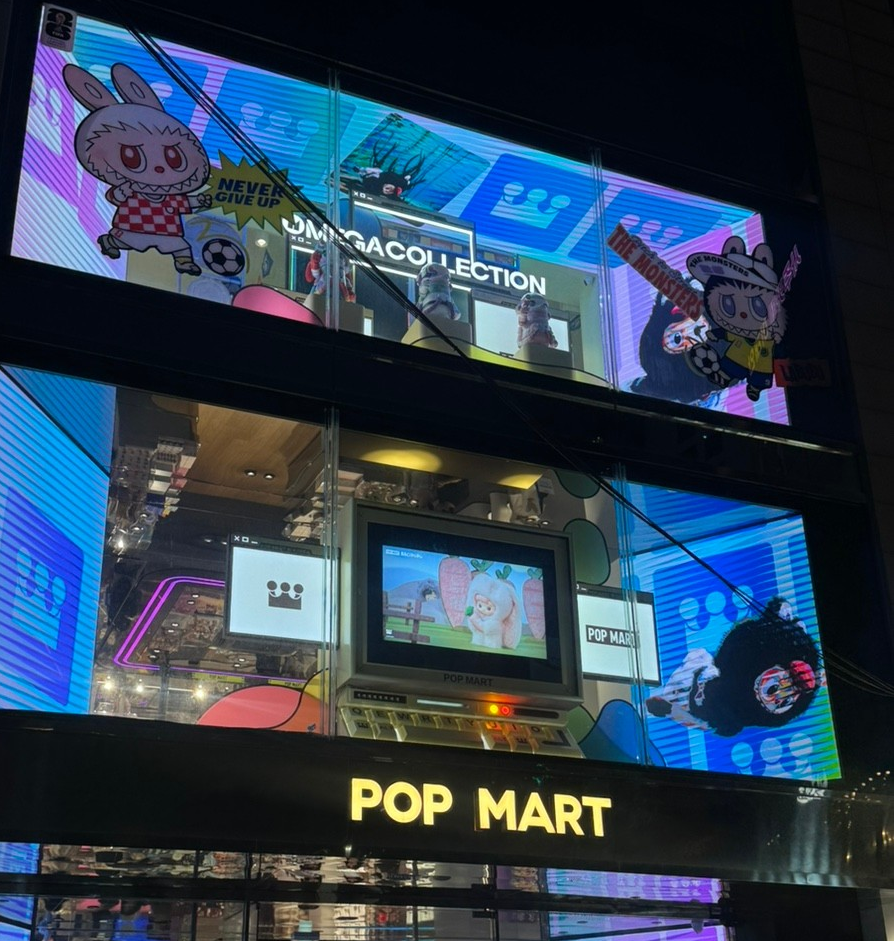
Nine pointy teeth, rabbit-like ears, and a grin that splits the difference between cute and unsettling — that’s Labubu, the character that turned a Chinese toy company’s blind-box aisle into one of the most photographed corners of Seoul. At various points over the last two years, this small monster doll has caused police to be called to Seoul shopping malls, sent resale prices soaring past fifty times retail, forced Pop Mart Korea to suspend in-store sales nationwide, and prompted a formal customs warning about carcinogens in counterfeits.
The twist, as of mid-2026, is that the mania has entered a strange second act. Resale prices that once hit 40 times retail have collapsed. Secondhand marketplaces are full of people practically giving Labubus away. And yet new Pop Mart releases still sell out within hours — while the lines outside the Hongdae flagship are increasingly forming for entirely different characters. Here’s what actually happened, how to buy a real Labubu without overpaying, and what Korean collectors are chasing now.
A quick note: prices, stock, raffle schedules, and store hours below move fast and change with each new series drop. Treat this as a guide to where to look and what to check, not a guaranteed in-stock list — and check the Pop Mart Korea app for that week’s actual situation.
In this guide:
- What Is Labubu, and Why Was It Suddenly Everywhere?
- Where to Buy Labubu in Korea (2026 Store List)
- The 2025 Mania: Police, a Sales Suspension, and a Buying Lottery
- The 2026 Crash: From ₩170,000 to Near Retail
- How to Spot a Fake: Real Labubu vs. “Lafufu”
- What Collectors Are Chasing Instead
- Quick Reference: Buying Pop Mart Figures in Korea
- Frequently Asked Questions
What Is Labubu, and Why Was It Suddenly Everywhere?
Labubu is a character from THE MONSTERS, a toy line created by Hong Kong–born, Netherlands-based artist Kasing Lung and produced as blind-box figures by the Chinese company Pop Mart starting in 2019. The figure — a grinning, sharp-toothed little monster with rabbit ears — comes packed inside a sealed box so you don’t know which colorway or pose you’ve gotten until you open it. That randomness, plus rare “secret” versions hidden at low odds inside a set, is the same slot-machine psychology that has powered Korea’s gacha and blind-box booms for years — Labubu is simply the character that broke out furthest and fastest.
The tipping point in Korea was K-pop. When BLACKPINK’s Lisa was repeatedly photographed with a Labubu keyring clipped to her bag — in airport fashion, on Instagram, backstage — it did what idol association reliably does to a product in Korea: turned a niche collector item into something a much wider audience suddenly wanted. Rosé followed with her own Labubu appearances, and by the time Pop Mart’s 10th-anniversary Labubu lineup and a Lisa-fronted FIFA World Cup collaboration landed in 2026, the character had fully crossed over from “collector hobby” into mainstream fashion accessory for the country’s MZ generation.
Where to Buy Labubu in Korea (2026 Store List)
Pop Mart Korea’s own stores are still the only way to guarantee an authentic figure at retail price, and the offline suspension of 2025 has eased as the panic-buying died down — walk into a Seoul store today and the scene is almost anticlimactic: a wall of Labubu boxes sitting there for anyone to pick up. These are also where older stock and Pop Mart’s other IP (Molly, Skullpanda, Dimoo, Crybaby) are sold normally:
| Store | Area | Map | Notes |
|---|---|---|---|
| Hongdae Flagship | Mapo-gu, Seoul | Naver Map | Pop Mart’s largest Korean store — two floors near Hongik Univ. Station (Exit 9), best-stocked in Seoul with rarer pieces upstairs |
| Myeongdong Premium Theme Shop | Jung-gu, Seoul | Naver Map | Near Myeongdong Station (Exit 6); themed rotating displays, convenient for the main shopping strip |
| COEX Mall | Gangnam-gu, Seoul | Naver Map | Inside Starfield COEX — easy to combine with the aquarium |
| The Hyundai Seoul | Yeongdeungpo-gu, Seoul | Naver Map | Department store location, Yeouido |
| I’Park Mall Yongsan | Yongsan-gu, Seoul | Naver Map | Same mall complex as several gacha shops |
| Starfield Goyang / Suwon / Anseong | Gyeonggi Province | Goyang Suwon Anseong | Regional locations outside central Seoul |
| Busan Samjeong Tower | Busan | Naver Map | The main outpost outside the Seoul metro area |
A few things worth knowing before you go:
- New, hyped “pop issue” drops still aren’t a casual walk-in purchase. Pop Mart Korea enforces a strict one-per-person limit with a physical photo ID check at checkout, and the highest-demand releases still route through online pre-registration draws on the official app and site — entries open for a set window, winners are notified by text, and the purchase voucher expires fast. Check the app before building a day around a drop.
- Lines form early on release mornings at Hongdae and Myeongdong especially — arriving at opening rather than mid-afternoon meaningfully improves your odds.
- Online, popmart.co.kr restocks periodically but sells out just as fast as physical stores during a hot drop; the full store list with hours is on the official store finder.
- Seongsu-dong hosts temporary Labubu pop-ups — including a widely photographed “Labubu’s Suspicious Convenience Store” concept shop — so check pop-up listing sites like Popply if you want a limited activation rather than the permanent stores.
- For sold-out series, KREAM (with authentication built into every listing), Bunjang, and Fruits Family are the realistic fallbacks — and post-crash, prices there are often at or below retail a couple of weeks after a drop.
The 2025 Mania: Police, a Sales Suspension, and a Buying Lottery
What followed was some of the most intense retail chaos Korea has seen over a toy: overnight lines outside Pop Mart’s Seoul flagships, tents pitched before store openings, and a KakaoTalk Gift Shop keyring drop that reportedly drew over 200,000 pre-registrations and sold out in under ten minutes.
In June 2025, crowds lining up for new Labubu drops grew large and chaotic enough that police were called to manage the scene — a smaller echo of scuffles that had already broken out at Pop Mart stores in the UK. Citing customer safety, Pop Mart Korea suspended in-store Labubu sales nationwide. When sales resumed, it was under a new model: online pre-registration raffles for a limited purchase voucher, with winners notified individually by text and given a window as short as a single day to redeem it at a designated store. Some releases routed the same voucher system through KakaoTalk Gift.
That engineered scarcity poured fuel on the resale market rather than cooling it off. On KREAM, Korea’s dominant sneaker-and-collectibles resale platform, the numbers got genuinely absurd:
- A THE MONSTERS Highlight Series “Zaa” keyring that retailed for ₩21,000 traded for roughly ₩610,000 — nearly 30 times its release price.
- A Labubu × Pronounce fantasy-wing plush, released at ₩128,000, changed hands for as much as ₩1,300,000.
- Korean financial press reported KREAM listings with resale premiums as high as 5,133% during the peak of the shortage, and one secret-edition figure reportedly fetched close to ₩4.6 million on the secondary market.
The 2026 Crash: From ₩170,000 to Near Retail
Here’s the part most global coverage of Labubu misses, because it’s happening right now, specifically in Korea: the resale bubble didn’t slowly deflate — it collapsed. What killed the frenzy wasn’t a single event; it was ordinary hype fatigue plus a trust problem, and both show up clearly in the numbers.
Resale prices fell off a cliff. Figures that were trading around ₩170,000 at the peak now go for roughly ₩26,000–27,000 on KREAM — barely above Pop Mart’s own retail price, which itself was raised from ₩21,000 to ₩24,000 for the current Highlight series blind box. A six-piece blind-box set that once traded near ₩450,000 changed hands by June 2026 for closer to ₩120,000, barely above its ₩126,000 retail price. Some sellers have reportedly resorted to giving unsold stock away for free on secondhand apps. That’s a drop of more than 80% from the top of the market.
Counterfeits broke the trust the whole market ran on. As demand outstripped supply through 2025, the secondary market filled with increasingly convincing fakes. Buyers who paid resale premiums specifically to guarantee authenticity started discovering, after the fact, that they’d bought counterfeits anyway — which undermines the entire premise of paying a markup in the first place.
It was a short-form-video trend, and those burn out fast. Analysts covering the crash point to a familiar pattern: a product that blows up almost entirely through Instagram Reels and YouTube Shorts tends to peak and fatigue on the same accelerated timeline. Korean search interest in “라부부” (Labubu) has fallen from a peak index of 100 down to roughly 3 as of mid-2026 — about as clean a boom-bust curve as a consumer trend produces.
But retail demand hasn’t disappeared — just the speculative froth. When Pop Mart released its “Retro Barbershop” Labubu series in late June 2026, it still sold out at official stores on release day. The difference: resale listings appeared below retail price within days, something unthinkable a year earlier. In practice, that means 2026 is arguably the best window in two years to buy a Labubu near actual retail price — you just need to be there on drop day, or shop resale a week or two after a release rather than during the initial frenzy.
How to Spot a Fake: Real Labubu vs. “Lafufu” — and Why It Actually Matters
Counterfeits — nicknamed “Lafufu” online — are common enough in Korea’s secondhand and street markets that Pop Mart itself has published guidance on spotting them. And this is the section worth reading even if you have zero interest in owning one, because the fake-goods problem goes beyond “you got ripped off.”
In late 2025, Korea Customs tested counterfeit Labubu keyrings and jewelry seized from overseas direct-purchase shipments. Of 250 counterfeit accessories tested, 112 items (44.8%) contained carcinogenic substances — lead, cadmium, and plasticizers — above legal safety limits. Two counterfeit Labubu keyrings tested at 344 times the domestic safety standard for DEHP, a plasticizer classified as a possible human carcinogen and linked to endocrine disruption. Some counterfeit metal jewelry in the same batch tested at over 5,000 times the legal limit for lead and cadmium. Separately, U.S. product safety regulators have warned that flimsy counterfeits break apart easily, creating a choking hazard for small children.
Before you buy anywhere other than an official store, check:
- The teeth. A real Labubu has exactly nine teeth. Fakes frequently get the count wrong.
- The box. Genuine boxes carry a holographic authentication sticker and a sharp, clean POP MART logo; a blurry or slightly-off version is a red flag.
- The paw. Authentic figures have a QR code and UV-reactive stamp on the sole of one foot — under blacklight it reveals a clean logo and character image.
- The code. The serial number or QR code should register successfully on Pop Mart’s official Global App; fakes typically fail to register.
- The paint and feel. Paint should be precise around the eyes, teeth, and blush with no bleeding; counterfeits tend to use lighter, hollow-feeling plastic versus the denser official build.
- The price and availability. A hyped, sold-out figure sitting in stock at a random shop under roughly ₩10,000 is the single biggest red flag — genuine figures don’t sell that cheap even on markdown.
- The seller. Official Pop Mart stores, the official app, or KREAM’s authentication service. Street stalls and unverified social-media sellers are where most fakes circulate — Korean collectors actively share “정품 구별법” (how to spot a real one) guides for good reason.
Given the customs findings, treat any unverified Labubu as decor, not a kids’ toy, until you know where it came from.
What Collectors Are Chasing Instead
The more telling part of this story isn’t that Labubu fell — it’s what replaced it. Ask the person third in line outside the Hongdae flagship what they’re actually waiting for in 2026, and there’s a decent chance the answer is 크라이베이비 (Crybaby), 트윙클트윙클 (Twinkle Twinkle), or 스컬판다 (Skullpanda).
Crybaby is the character most often described as “the one that pushed Labubu aside” in Korea. Created by Thai artist Molly Illom — reportedly inspired by grief over the loss of her own cat — Crybaby is a figure that is, permanently and without exception, mid-cry. Fans describe it as a toy that “cries so you don’t have to,” turning it into an odd little comfort object as much as a collectible. Fresh blind-box series arrive every few months — a Powerpuff Girls crossover, a “표범 냥이” (leopard cat) line, and a summer “눈물 바다” (sea of tears) drop have all landed in 2026 — and celebrity sightings have made it socially legible well beyond the hobbyist crowd: actor Jung Ryeo-won, IVE’s Jang Wonyoung, and Oh My Girl’s Mimi have all been photographed with Crybaby keyrings.
Twinkle Twinkle (우리는 반짝반짝 작은별), named after the Korean lyric for “Twinkle Twinkle Little Star,” is a constellation-themed line with a reputation for vanishing from shelves within minutes of restock. Skullpanda is the moodier, collector-forward end of the lineup — and Pop Mart’s vehicle for 2026’s more unexpected collaborations, including a Skullpanda × My Little Pony keyring series that briefly turned two very different fandoms into the same waiting line. Blind-box keyrings and figures across these lines typically retail between ₩8,000 and ₩32,000; restocks are announced with a day or two of notice on the official app and Instagram (@popmart_korea).
Beyond Pop Mart entirely, the collector mood has shifted toward what Koreans call “나만 아는 레어 캐릭터” — a rare character only I know about. The clearest beneficiary is 슈가바니즈 (Sugarbunnies), a minor 2004 Sanrio property about seven twin rabbit siblings who are genius confectioners — soft, whimsical, and deliberately uncommercial-feeling, which is exactly its appeal to collectors tired of the biggest name winning by default. Korean media has started calling 2026 “the year of Sugarbunnies.” Unlike Labubu, its goods mostly circulate through Seoul’s booming gacha shop scene — capsule machines in Hongdae and Seongsu carrying Sugarbunnies sets reportedly sell out fast enough to create their own mini open-run moments.
And for buyers tired of gambling on a blind box altogether, Jellycat’s Amuseables line — plush, googly-eyed versions of everyday objects like a croissant or a coffee cup, sold at select department stores — has been posting sharp growth across Asia as a pick-it-yourself alternative with the same underlying appeal: an inexpensive, extremely photogenic object to own, display, and clip to a bag.
Quick Reference: Buying Pop Mart Figures in Korea
| What | Details |
|---|---|
| Best store for selection | Hongdae Flagship (2 floors, near Hongik Univ. Station Exit 9) |
| Most convenient for tourists | Myeongdong Premium Theme Shop or COEX Mall |
| Typical blind-box price | ₩8,000–32,000 per figure depending on series; Labubu Highlight series |
| Purchase limit on new drops | 1 per person, photo ID required; hottest releases via app raffle |
| Best time to go | Store opening on release day, or ~1–2 weeks after a drop for calmer resale prices |
| How to spot a fake | Hologram sticker, QR code, UV paw stamp, exactly 9 teeth |
| Trusted resale platforms | KREAM (authenticated), Bunjang, Fruits Family |
Frequently Asked Questions
Is Labubu still popular in Korea in 2026? Yes, but its peak buzz has passed. Retail demand is still strong enough that new releases sell out on launch day, but the extreme resale premiums — once as high as 40–50 times retail — have collapsed, and Pop Mart is actively promoting newer characters like Crybaby, Twinkle Twinkle, and Skullpanda to sustain growth. Labubu is still sold and collected, just no longer the character driving the longest lines.
Can I just walk into a Pop Mart store in Seoul and buy one? For most figures and past series — yes, and without the lines and scuffles of 2025. For brand-new, hyped releases, expect a one-per-person limit with ID check, and check the Pop Mart Korea app first: the hottest drops still sell through online pre-registration draws with short redemption windows.
Why did Labubu prices crash? A combination of trend fatigue from a hype cycle driven almost entirely by short-form video, and a wave of convincing counterfeits that undermined buyer trust in the resale market. Resale prices have fallen more than 80% from their 2025 peak, with some sets now trading below retail within days of release.
How do I know if a Labubu is real or a “Lafufu” fake? Buy from Pop Mart’s official channels or KREAM’s authentication service. Check the box for a holographic sticker and scannable QR code, look for the UV stamp and QR code on the sole of the foot, count the teeth (exactly nine), and try registering the serial code on Pop Mart’s Global App.
Are fake Labubus actually dangerous, or is that overblown? It’s not overblown. Korean customs testing in late 2025 found carcinogenic substances — lead, cadmium, and plasticizers — at up to hundreds of times legal safety limits in nearly half of counterfeit units tested, and separate warnings flag choking hazards from cheaply made fakes. Don’t give an unverified one to a small child.
What’s replacing Labubu as Korea’s collecting obsession? Within Pop Mart, Crybaby is the clearest successor, alongside Twinkle Twinkle and Skullpanda. Outside it, Sanrio’s long-forgotten Sugarbunnies line has become the “rare character only I know” of 2026, sold mainly through Seoul’s gacha shops rather than blind-box retail.
How much do Crybaby and Skullpanda figures cost? Blind-box keyrings and figures typically retail between ₩8,000 and ₩32,000 depending on the series. Resale prices for sold-out or “secret” editions can spike right after a drop, then fall sharply once attention moves to the next release — treat any resale price as a snapshot of that day, not a stable market.
Whatever you make of a snaggle-toothed monster elf commanding overnight camping lines, Labubu has become a genuine, if unlikely, piece of what it feels like to shop in Seoul right now — and with the speculative bubble deflated, this is closer to a normal toy-store experience than it’s been in two years. Show up on release morning, bring your passport, and check the teeth. For more of what’s driving Seoul’s collector scene, see the gacha shop craze, Daiso’s sold-out mania, and what else is currently going viral across Korea.


