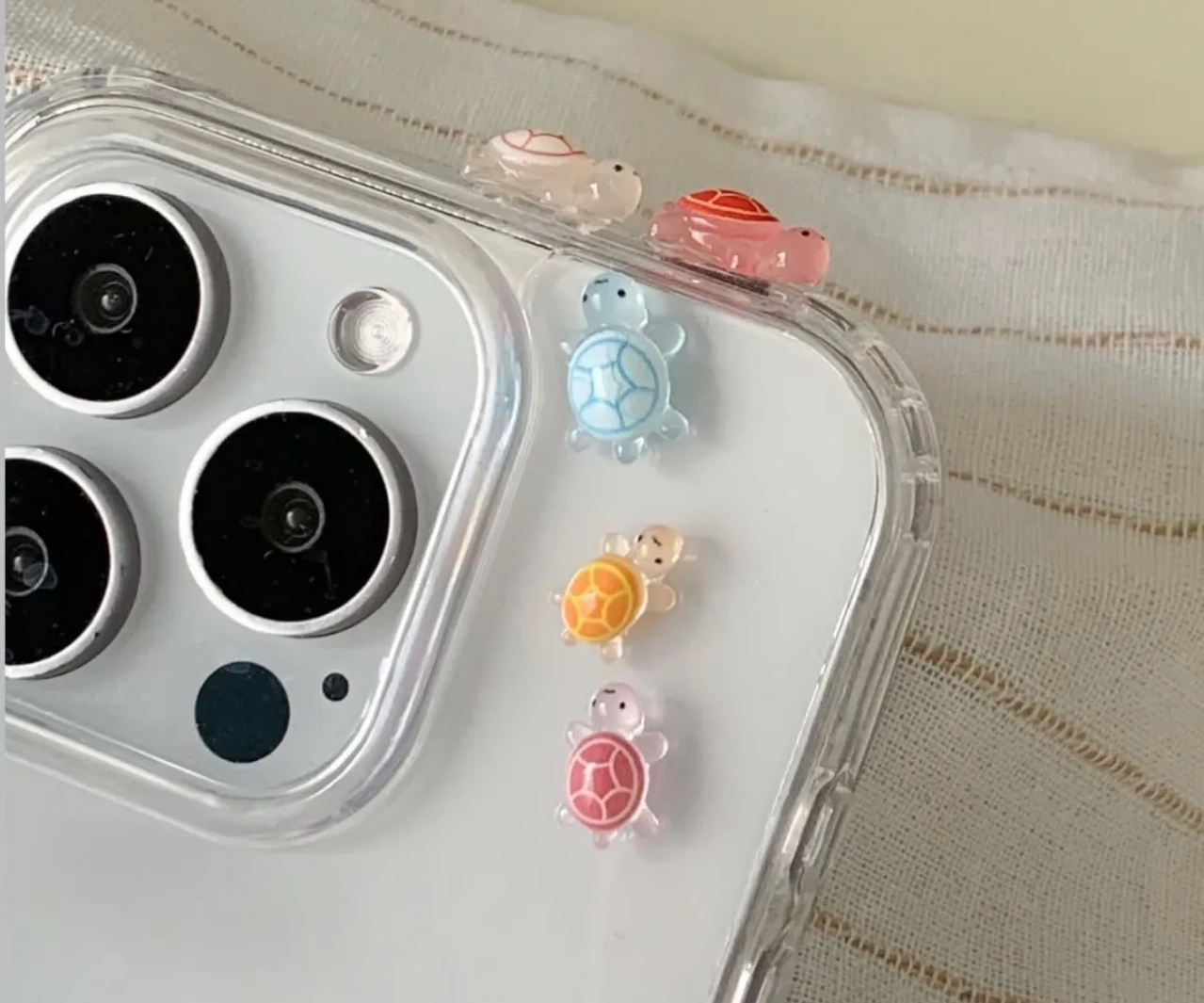
Look at enough phones in Seoul this summer and you’ll start noticing the same tiny detail clipped to the case: a turtle, no bigger than a fingernail, in pink or green or gold. It isn’t a licensed character, there’s no franchise behind it, and six months ago almost nobody outside a small hobbyist crowd had one. Then a couple of idols posted ordinary mirror selfies, and by August it had become one of the most photographed accessories in the country.
That’s the Lucky Turtle (럭키 거북이) — and it’s really the visible tip of something much bigger: a Korean phone- and bag-decorating culture, generally called 폰꾸 (phone-kku), that’s exploded into a full DIY retail category of its own, with entire market floors in Seoul now dedicated to it. Here’s what the turtle trend actually is, why it caught fire, and how to buy one or build your own.
A quick note: viral accessory trends move fast, and this one is barely a few months old as of publication. Specific shops, stock, and prices below are accurate as of writing, but check ahead if you’re planning a special trip around any single store.
In this guide:
- What Is the Lucky Turtle Charm Trend?
- How It Went Viral: Nayeon, Haneul, and ATEEZ’s San
- What Each Color Actually Means
- The Bigger Trend Underneath It: Korea’s 폰꾸 Explosion
- Where to Buy a Ready-Made Lucky Turtle Charm
- DIY It Yourself: Dongdaemun’s Fifth-Floor Charm Arcade
- Why Tourists Are Skipping the Luxury Floor for This
- Quick Reference
- Frequently Asked Questions
What Is the Lucky Turtle Charm Trend?
The Lucky Turtle is exactly what it sounds like: a miniature turtle charm — usually a soft enamel or resin sticker-style piece a couple of centimeters across — clipped or stuck onto a phone case, grip tok, or bag strap. In Korean folk symbolism, the turtle has long stood for longevity, protection, and good fortune, closely related to the 거북이 (turtle/tortoise) imagery that shows up in traditional talismans (부적) and gift charms. What’s new isn’t the symbol — it’s the format: a cheap, tiny, endlessly stackable accessory built for a phone case rather than a shelf.
Unlike most of the collectible manias that have swept Korea over the past couple of years, the Lucky Turtle wasn’t launched by a toy company or backed by a marketing campaign. It began as one artist’s handmade project: ceramic artist Hwang Se-rin, who started making the tiny turtles around 2023 out of her studio Animini (애니미니, @luck.turtle) — first for a ceramics graduation show, then at campus flea markets — hand-painting each one and later registering the design. What turned a niche handmade piece into a nationwide craze was the cheaper, mass-produced adhesive versions that followed, spreading the old-fashioned way — person to person, photo to photo — until they were everywhere.
How It Went Viral: Nayeon, KISS OF LIFE, Dino, and ATEEZ’s San
The trend has a traceable starting point, which is unusual for something this organic. TWICE’s Nayeon and members of KISS OF LIFE (both Haneul and Natty have been photographed with the charm on their phones) posted casual selfies showing a small turtle clipped to the case — not a sponsored post, not a brand collaboration, just an ordinary detail in an ordinary photo. (Nayeon’s set was quickly picked apart by fans as a specific trio of wishes — blue for success, pink for love, yellow for wealth.) Fans noticed anyway, the way K-pop fandoms notice everything, and the charm started showing up in other idols’ photos and livestreams shortly after.
From there the sightings snowballed. SEVENTEEN’s Dino showed off turtles matching the group’s colors on a Weverse livestream; ZEROBASE ONE’s Sung Hanbin had earlier introduced a set of custom charms gifted by his manager; and ATEEZ’s San gave the trend one of its clearest public moments, mentioning on a livestream that he kept seeing Lucky Turtles everywhere among Korea’s younger crowd and decided to get his own rather than keep watching from the sidelines. That’s the same mechanic that has powered nearly every recent Korean accessory craze — from Labubu’s rise after BLACKPINK’s Lisa was photographed with one, to gacha shop culture feeding phone-deco habits — a visible idol endorsement turning a niche item into something a much wider audience suddenly wants. What makes the turtle a little different is that none of these appearances were staged. It read as genuine, and that’s part of why it spread as fast as it did.
What Each Color Actually Means
Part of the charm’s appeal — literally — is that it isn’t just decoration. Each turtle comes in a specific color, and each color carries its own meaning, turning the whole thing into a small, wearable wish:
| Color | Meaning |
|---|---|
| Pink | Love and romance |
| Red | Passion and energy (some makers read it as love, too) |
| Green | Health and vitality |
| Yellow / Gold | Wealth and financial luck |
| Blue | Success and career luck |
| Purple | Exam luck and wisdom |
Because there’s no single brand behind the trend — the charms are made and sold by dozens of independent artists and shops — the palette isn’t perfectly standardized. You’ll also run into blue read as general good luck, brown or beige as stability, and orange as joy, depending on the maker, so it’s worth checking the specific seller’s key if a particular meaning matters to you.
That system is a big part of why people don’t stop at one — a single turtle is a cute accessory, but a small cluster of different colors reads as a set of specific wishes you’re carrying around, which is exactly the kind of personal, stackable meaning Korean decorating trends tend to reward. It’s also why the most-photographed sets tend to mix three or four at once: when TWICE’s Nayeon was spotted with the charms, she reportedly had a trio on her case — blue for success, pink for love, and yellow for wealth.
The Bigger Trend Underneath It: Korea’s 폰꾸 Explosion
The Lucky Turtle is a single viral item, but it’s riding a much larger wave: 폰꾸 (short for 폰 꾸미기, “phone decorating”), which by 2026 has grown well past simply picking a case. Korean trend coverage generally groups the current wave into a few overlapping styles:
- Y2K-glitter styling — early-2000s-style holographic stickers and shimmering photocards, leaning into a broader “2016 is back” nostalgia wave currently running through Korean social media.
- “최애” (bias) goods styling — photocards and keyrings people make themselves from photos of a favorite idol, character, or even their own pet, then cluster onto the case.
- Minimal photo styling — small printed personal or travel photos slipped inside a clear case, a quieter, more understated version of the same instinct.
However it’s styled, the toolkit is the same: 스티커 (stickers), a 스마트톡 / 그립톡 (smart tok / grip tok) holder, MagSafe card wallets, and increasingly elaborate custom cases, layered together until the phone becomes a small, constantly-updated display case. The same instinct extends to bags as 가방꾸미기 (bag decorating) — charms and keyrings clipped densely along a strap — and it’s the reason gacha capsule shops, covered here in detail, have become such reliable business: cheap capsule toys are one of the easiest ways to keep feeding the habit.
Where to Buy a Ready-Made Lucky Turtle Charm
If you just want one without making it yourself, ready-made turtle charms are inexpensive and widely stocked:
- Artbox — the ubiquitous Korean character-stationery chain, with branches across Hongdae, Myeongdong, and most major shopping streets, carries turtle-style grip tok and keyring charms as part of its regular phone-accessory wall.
- Independent online sellers on Korean marketplaces (Zigzag, POOM, Idus) list turtle stickers and charm parts individually, typically starting around ₩3,000–3,300 per piece.
- From outside Korea, sites that export Korean character goods and K-pop-adjacent merchandise — along with Etsy and eBay listings from Korea-based sellers — carry Lucky Turtle keyring sets for international shipping, usually in the $3–6 range plus postage.
- The original handmade version — hand-painted ceramic turtles from the artist who started it all, Animini (@luck.turtle) — is a pricier collector’s item at roughly ₩10,000–20,000 each, sold in small batches through flea markets and Instagram reservations rather than regular retail, so it takes more effort to track down.
None of this requires speaking Korean — these are self-service, browse-and-grab purchases at any Artbox till.
DIY It Yourself: Dongdaemun’s Fifth-Floor Charm Arcade
The more interesting — and more Korean — way to get one is to build it yourself, and there’s a specific place in Seoul built entirely around that: the accessories floor of Dongdaemun Jonghap Sijang (동대문종합시장), Dongdaemun’s sprawling wholesale market. Local coverage has taken to calling the market’s fifth-floor accessory arcade a “playground” for Gen Z, and it’s easy to see why once you’re there.
The floor is packed with small wholesale stalls selling beads, chains, ribbons, character parts, and blank bases by weight or by piece, meant for the clothing and craft trade — but increasingly overrun by teenagers and twenty-somethings building their own charms from scratch. The culture even has its own vocabulary, all built on the same “-꾸” (deco) suffix as 폰꾸: 키꾸 (decorating a keycap), 볼꾸 (decorating a pen), 거꾸 (decorating a mirror), and 빗꾸 (decorating a comb). One shop on the market’s C-dong, 5th floor — Lily Daisy (릴리데이지) — has built a specific reputation for phone straps and beadwork components, and is one of the names that comes up most often as a starting point.
A few things worth knowing before you go:
- It gets crowded early. The floor has developed its own version of “오픈런” (opening-run) culture, with regulars showing up close to opening time on weekends to get first pick of new stock.
- Budget roughly ₩10,000 for a proper haul — at wholesale, per-piece prices are low enough that a modest budget covers enough beads, chains, and turtle-style parts to build several charms.
- Bring your own base. Most stalls sell components, not finished products — a phone strap, keyring ring, or grip tok base to assemble everything onto is worth having (or buying at the market) before you start picking parts.
- No assembly required on-site. Unlike some craft markets, there typically isn’t a workshop table to sit and build at — you buy the parts and put them together yourself afterward, so factor that into how much time you actually need at the market itself.
For getting there, pull up 동대문종합시장 on Naver Map — it sits right by the Dongdaemun History & Culture Park area, an easy add-on to a day that already includes Dongdaemun’s fashion wholesale towers and the DDP.
Why Tourists Are Skipping the Luxury Floor for This
This isn’t just a domestic trend anymore. Korean retail coverage in 2026 has repeatedly flagged a real shift in what foreign visitors spend money on in Seoul: fewer trips straight to the luxury floor, more time in stationery shops, craft markets, and neighborhood stores selling exactly this kind of small, personal, photogenic item. One widely shared piece of retail reporting put it bluntly — stationery shops now feel busier than the luxury hall in some parts of the city.
The clearest evidence is geographic. Neighborhoods like Mangwon-dong and Haebangchon, well outside the traditional Myeongdong/Gangnam shopping circuit, have seen a genuine wave of foreign visitors specifically for their independent stationery shops and prop stores — the same instinct that drives Korea’s 다꾸 (diary decorating) culture, a close cousin of 폰꾸 built around washi tape, stickers, and stamps instead of phone cases. Commercial vacancy in Mangwon-dong has reportedly dropped close to 1% as foreign foot traffic has picked up, English menus have become standard, and the neighborhood has settled in alongside Hongdae and Yeonnam-dong as a stop on a newer, less luxury-driven kind of Seoul itinerary — one built around small, affordable, extremely personal souvenirs rather than a shopping bag with a designer logo on it.
Quick Reference
| What | Details |
|---|---|
| What it is | A miniature color-coded turtle charm clipped to a phone case or bag, symbolizing luck, health, or wealth depending on color |
| Originated by | Ceramic artist Hwang Se-rin (studio Animini / @luck.turtle), c. 2023, then mass-produced |
| Popularized by | Casual selfies from TWICE’s Nayeon and KISS OF LIFE (Haneul and Natty); amplified by SEVENTEEN’s Dino, ZEROBASE ONE’s Sung Hanbin, and ATEEZ’s San |
| Color meanings | Pink = love; red = passion; green = health; yellow/gold = wealth; blue = success; purple = exam luck (varies by maker) |
| Ready-made price | ~₩3,000–3,300 (about $2–2.50) per charm at Artbox or Korean online marketplaces |
| Best DIY spot | 5th-floor accessory arcade, Dongdaemun Jonghap Sijang (동대문종합시장) — try Lily Daisy on C-dong, 5F |
| DIY budget | ~₩10,000 for enough parts to build several charms |
| Broader trend | 폰꾸 (phone decorating) and 가방꾸미기 (bag decorating) — see also Seoul’s gacha shop craze |
| Related tourist shift | Foreign visitors increasingly favoring stationery/craft shopping in Mangwon-dong and Haebangchon over luxury retail |
Frequently Asked Questions
What is the Lucky Turtle charm trend in Korea? It’s a 2026 viral accessory trend built around miniature turtle-shaped charms clipped to phone cases or bags. Each color is said to represent a different kind of luck — pink for love, green for health, yellow or gold for wealth, blue for success, purple for exam luck — and it spread after K-pop idols were spotted wearing them in casual, unstaged photos.
Which K-pop idols started the Lucky Turtle trend? The turtles themselves were originally made by ceramic artist Hwang Se-rin (studio Animini) starting around 2023, but the trend went mainstream through K-pop sightings. TWICE’s Nayeon and KISS OF LIFE (members Haneul and Natty have both been spotted with it) were among the first widely noticed, in ordinary selfies rather than sponsored content. SEVENTEEN’s Dino, ZEROBASE ONE’s Sung Hanbin, and ATEEZ’s San followed — San confirmed on a livestream that he’d joined in after noticing the charms everywhere — which pushed the trend further into the mainstream.
Where can I buy a Lucky Turtle charm in Korea? Artbox, Korea’s character-stationery chain with branches across Hongdae and Myeongdong, carries them as part of its regular phone-accessory selection. Korean online marketplaces sell them individually from around ₩3,000. If you’re not traveling to Korea, some Korea-based sellers ship turtle charm sets internationally via Etsy and eBay.
What does each turtle color mean? Pink represents love and romance, green represents health and vitality, yellow or gold represents wealth and financial luck, blue represents success and career luck, and purple represents exam luck and wisdom. Red is usually read as passion or energy (some makers treat it as love). Because the charms are made by many independent sellers rather than one brand, the exact meanings vary a little from shop to shop, and many people collect several colors to combine wishes.
Can I make my own charm instead of buying one? Yes — the fifth-floor accessory arcade at Dongdaemun Jonghap Sijang (동대문종합시장) sells beads, chains, and charm parts by the piece specifically for this kind of DIY decorating, with roughly ₩10,000 covering enough materials for several charms. Bring or buy a phone strap or grip tok base to assemble everything onto.
Is this related to Korea’s other collectible trends, like Labubu or gacha shops? Loosely, yes — they’re all expressions of the same underlying 폰꾸/가방꾸미기 (phone- and bag-decorating) culture that’s become one of Korea’s defining self-expression trends of the mid-2020s. The Lucky Turtle is smaller-scale and cheaper than Labubu’s blind-box mania, and more personal-symbolism-driven than the randomized pulls of a gacha shop, but all three end up decorating the same phone case.
Whether the Lucky Turtle is still clipped to Korean phone cases a year from now or has already been replaced by the next small obsession, it’s a genuinely useful window into how Korean trends actually work in 2026 — cheap, personal, and spread by an unstaged photo rather than a marketing budget. If you’re in Seoul, an Artbox stop takes five minutes; the Dongdaemun arcade is worth a full afternoon. For more of what’s driving Seoul’s collector and decorating scene right now, see Korea’s gacha shop craze, Daiso’s sold-out mania, and where to actually buy a Labubu.