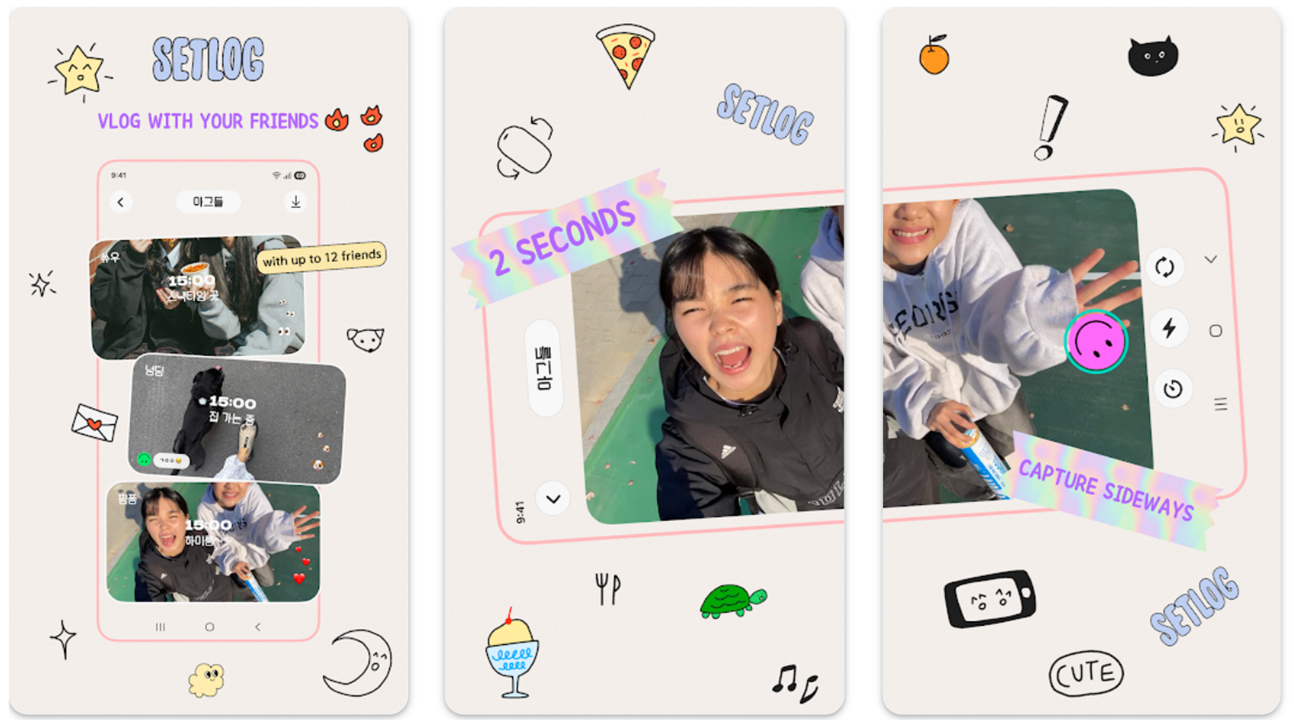
Ask a Korean teenager in 2026 whether they still use Instagram and the honest answer is often some version of “not really.” What they’re actually opening dozens of times a day is Setlog (셋로그) — an app that, on paper, sounds like a downgrade from everything social media has spent fifteen years building. No filters. No captions to agonize over. No do-overs. Just a two-second video, shot the instant your phone buzzes, shared with a room of people who already know you.
By mid-2026 that “downgrade” had become one of the fastest-growing apps South Korea has produced in years — a genuine App Store No. 1, a K-pop obsession, and, improbably, the engine behind Korea’s newest blind-dating craze. Here’s what Setlog actually is, why it exploded, and how to try it yourself.
A quick note: app rankings, download figures, and viral trends move fast. The mechanics and cultural context below are accurate as of publication, but check the App Store or Google Play listing directly for the current version and regional availability before you download.
In this guide:
- What Is Setlog, and Why Is Everyone Suddenly Using It?
- How Setlog Actually Works, Step by Step
- The K-Pop Effect: How Seventeen and Karina Sent It Viral
- Setlog vs. BeReal vs. Instagram: What’s Actually Different
- “셋로그 소개팅”: Korea’s Viral New Blind-Dating Trend
- The Privacy Question: What to Know Before You Join a Room
- How to Download and Try Setlog Yourself
- Quick Reference
- Frequently Asked Questions
What Is Setlog, and Why Is Everyone Suddenly Using It?
Setlog is a Korean social app built around one idea: record your day as it actually happens, not as you’d like it to look. Users join a small private group — Setlog calls it a 로그방 (log room), capped at somewhere between two and twelve friends — and throughout the day the app sends everyone in the room the same random notification, roughly once an hour, telling them to shoot a two-second video right now. Whatever you’re doing when the alert lands is the content: on the bus, mid-meal, half asleep in a lecture hall. There’s no way to upload something you filmed earlier, and no way to backdate a missed moment. At the end of the day, Setlog automatically stitches everyone’s clips into a single chronological mini-vlog that the whole room can watch together.
That single rule — real time only, no editing — is precisely what has made it feel new to a generation that grew up curating everything. Korean coverage has described the appeal as the difference between “an SNS for showing off” (Instagram) and “an app for keeping a record” (Setlog): less performance, more evidence that you actually lived your day. One widely shared Wikitree headline put it more bluntly, quoting a young user: “인스타는 이제 안 해요” — “I don’t really use Instagram anymore.”
The numbers back up the vibe shift. Setlog reached the top of Apple’s Korean App Store social-networking chart by mid-April 2026, held the No. 1 spot on the overall free-app chart by May, and according to the app-analytics firm Appfigures was downloaded more than 2 million times in May alone — remarkable for an app most people outside Korea had never heard of six months earlier.
How Setlog Actually Works, Step by Step
- Download and create an account. Setlog is free on both the App Store and Google Play.
- Create or join a 로그방 (log room) with an invite code — usually shared by a friend already using the app. Rooms typically hold anywhere from 2 to 12 people.
- Wait for the prompt. Roughly once an hour, everyone in the room gets the same push notification at the same moment.
- Shoot a 2-second clip, immediately. Front or back camera, whatever is in front of you. You get one take — there’s no retry, no gallery upload, and no filter step.
- Add a short caption if you want, then it’s locked in. You can see what everyone else in the room captured for that slot as the day goes on.
- At midnight, the day compiles automatically into a single portrait-format video — everyone’s clips stitched in order — that the room can rewatch or, if they choose, export and post elsewhere.
The friction is the point. Because clips are so short and unplanned, there’s very little room for the anxiety that comes with a traditional Instagram post — no wondering whether the photo is good enough, no waiting for the “right” moment. Setlog’s own framing is that it’s less a social feed than a shared diary that happens to update itself.
The K-Pop Effect: How Seventeen and Karina Sent It Viral
Setlog’s growth curve has a very specific inflection point, and it isn’t a marketing campaign. It’s idols posting their own daily Setlogs to fans. All nine active members of Seventeen — one of K-pop’s biggest boy groups — have shared vlogs made with the app, and Aespa’s Karina has done the same. For fandoms that already treat every unscripted glimpse of an idol’s real life as precious, an app explicitly designed to be unscripted and unfilterable was close to perfectly engineered for virality.
Once idols were doing it, imitating them became a form of participation available to anyone — no ticket, no fan meeting, no luck required, just the same app on your own phone with your own friends. That’s a large part of why Setlog crossed from “idol novelty” into genuine daily habit for millions of ordinary Gen Z and Gen Alpha users so quickly: the format is identical whether you’re a member of a nine-person boy group or a group chat of five university friends.
Setlog vs. BeReal vs. Instagram: What’s Actually Different
Setlog is frequently compared to BeReal, the French app that popularized the “post your unfiltered real life, once a day, at a random time” concept a few years earlier — and the family resemblance is real. But the mechanics diverge in ways that explain why Setlog caught on in Korea specifically where BeReal’s popularity had already cooled:
| Setlog | BeReal | ||
|---|---|---|---|
| Format | 2-second video, roughly hourly | Two photos (front + back camera), once daily | Photos, videos, Reels — anytime |
| Audience | Private log room, 2–12 friends | Your full friend list | Public or curated follower list |
| Editing | None — real-time only, no re-takes | Limited retakes allowed | Full editing, filters, captions |
| Output | Auto-compiled daily group vlog | Individual daily post | Curated personal feed |
| Core appeal | Shared, cumulative daily record with a small circle | One honest daily snapshot | Best-version self-presentation |
Where BeReal is a single individual moment shared once a day, Setlog is cumulative and social by design — the whole point is watching a shared day assemble itself frame by frame with people who already matter to you. Korean commentary on the trend has repeatedly landed on the same description: Setlog has a casualness and intimacy that Instagram, BeReal, and even group chats can’t quite replicate, because it isn’t asking anyone to say anything — just to exist on camera for two seconds, over and over, all day.
“셋로그 소개팅”: Korea’s Viral New Blind-Dating Trend
The most unexpected offshoot of Setlog’s rise is 셋로그 소개팅 (Setlog blind dating), also nicknamed 3일팅 (“three-day dating”) — a matchmaking format that has spread through Korean Gen Z almost entirely by word of mouth in 2026.
Here’s how it works: organizers set up a 5-on-5 log room — five men, five women — that participants join with an invite code, exactly like a normal Setlog group. For three days, everyone posts their regular real-time clips, at least seven times a day, exactly as they would in any other room. There’s no profile to fill out and no forced conversation to perform. Instead, participants simply watch each other’s unfiltered daily footage accumulate — what someone actually eats, how they talk to their friends, what their commute looks like, what makes them laugh. On the final day, each participant privately signals who they were drawn to; if the interest is mutual, contact information is exchanged.
The appeal, according to people who’ve tried it, is that it sidesteps everything people already find exhausting about dating apps: no staged profile photos, no small talk over a stilted first meetup, no venue to book. “상대의 성격이나 생활 방식을 빠르게 파악할 수 있다” — you get a fast, honest read on someone’s personality and lifestyle — is the phrase that comes up repeatedly in Korean coverage of the trend. One organizer running these rooms told local media that at least one couple typically forms per round.
It’s a genuinely novel idea — using an app built for keeping a record with friends as a low-stakes matchmaking mechanism — and it’s exactly the kind of trend that’s easy to miss if you’re not reading Korean social media directly, since it hasn’t been a format any major dating app has replicated elsewhere yet.
The Privacy Question: What to Know Before You Join a Room
Setlog’s entire appeal rests on constant, involuntary documentation — which is also its most obvious risk. Because the app is recording your literal location and activity roughly once an hour, every person in your log room effectively knows where you are and what you’re doing for most of your waking day. Korean commentary on the app’s growth has flagged exactly this concern: the same feature that makes Setlog feel intimate among close friends can just as easily become a tool for overexposure or, in a romantic relationship, a means of low-key monitoring a partner’s whereabouts.
None of this makes Setlog unusually dangerous compared to any other location- or activity-sharing app — but it’s worth being deliberate about who you let into a log room with you, in a way that matters less on a platform like Instagram where you control exactly what gets posted and when. A few practical habits worth adopting if you try it: keep rooms limited to people you’d already tell your daily schedule to, mute or leave a room during a period you’d rather not document, and remember that once a day’s vlog compiles, everyone in the room can rewatch it.
How to Download and Try Setlog Yourself
Setlog is a free download on both the App Store and Google Play, and — unlike some Korea-only apps — it isn’t locked to a Korean app-store region. It supports Korean, Japanese, and English, and listings are live in multiple international App Store regions beyond Korea, which is part of why it’s begun spreading to Hong Kong and other markets in 2026.
To actually get value from it, though, you need people to do it with — a log room with one or two friends doesn’t generate much of a “day,” and the format really only clicks with a group of at least three or four. If you’re traveling in Korea and make local friends, ask if they’re on Setlog — it’s become enough of a default among Korean Gen Z that it’s a genuinely easy, low-pressure way to stay loosely in touch and see slices of each other’s daily lives after you’ve gone your separate ways, in a way that a one-off Instagram follow rarely sustains.
Quick Reference
| What | Details |
|---|---|
| What it is | Real-time group video-vlogging app — 2-second clips, roughly hourly, compiled into a daily group vlog |
| Group size | 2–12 friends per “log room” (로그방) |
| Cost | Free on the App Store and Google Play |
| Languages | Korean, Japanese, English |
| Peak Korean ranking | No. 1 on Apple’s Korean App Store (social + overall), April–May 2026 |
| Downloads | 2M+ in May 2026 alone (Appfigures) |
| Notable users | All 9 active members of Seventeen; Aespa’s Karina |
| Closest comparison | BeReal, but video-based, group-oriented, and hourly rather than once a day |
| Viral spinoff | 셋로그 소개팅 / “3일팅” — a 5-on-5 blind-dating format built on shared log rooms |
Frequently Asked Questions
What is Setlog? Setlog (셋로그) is a Korean social app where a small private group of friends — a “log room” of 2 to 12 people — all receive the same random hourly notification to shoot an unedited, real-time 2-second video clip. The day’s clips are automatically compiled into a single shared vlog at midnight. It became the No. 1 app on Korea’s App Store in 2026.
Why did Setlog suddenly become so popular? Two forces combined: a broader Gen Z fatigue with curated, performative social media, and a wave of K-pop idols — including all nine members of Seventeen and Aespa’s Karina — posting their own Setlog vlogs, which turned an already-growing app into a mainstream must-have almost overnight.
How is Setlog different from BeReal? BeReal prompts one photo (front and back camera) once a day, shared with your whole friend list. Setlog prompts a short video roughly every hour, shared only with a small private “log room,” and automatically compiles everyone’s clips into one cumulative daily vlog rather than individual posts.
What is “셋로그 소개팅” (Setlog blind dating)? It’s a matchmaking trend built on top of the app: five men and five women join a shared log room via invite code and post their normal real-time clips for three days. On the final day, participants privately indicate who they’re interested in, and contact details are exchanged if the interest is mutual — no staged profiles, no scheduled first date.
Is Setlog available outside Korea? Yes. It’s a free download on the App Store and Google Play, supports Korean, Japanese, and English, and has listings live in multiple international app-store regions — it has already started spreading to markets like Hong Kong.
Is Setlog safe to use, privacy-wise? It’s not inherently unsafe, but because it records your location and activity roughly hourly, everyone in your log room effectively knows where you are and what you’re doing most of the day. Korean commentary has flagged this as a real risk for overexposure or low-key monitoring in close relationships — only join rooms with people you’d already share your daily schedule with.
Whether Setlog’s hourly buzz becomes a lasting fixture of Korean social media or the next fast-burning trend remains to be seen — but for now, it’s the clearest window into what Korea’s Gen Z actually wants from an app in 2026: less performance, more proof of life. If you’re chasing what else is trending in Korea right now, see what’s driving the Daiso sold-out mania, Seoul’s gacha shop craze, and the random play dance flash mobs popping up across Hongdae.