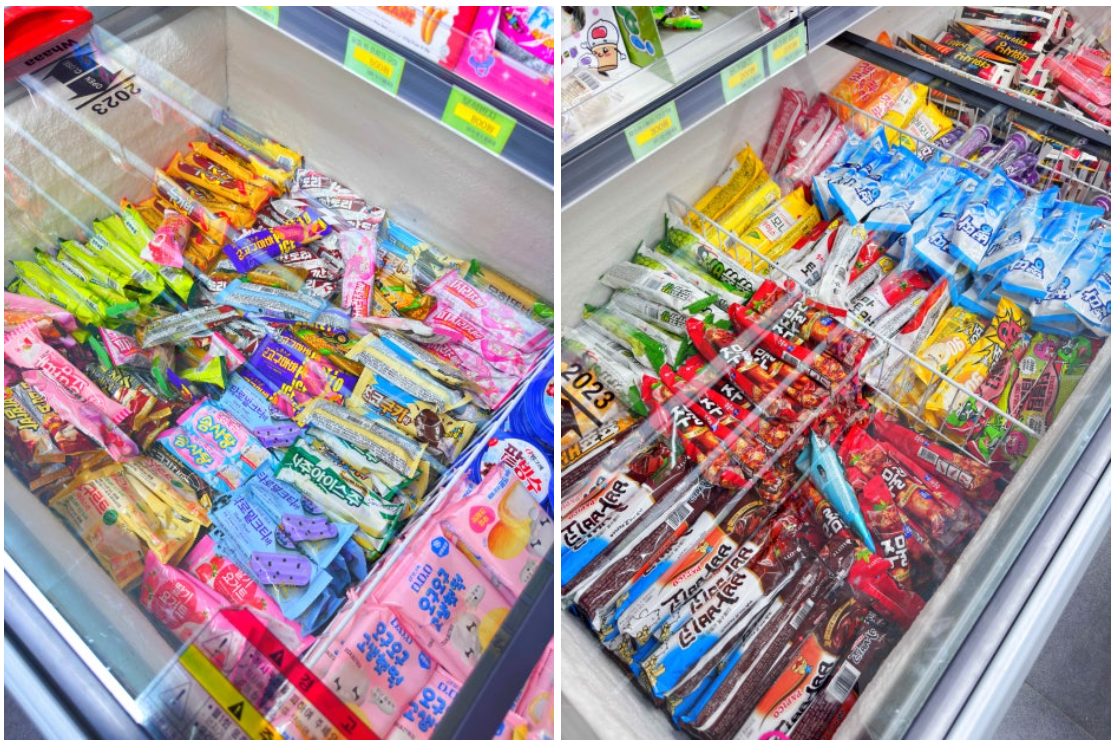
Walk down almost any residential street in Korea in 2026 and you’ll pass one: a small, brightly lit shop with no cashier, a wall of chest freezers stacked to the ceiling with ice cream, and a self-checkout kiosk by the door. No one greets you. No one watches you shop. You scan your own barcodes, tap your card, and leave — sometimes at 3am, sometimes on your way home from work, sometimes because a TikTok told you a specific cone was ₩800 here and ₩2,500 at the convenience store next door.
This is 무인 아이스크림 할인점 (muin aiseukeurim halinjeom, literally “unmanned ice cream discount store”), known casually as 아할 or 무아 — and while it has been quietly multiplying in Korean neighbourhoods for years, 2026 is the year it turned into a full-blown social media phenomenon, a talking point in local news, and a genuine curiosity for visitors who’ve never seen a store with zero staff and a freezer aisle longer than the rest of the shop combined.
What Is 아이스크림 할인점, Exactly?
The format is almost aggressively simple. A small storefront — often a converted street-level unit no bigger than a convenience store — is filled almost entirely with chest freezers, floor to ceiling, packed with every ice cream bar, cone, sandwich, and tub sold in Korea. There’s a rack of snacks, instant noodles, and drinks near the register for good measure, but the ice cream is the whole point. There is no staff. You pick what you want, scan it yourself at a kiosk, and pay by card. Some locations are open 24 hours; almost none have a person in them after dark.
The pitch is entirely about price. Store owners buy stock in bulk directly from distributors at wholesale rates — often somewhere around ₩400–₩500 for a basic bar or twin-pop, ₩700–₩900 for a cone or ice cream sandwich — and sell it on with a thin markup instead of the standard retail margin. The same item at a convenience store like CU, GS25, or 7-Eleven can run two to three times higher. Skipping a cashier is what makes the economics work: no labour cost means the discount can be real rather than a marketing gimmick.
Why It’s Suddenly Everywhere
The scale is bigger than most people realize. By some industry counts, unmanned ice cream shops now number in the thousands nationwide, and in 2023 they accounted for roughly 36% of all ice cream purchases in Korea — more than double the share bought at convenience stores. It’s no longer a niche budget hack; it’s become the default way a large share of the country buys ice cream.
An unlikely age group is driving it. Local retail coverage has repeatedly flagged that the customer base skews older than you’d expect for a bargain-snack format — Koreans in their 40s are showing up in disproportionate numbers, which analysts put down to a value-first, price-sensitive streak among middle-aged shoppers that lines up neatly with a deep-discount format. It doesn’t hurt that these shops, with their racks of retro snacks, carry a faint echo of the neighbourhood 문방구 (stationery-shop) candy counters that generation grew up on.
Convenience stores are fighting back, which is its own story. The pressure has gotten large enough that major chains have started responding directly — CU, for instance, rolled out its own sub-₩1,000 ice cream lines in 2025 — including 800-won bars priced specifically to compete with the unmanned shops next door. When a 24-hour, fully-staffed national chain restructures its pricing to compete with a no-name unmanned freezer room, that’s a sign the trend has real teeth.
It’s built for short-form video. A slow pan down a wall of hundreds of ice cream flavours, a price sticker showing ₩800 next to a receipt, a “guess how much this haul actually cost” reveal — unmanned ice cream stores have become a recurring genre on Korean TikTok and Instagram Reels, and increasingly on the accounts of visiting foreigners discovering the format for the first time and reacting to both the sheer volume of choice and the complete absence of a human being anywhere in the store.
What to Actually Buy
Selection varies store to store, but a few categories consistently anchor the freezer wall:
- 막대 아이스크림 (bar-type) — the cheapest tier, often ₩500–₩1,000. Classic Korean bars like 스크류바 and 죠스바 live here.
- 월드콘 / 부라보콘 (cone-type) — Korea’s iconic cone ice creams, usually ₩1,000–₩1,500, roughly half what a convenience store charges for the same box.
- 샌드류 (ice cream sandwiches) — including 붕어싸만코**,** the fish-shaped waffle-cone sandwich that’s become a minor celebrity of its own on social media.
- 아이스크림 케이크 & 팥빙수 tubs — larger, shareable formats that are genuinely difficult to find this cheap anywhere else.
- Rotating novelty items — seasonal and collab flavours that show up for a few weeks and then vanish, which is part of what keeps people checking back.
Because these shops buy whatever a given distributor has cheap that month, stock is inconsistent — the same store can be a treasure trove one week and half-empty the next. That unpredictability is, again, part of the appeal: half the content built around these stores is people documenting what they happened to find.
How to Shop One Like a Local
- Come with both a card and some cash — there’s no one to help if the kiosk glitches, so a backup payment method is worth having (see the payment section below for exactly how paying works as a foreigner).
- Check the freezer temperature with your hand before committing to a tub-sized item — turnover varies store to store, and a freezer that isn’t running cold enough is a sign to buy bars instead of anything that melts fast.
- Look for the paper price tags, not the printed retail price on the wrapper — the number on the packaging is the manufacturer’s suggested price, not what you’ll actually pay; the discount is on a separate sticker.
- Go in the evening or late at night if you want the full experience — this is when the “no one else is here” atmosphere that makes these stores a novelty is most pronounced, and when most of the viral video content is filmed.
- Don’t expect English signage — self-checkout kiosks are Korean-only, so a translation app’s camera mode helps if you’re unsure what you’re scanning or which button confirms the sale.
Paying at the Kiosk as a Foreigner
This is the one part of the experience that trips up visitors, so it’s worth knowing before you’re standing at the machine with a melting cone. The flow is always the same: scan each item’s barcode on the kiosk, wait for the total to appear on screen, then pay. Where foreigners get stuck is the payment step itself, so plan for it:
- Bring a physical chip card, and insert it if the tap fails. Most kiosks take major foreign-issued Visa and Mastercard, but contactless (“tap”) support is inconsistent in Korea — if a tap is rejected or ignored, insert the card into the chip slot instead, which works far more reliably. A few older machines only accept Korean-issued cards; that’s the one scenario a foreign card simply won’t clear.
- Carry cash as your fail-safe. Many kiosks have a bill-and-coin acceptor, and cash never gets “declined” for being foreign-issued. A couple of ₩1,000 notes and some coins will cover most hauls and save the trip if your card doesn’t read. Note that some newer stores are card-only, so cash is a backup, not a guarantee on its own — carrying both covers you either way.
- Don’t count on phone wallets. Apple Pay is still not widely accepted at these kiosks, and Samsung Pay or Kakao Pay only work if they’re linked to a Korean card — so for most visitors, tapping your phone won’t go through. Treat your physical card and cash as the real options.
- If it won’t go through, look for the owner’s number on the wall. There’s no cashier, but nearly every store posts a phone number or a KakaoTalk/QR contact for the owner near the door or kiosk for exactly this situation — a payment jam, a stuck machine, or an item that won’t scan.
Why This Is Worth Knowing About as a Visitor
Unmanned ice cream stores aren’t set up with tourists in mind — there’s no marketing effort aimed at visitors, no English branding, nothing resembling the deliberate tourist-facing push behind Daiso’s sold-out mania or a planned mart attack at E-Mart. That’s exactly what makes them worth a detour: this is what Korean neighbourhood retail actually looks like when no one is performing for an outside audience. If you’re already stocking up on snacks to bring home or ducking into a convenience store or mart between sightseeing stops, a five-minute stop at the nearest 아이스크림 할인점 costs almost nothing and hands you both a genuinely good deal and a small, honest slice of daily life here — the kind of thing that’s much harder to stumble into on a itinerary built around palaces and photo spots.
The Bigger Picture
What makes this trend different from Korea’s usual fast-burning viral obsessions is that there’s no drop, no raffle, and nothing to chase — the entire appeal is that it’s already there, every day, in a shop that looks the same whether or not anyone is filming it. Compared to the frenzy around Daiso’s sold-out items or the resale chaos around Labubu and blind boxes, unmanned ice cream stores are almost boring by design — which, in a retail landscape this driven by hype cycles, has quietly become their own kind of remarkable.