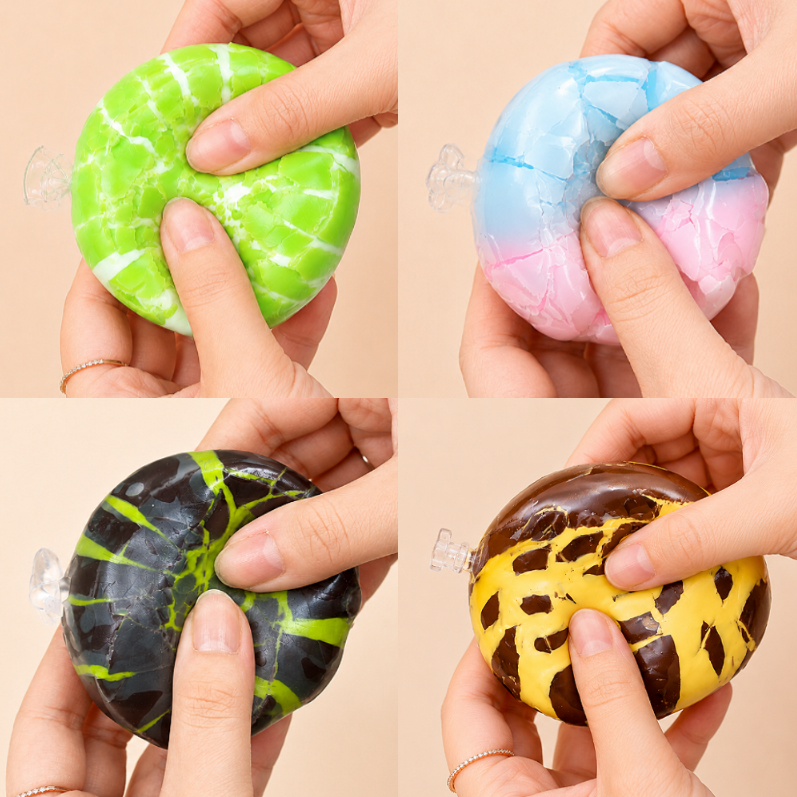
Scroll through Korean short-form video right now and, sooner or later, you’ll hit the same clip: a hand pressing down on a smooth, candy-colored ball until it gives way with a sharp, satisfying crack, revealing a soft, slime-like filling underneath. No dialogue, no music drop, sometimes not even a caption — just the sound. That’s the entire genre, and in 2026 it’s become one of the most-watched, most-copied content formats to come out of Korea.
That’s the wakppu ball (왁뿌볼) — and it has gone from a niche livestream-fandom in-joke to an international news story, with CNN and Korea’s English-language press both covering the craze this summer. Here’s what it is, how it caught fire, and where you can actually buy one if you’re in Seoul.
A quick note: fast-moving sensory-toy trends like this one can shift retailer and pricing details within weeks. What’s below is accurate as of publication, but treat specific shops and prices as a snapshot rather than a permanent list.
In this guide:
- What Is a Wakppu Ball, Exactly?
- Where the Name — and the Trend — Came From
- Why It Exploded in 2026
- Where to Buy One in Seoul
- How to Get the Best Crack: Tips & Tricks
- The Waste Debate: Is This Just Disposable Plastic?
- How It Fits Into Korea’s Bigger Trend Cycle
- Quick Reference
- Frequently Asked Questions
What Is a Wakppu Ball, Exactly?
A wakppu ball is a palm-sized sphere with a hardened wax-like outer shell wrapped around a soft, slime-or-clay filling, usually bound with a thin rubber layer and a cable tie so the whole thing holds its shape. The standard ritual is simple and always the same three steps: freeze it for about 10 minutes so the shell hardens fully, crack it open by hand for that sharp, brittle “아그작” (agujak) snap, then knead the exposed filling like slime for the second, softer sensory payoff.
It’s a two-stage toy, in other words — a crunchy shell first, a squishy fidget-toy afterward — and both stages are built specifically to be filmed. The genre lives almost entirely on YouTube Shorts, Instagram Reels, and TikTok, where the appeal is less about the toy itself than about the ASMR moment of the crack, viewed and re-viewed by millions.
You’ll also see it written as wakppuball, wax ball, wax-crushing ball, or 왁뿌 (wakppu) for short — all describing the same object.
Where the Name — and the Trend — Came From
The name is a compound: 왁 (wak), the Koreanized shorthand for “wax” (왁스), plus 뿌시기 (ppushigi), meaning “smashing” or “crushing.” Put together, 왁뿌볼 reads literally as “wax-crushing ball.”
Korean trend coverage traces the format’s roots to late 2025, when short-form clips of wax-coated squishies being frozen and smashed started circulating out of overseas short-form video — back then usually butter or character squishies, a little different from today’s version. Through early 2026 that evolved into the now-standard form: a clay ball coated in wax, wrapped in a thin rubber layer, and cinched with a cable tie. By summer 2026 it had become a full general-audience craze, propelled by how easy the format is to copy: no skill required, no talking, just a ball, a freezer, and a camera.
Why It Exploded in 2026
It’s an ASMR trend with built-in stakes. Unlike most fidget toys, a wakppu ball only gets one perfect “reveal” — once it’s cracked, it doesn’t reset. That one-and-done structure gives every clip a small, real payoff (will the crack be clean? how loud will it be?) that a reusable stress ball can’t replicate, which is exactly why the format has stayed so watchable at scale.
Idols got involved. Members of boy groups Enhypen and Cravity have both been seen cracking wakppu balls on livestreams and YouTube content this year, giving the trend the same kind of organic celebrity visibility that has powered nearly every other recent Korean craze — from Labubu’s rise to the Lucky Turtle charm. None of it reads as sponsored; it reads as idols doing the same thing their fans are already doing.
It taps a specific kind of nostalgia and relief. Korean commentary around the trend frames it as a reaction to sensory overload — a generation raised on hyper-stimulating short-form video and intensely flavored food reaching, almost paradoxically, for a small, contained, low-stakes physical sensation instead. It also echoes childhood clay and putty toys, giving it a nostalgic pull on top of the pure ASMR appeal.
It’s cheap enough to try on a whim. With individual balls generally starting around ₩4,000–5,000, and bulk multi-packs of smaller ones going for as little as ₩4,000 for a dozen online, there’s essentially no barrier to trying it, which matters enormously for a trend that lives and dies by how easy it is to copy.
International press picked it up fast. CNN ran a segment on the craze, and English-language outlets including the Korea JoongAng Daily and the Korea Times have all covered it this summer — unusually fast international pickup for what started as a niche Korean fan-content format, and a sign it’s likely to keep spreading the way Labubu and gacha shop culture did before it.
Where to Buy One in Seoul
Wakppu balls are sold as a general novelty item rather than through one exclusive brand, which makes them easy to find but inconsistent in packaging and quality:
- Artbox and Hottracks — Korea’s ubiquitous character-stationery and gift chains, with branches across Hongdae, Myeongdong, and most major shopping streets, stock wakppu balls alongside their usual wall of phone charms and fidget toys.
- Daiso — reported to carry versions of the toy as part of its broader sensory-toy and novelty selection; stock varies by branch, so check the flagship Myeongdong or Hongdae stores first, the same way you would for any Daiso viral item.
- Specialty online stores, such as Mallang Stay (말랑스테이), sell dedicated wakppu ball ranges — multiple colors, scents, and sizes — shipped domestically.
- General marketplaces — Coupang, POOM, and Kakao Gift all list wakppu balls from various sellers, typically in the ₩4,000–8,000 range depending on size and whether it’s a single ball or a multi-pack.
- Secondhand and resale apps like Bunjang also carry them, particularly limited scented or character-themed versions that sell out at retail.
None of this requires speaking Korean — these are self-service, browse-and-grab purchases at any Artbox or Daiso till, and the online listings are easy to navigate with a translation app if you’re ordering ahead of a trip.
Easiest areas in Seoul. If you’d rather just head somewhere and find one on foot, three areas make it easy:
- Hongdae — the best all-round bet. The highest concentration of the exact shops that stock wakppu balls, plus it’s where viral items surface first. A single anchor: Artbox Hongdae (아트박스 홍대점), with a big Daiso and a strip of novelty-toy shops within a few minutes’ walk.
- Myeongdong — the most convenient if you’re already sightseeing. The 12-floor Daiso Myeongdong (다이소 명동역점) flagship alone is worth the stop, with Artbox branches nearby in the main shopping grid.
- Dongdaemun (Changsin-dong) Stationery & Toy Street — for the widest and cheapest selection in one place. Korea’s largest wholesale stationery-and-toy market, where the small shops themselves buy stock, so it’s the spot for variety or a multi-pack: 동대문 문구·완구거리.
Because wakppu balls aren’t a single branded product, no one store is guaranteed to have them on a given day — but in Hongdae or Myeongdong you’ll have enough candidate shops within a short walk that finding one is easy.
How to Get the Best Crack: Tips & Tricks
Half the people who buy one are disappointed the first time, and it’s almost always for the same reason: they crack it too soon. The satisfying, clean “아그작” snap you see online is a technique, not a given. A few tricks — the freezer being the big one — make the difference between a wet crumble and the crisp shatter that makes the toy worth it.
- Freeze it first — this is the whole trick. Crack a wakppu ball straight off the shelf and the shell just bends and squishes. Pop it in the freezer for about 5–10 minutes so the wax hardens fully, and then crack it: that’s what produces the loud, brittle snap. Undercrisp shells are the single most common reason a crack falls flat.
- Don’t over-freeze it. Leaving it in far longer doesn’t make it better — it turns the ball rock-hard, so it takes real force to break and tends to split messily instead of cleanly. Korean guides only half-joke that an over-frozen one becomes “a literal stone.”
- If it froze too hard, rescue it — don’t force it. Let a too-solid ball sit at room temperature for a few minutes, or microwave it 20–30 seconds, until it gives slightly under a press. Forcing a frozen-solid ball is how you hurt your hand or get an ugly shatter.
- A fridge works if you don’t have a freezer. Hotel room with only a mini-fridge? Chilling it in the fridge still firms the shell up — it just needs a bit longer than the freezer’s 5–10 minutes.
- Crack over a plate or into your palm. The shell fractures into small, waxy shards that scatter, and the filling underneath is soft and sticky — doing it over a surface keeps the mess (and the cleanup) contained, which matters in a hotel room.
- Knead the filling right after. Once the shell is off, the soft core is the second half of the toy — warm it up in your hands and knead it like slime for the squishy payoff that follows the crunch. This part is reusable for a while, even though the shell is one-and-done.
- Expect quality to vary. Because these are made by many different sellers with no single standard, some balls simply crack better than others — a disappointing one is often the product, not your technique, so don’t read too much into a single dud.
The Waste Debate: Is This Just Disposable Plastic?
Not everyone is charmed. Korean press has raised a genuine environmental and safety critique alongside the trend’s coverage: because the entire appeal is built around a single crack-and-discard moment rather than repeated use, a wakppu ball’s useful life as “content” is often over in seconds, after which the wax shell and filling — plastic-adjacent materials not designed for recycling — typically go straight in the trash. Outlets including the Korea Times and Hankook Ilbo have specifically flagged this one-second-of-dopamine, lasting-waste pattern, and some coverage has raised questions about what exactly is in the wax coating and filling, given that these are marketed as toys handled directly by hands (and sometimes mouths, for younger kids).
If you’re trying one, it’s worth treating it a bit like a novelty souvenir rather than a proper toy: buy one or two to experience the format rather than a large multi-pack, and dispose of the shell responsibly once you’re done with it.
How It Fits Into Korea’s Bigger Trend Cycle
The wakppu ball is the latest entry in a very consistent 2026 pattern: a cheap, small, extremely photogenic object goes viral through organic idol visibility and short-form video, gets picked up by every convenience store and stationery chain within weeks, and burns through its hype cycle in a matter of months before the next thing takes over. It’s the same arc that carried Daiso’s sold-out crazes, gacha shop culture, and the Lucky Turtle phone charm — the specific object changes, but the mechanics (idol sighting, short-form format, low price, fast saturation) barely do.
What makes the wakppu ball a little different is that it’s not really collectible or wearable like those other trends — it’s consumable, built to be experienced once and thrown away, which is exactly what’s fueling the pushback alongside the popularity.
Quick Reference
| What | Details |
|---|---|
| What it is | A wax-shelled, slime-filled sensory toy: freeze it, crack it for an ASMR “crunch,” then knead the filling like slime |
| Name meaning | 왁 (wak, short for 왁스/wax) + 뿌시기 (ppushigi, “smashing”) + 볼 (ball) |
| Traced to | Late-2025 overseas wax-squishy short-form content, evolving into the Korean clay-ball form and going mainstream in 2026 |
| Popularized by | Viral ASMR clips on YouTube Shorts, Reels, and TikTok; members of Enhypen and Cravity cracking them on livestreams |
| Price | ~₩4,000–5,000 per ball; multi-packs of smaller ones from ~₩4,000 for a dozen |
| Best-crack tip | Freeze 5–10 min so the shell hardens before cracking; don’t over-freeze (rock-hard = messy break), and microwave 20–30 sec if it sets too solid |
| Where to buy | Artbox, Hottracks, Daiso, Mallang Stay (online), Coupang, POOM, Kakao Gift |
| Known criticism | Flagged by Korean press (Korea Times, Hankook Ilbo) as a single-use, hard-to-recycle novelty item |
| Related trends | See also Daiso’s sold-out mania, gacha shops, and the Lucky Turtle charm |
Frequently Asked Questions
What is a wakppu ball? It’s a Korean viral sensory toy: a palm-sized ball with a hard wax-like shell around a soft, slime-like filling. You freeze it for about 10 minutes to harden the shell, crack it open by hand for a sharp ASMR crunch, then knead the exposed filling like slime. It’s also written as wakppuball or wax ball, and the Korean name is 왁뿌볼.
Why is it called “wakppu”? “Wak” is short for 왁스 (wax), and “ppu” comes from 뿌시기 (ppushigi), meaning “to smash” or “crush.” Together, wakppu means roughly “wax-crushing.”
Where can I buy a wakppu ball in Seoul? Artbox and Hottracks (Korea’s character-stationery chains) stock them across their Hongdae and Myeongdong branches, and Daiso carries versions too, though stock varies by store. Online, Mallang Stay specializes in them, and general marketplaces like Coupang and POOM list many sellers, typically ₩4,000–8,000 depending on size and pack.
Is it safe, and is there any controversy around it? Korean press coverage, including the Korea Times and Hankook Ilbo, has raised concerns that the toy is essentially single-use — the whole appeal is a one-time crack — and that the wax and filling materials aren’t designed to be recycled, generating quick, hard-to-avoid waste. If you’re curious, it’s worth treating it as a one-off novelty rather than stocking up.
Is this related to Korea’s other viral collectible trends? Loosely. It shares the same viral mechanics as Labubu, the Lucky Turtle charm, and Daiso’s sold-out items — cheap, photogenic, spread by organic idol sightings and short-form video — but unlike those, a wakppu ball isn’t meant to be kept or displayed. It’s built to be used once, which is exactly what makes it distinct (and what’s drawing criticism).
Whether the wakppu ball is still showing up on Korean feeds by the end of the year or has already been replaced by the next crunchy, crackable obsession, it’s a useful snapshot of how fast Korea’s trend cycle moves in 2026 — from a niche fan-content format to an international news story in a matter of months. If you want to try one, an Artbox or Daiso stop takes five minutes to add to any Seoul shopping trip. For more of what’s currently driving Korea’s viral object economy, see Daiso’s sold-out mania, Korea’s gacha shop craze, and the Lucky Turtle charm trend.